
Free GCC Assessment with Experts


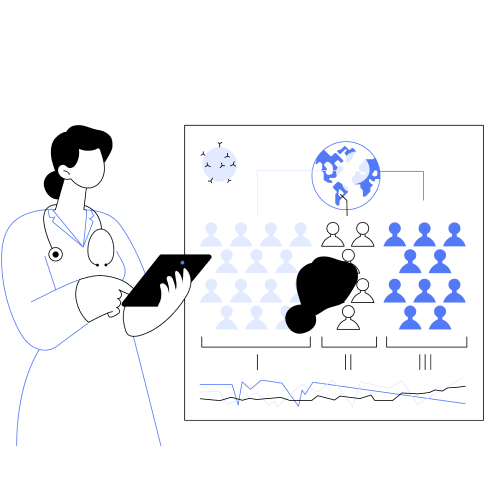
Zymr engineers custom Population Health Intelligence Platforms that combine longitudinal patient records, predictive analytics, AI-driven insights, care management workflows, and real-time population monitoring into a unified solution.
Building on our expertise in Healthcare Data Analytics Platform Development Services and AI-Ready Healthcare Data Services, we help healthcare organizations transform fragmented healthcare data into proactive intelligence that drives better clinical, operational, and financial outcomes.
Earlier Sepsis Detection
AI-Powered Risk Stratification
Care Gap & SDOH Intelligence
EHR-Integrated, No Vendor Lock-In
Population Health Intelligence Needs
PHM Strategy & Value-Based Care Consulting
Every population health program should align with measurable clinical and financial objectives.We help healthcare organizations define population health strategies, assess value-based care readiness, prioritize high-impact use cases, and design scalable platforms that support quality improvement, cost optimization, and long-term care transformation.
Risk Stratification & Predictive Analytics
The earlier high-risk patients are identified, the greater the opportunity to improve outcomes.Leveraging our broader AI/ML Services expertise, we build predictive risk models that identify rising-risk patients, forecast readmissions, predict disease progression, and prioritize interventions based on clinical, behavioral, and utilization data.
Care Gap Identification & Closure
Preventive care depends on identifying and addressing gaps before they affect patient outcomes.We engineer intelligent workflows that detect missed screenings, overdue follow-ups, medication adherence issues, and quality measure gaps, enabling care teams to coordinate timely interventions and improve quality performance.
SDOH & Health Equity Analytics
Clinical data tells only part of the patient's story.We integrate Social Determinants of Health (SDOH), community-level indicators, and demographic data to identify health disparities, measure social risk, and support targeted interventions that improve health equity across patient populations.
Care Management & Coordination Platform
Managing high-risk populations requires seamless collaboration across multidisciplinary care teams.Leveraging our broader EHR Development Services expertise, we build care management platforms that support longitudinal care plans, task management, referrals, patient outreach, and coordinated care workflows directly within existing clinical environments.
Value-Based Care Financial Analytics & Reporting
Value-based care programs require continuous visibility into quality, utilization, and financial performance.We build analytics platforms that monitor shared savings, contract performance, quality metrics, utilization trends, and reimbursement outcomes, helping organizations optimize value-based care initiatives while improving operational and financial results.
Population Health Intelligence Capabilities
Data Foundation Layer

Risk & Stratification Layer
Care Gap & Quality Layer
SDOH & Health Equity Layer
Care Management & Engagement Layer
Value-Based Care Financial & Reporting Layer
Integration & Point-of-Care Layer
AI & Intelligence Layer
Population Health Intelligence Platform Development Services
Community Health Network Improves Early Intervention with Population Risk Intelligence
A community health network needed to identify deteriorating patients sooner and prioritize care for high-risk populations across multiple care settings. Traditional monitoring approaches made it difficult to intervene before patients required acute care.Zymr engineered a real-time clinical intelligence platform that combined connected medical device data with predictive analytics to continuously assess patient risk. The solution identified sepsis nearly 19 hours earlier, enabling faster interventions and improving care coordination across the network.
Project Details →
Regional Hospital Network Builds a Longitudinal Patient Record Across 18 EHRs
A regional hospital network operating 18 independent EHR systems lacked a unified patient view, making population health reporting, risk identification, and coordinated care challenging. Zymr engineered a FHIR-based interoperability platform that unified clinical information across more than 2.4 million patient encounters, creating longitudinal patient records that support population health analytics, care gap identification, and value-based care initiatives.
Project Details →
Mid-Sized Health Plan Improves Value-Based Performance with AI-Powered Population Analytics
A regional health plan needed deeper insight into claims utilization, member risk, and reimbursement performance to strengthen value-based care programs and improve financial outcomes.Zymr developed an AI-powered healthcare intelligence platform that analyzed 4.1 million claims, achieved 91% prediction accuracy, and helped recover approximately $24 million through intelligent automation and predictive analytics. The platform enabled better member segmentation, utilization analysis, and proactive intervention planning.
Project Details →
Who We Serve
Health Systems & Hospitals
ACOs & Value-Based Care Organizations
Digital Health & HealthTech Companies
Health Insurance Payers
ACOs & Value-Based Care Organizations
Clinically Integrated Networks
FQHCs & Community Health Centers
Digital Health & Care Management Companies
Medicare Advantage & Managed Care Organizations
Employers & Population Health Programs
Solutions We Deliver
Custom Population Health Intelligence Platform
Every healthcare organization has unique patient populations, care models, and value-based care objectives. We engineer custom population health intelligence platforms that unify clinical, operational, and financial data while supporting risk stratification, care management, quality improvement, and long-term population health transformation without vendor lock-in.
Risk Stratification & Predictive Intelligence Engine
Effective population health starts with identifying patients who need intervention before adverse events occur.Leveraging our broader AI/ML Services expertise, we build predictive intelligence engines that continuously assess patient risk, forecast readmissions, identify rising-risk populations, and prioritize interventions based on clinical, behavioral, and utilization data.
Care Gap & Quality Analytics Platform
Closing preventive care gaps improves both patient outcomes and value-based care performance.We engineer analytics platforms that continuously identify missed screenings, preventive care opportunities, medication adherence issues, and quality measure gaps, enabling care teams to intervene earlier and improve HEDIS, Star Ratings, and other quality metrics.
Intelligent Care Management Platform
Population health depends on coordinated action across multidisciplinary teams.We build care management platforms that combine longitudinal care plans, task management, referrals, patient outreach, and collaboration into a single workspace, helping providers deliver proactive, patient-centered care throughout the continuum.
SDOH & Health Equity Intelligence
Clinical data alone cannot explain population health outcomes.We engineer SDOH intelligence platforms that combine social, demographic, geographic, and community-level data with clinical records to identify disparities, prioritize vulnerable populations, guide community interventions, and support equitable care delivery.
AI-Driven Outreach & Point-of-Care Intelligence
The greatest value comes from delivering intelligence when decisions are being made.Leveraging our broader Clinical Decision Support Solutions expertise, we build AI-powered outreach, next-best-action recommendations, and embedded clinical intelligence that surface patient risks, care gaps, and intervention opportunities directly within clinician workflows, improving engagement while reducing avoidable utilization.
AI-Driven Outreach & Point-of-Care Intelligence
The greatest value comes from delivering intelligence when decisions are being made.Leveraging our broader Clinical Decision Support Solutions expertise, we build AI-powered outreach, next-best-action recommendations, and embedded clinical intelligence that surface patient risks, care gaps, and intervention opportunities directly within clinician workflows, improving engagement while reducing avoidable utilization.
Why Zymr
Custom Platform Without Vendor Lock-In
AI-Native Intelligence With Proven Outcomes
Built on a Trusted Healthcare Data Foundation
Intelligence Embedded at the Point of Care
Complete Population View With GCC Delivery
Tech Stack
Data Platform
Databricks | Snowflake | Google BigQuery | AWS HealthLake | Azure Health Data Services | HAPI FHIR | Firely Server
Risk Intelligence
Johns Hopkins ACG | CMS-HCC Risk Adjustment | Python | Scikit-learn | TensorFlow | PyTorch
Healthcare Standards
FHIR R4/R5 | HL7 v2/v3 | SMART on FHIR | CDS Hooks | LOINC | SNOMED CT | ICD-10-CM | RxNorm | CPT | HEDIS | MIPS
AI & Machine Learning
Python | Scikit-learn | TensorFlow | PyTorch | spaCy | medspaCy | Hugging Face Transformers | LangChain | LlamaIndex
Integration
SMART on FHIR | CDS Hooks | HL7 ADT | Mirth Connect | Rhapsody | Cloverleaf | HIE Integration | QHIN Connectivity
Business Intelligence & Visualization
Tableau | Microsoft Power BI | Looker | Apache Superset | Grafana
Cloud Infrastructure
Amazon Web Services (AWS) | Microsoft Azure | Google Cloud Platform (GCP) | Kubernetes | Docker | Terraform
Frequently Asked Questions
What is Population Health Intelligence?
Population Health Intelligence is the use of integrated healthcare data, analytics, and AI to identify high-risk patients, predict future health events, close care gaps, and support proactive interventions across defined patient populations. It enables healthcare organizations to improve outcomes while reducing costs under value-based care models.
Should I build a custom platform or use Arcadia, Innovaccer, or Epic Healthy Planet?
The best choice depends on your long-term strategy.Commercial platforms offer faster implementation but often limit customization, data ownership, and AI innovation. A custom Population Health Intelligence Platform gives healthcare organizations complete control over workflows, risk models, integrations, and analytics while avoiding long-term vendor lock-in.
What is care gap identification and closure?
Care gap identification detects patients who are overdue for preventive screenings, chronic disease management activities, medications, follow-up appointments, or other evidence-based interventions. Population health platforms automate these workflows so care teams can proactively close gaps before they affect patient outcomes or quality measures.
What is SDOH and why is it important for population health?
Social Determinants of Health (SDOH) include factors such as housing, transportation, food access, education, income, and community environment that influence patient health beyond clinical care. Incorporating SDOH into population health intelligence helps organizations identify vulnerable populations, reduce disparities, and deliver more targeted interventions.
What is the Johns Hopkins ACG System and how does it support risk adjustment
The Johns Hopkins Adjusted Clinical Groups (ACG) System is a widely used population risk stratification methodology that evaluates clinical conditions, diagnoses, demographics, and healthcare utilization to predict future healthcare needs. It helps providers and payers identify high-risk populations, improve care planning, and strengthen value-based care performance.
How much does a Population Health Intelligence Platform cost?
Platform costs depend on factors such as the number of integrated systems, analytics capabilities, AI requirements, value-based care programs, cloud infrastructure, and implementation scope. Organizations often realize greater long-term value from a custom platform because it eliminates recurring licensing costs while providing complete ownership and flexibility.
What is Population Health Management (PHM)?
Population Health Management (PHM) is the coordinated process of monitoring, managing, and improving the health outcomes of a patient population. It combines clinical data, claims, care management, quality measures, and patient engagement to deliver preventive, personalized, and value-based care.
What is risk stratification and how does it work?
Risk stratification categorizes patients according to their likelihood of future healthcare events such as hospitalization, disease progression, emergency department visits, or readmissions. It combines clinical history, claims, utilization patterns, medications, laboratory results, and other risk factors to help care teams prioritize interventions.
How does population health intelligence support value-based care?
Population health intelligence helps organizations identify high-risk patients earlier, improve preventive care, optimize quality measures, reduce avoidable utilization, and monitor financial performance across value-based contracts. These capabilities improve both clinical outcomes and shared savings opportunities.
How does AI improve population health management?
AI enables healthcare organizations to predict patient risk, identify care gaps, recommend next-best actions, automate patient outreach, analyze unstructured clinical notes, and continuously monitor changing patient conditions. This allows care teams to intervene earlier and improve outcomes at scale.
How do you integrate population health intelligence into the EHR?
Population health intelligence is integrated using standards such as SMART on FHIR, CDS Hooks, HL7, and FHIR APIs. These integrations surface patient risk scores, care gaps, quality measures, and next-best-action recommendations directly within clinician workflows, eliminating the need to switch between multiple applications.
How does Zymr price Population Health Intelligence Platform Development Services?
Pricing varies based on platform complexity, data integration requirements, AI capabilities, care management workflows, cloud architecture, and engagement model. Organizations can engage Zymr through fixed-scope implementations, dedicated engineering teams, or long-term Global Capability Center (GCC) engagements.
Ready to build population health intelligence?
Custom-built. AI-native. Embedded at the point of care. Engineered for measurable outcomes.

.svg)
.svg)
.svg)
.svg)
.svg)
.svg)