
Free GCC Assessment with Experts

Clinical Decision Support Solutions
Clinical decisions should be powered by the best available data, not buried under noise. Zymr engineers clinical decision support software that blends AI/ML predictions with evidence‑based rules engines, embeds CDS Hooks and SMART on FHIR into leading EHRs, and uses real‑time IoMT data to surface the right insight at the right moment in the clinician’s workflow.


Most CDS projects fail not because the logic is wrong, but because the experience is. Up to 96% of medication alerts are overridden in some settings, a symptom of “alert fatigue” where clinicians stop paying attention to pop‑ups that do not reflect real‑world risk or context. Zymr approaches clinical decision support software as a partnership between clinical reasoning and computation, designing systems that prioritize relevance, timing, and explainability.
Our engineering teams combine rule‑based CDSS and AI/ML models so that evidence‑based guidelines, order sets, and dosing calculators live alongside predictive scores for sepsis, deterioration, readmission, or coding risk. Using CDS Hooks and SMART on FHIR, these insights appear inside the native EHR, CPOE, or care management workflow - not in separate, easily ignored dashboards.
Impact highlights:
- Healthcare AI and clinical decision support projects
- Up to 91% prediction accuracy demonstrated on health plan claims risk models
- Sepsis risk surfaced up to 19 hours earlier in IoMT‑powered early warning deployments
- Solutions engineered to align with ONC CDS certification criteria and applicable FDA SaMD guidance
Why Custom Clinical Decision Support? Problem and Opportunity
Off‑the‑shelf CDS tools often ship with generic rule sets and static thresholds that do not match local populations, formularies, or workflows. When alerts fire too often or in the wrong context, clinicians develop alert fatigue, override rates climb, and the perceived value of CDS drops quickly. At the same time, AI‑based CDS requires local data for training and calibration to avoid bias and ensure performance holds in production.
Value‑based care and risk‑bearing contracts introduce new demands: care gap detection, HCC risk adjustment prompts, and quality measure tracking need to be woven directly into everyday clinical workflows, not addressed through retrospective reports. IoMT deployments stream continuous vitals and monitoring data that only become clinically useful when they drive timely, trustworthy decision support. Finally, the regulatory landscape has evolved: organizations must understand whether a CDS function qualifies as FDA‑regulated SaMD or is exempt as non‑device CDS under the 21st Century Cures Act criteria.
Custom clinical decision support software addresses these gaps by:
Encoding local protocols, formularies, and care models into rules engines and AI models.
Integrating CDS tightly with existing EHRs and healthcare data interoperability strategies.
Using your data to train AI models and validate performance on real populations.
Designing CDS to either meet SaMD requirements or fit within non‑device CDS exemption, as appropriate.
Supporting value‑based care, quality programs, and revenue integrity alongside clinical safety and efficiency.

CDSS Development Needs
Zymr structures clinical decision support software development around six service pillars. Each can be engaged independently or as part of an end‑to‑end CDSS platform program.
CDSS Strategy & Clinical Workflow Analysis

Custom CDSS Platform Development
AI/ML Predictive CDS Engine (Zymr Unique)
CDS Hooks & SMART on FHIR Integration (Zymr Unique)
CDSS EHR Integration & Interoperability
FDA SaMD Regulatory & Compliance Engineering
CDSS Engineering Capabilities
Zymr’s clinical decision support software engineering spans rules, AI, workflow standards, IoMT, value‑based care, specialty content, and governance.
Rules‑Based CDS Engine
- Evidence‑Based Guidelines Engine: Encoding clinical guidelines and care pathways into executable logic using rule engines and standards such as Arden Syntax where appropriate.
- Drug‑Drug & Drug‑Allergy Interaction Alerts: Integrations with medication knowledge bases and local formularies to check for contraindications, interactions, and allergy conflicts in CPOE workflows.
- Medication Dosing Calculators: Weight‑, age‑, renal‑, and indication‑based dosing assistance, especially critical in pediatrics and high‑risk therapies.
- Order Set Management & Clinical Pathway Authoring: Tools for clinical leaders to author, update, and version order sets and pathways without full code changes.
- Alert Prioritization & Fatigue Reduction: Configuration of severity tiers, suppression rules, and user preferences to reduce unnecessary alerts and focus attention on high‑value interventions.
- Knowledge Base Management: Governance and versioning of clinical rules, including approval flows and audit trails for changes.
AI/ML Predictive CDS (Zymr Unique)
- Sepsis Prediction Models: Using time‑series vitals, labs, comorbidities, and text to identify sepsis risk earlier than traditional screening alone.
- Patient Deterioration Scoring (NEWS2, MEWS): Automated calculation and trend analysis of early warning scores, with thresholds tied to escalation pathways.
- Readmission Risk Prediction: Models trained on local population data to predict 30‑day readmission risk and highlight modifiable risk factors.
- Diagnostic Probability Modeling: Estimation of disease probabilities for specific differential diagnosis questions, presented as decision support rather than directives.
- Drug Interaction Severity Scoring via NLP: Automated extraction and scoring of potential interactions from literature, labeling, and pharmacology texts.
- Radiology & Imaging AI Integration: Incorporating third‑party or custom imaging AI outputs into CDS, including worklist prioritization and follow‑up prompts.
CDS Hooks & FHIR Integration (Zymr Unique)
- HL7 CDS Hooks Implementation: Implementing hooks such as patient-view, order-select, order-sign, and appointment-book to trigger cards that present recommendations, suggestions, or warnings in context.
- SMART on FHIR CDS App Development: Building responsive SMART apps that clinicians launch within EHRs, pre‑populated with patient data via FHIR queries, to provide deeper explanations or visualizations.
- FHIR ClinicalReasoning Module: Use of PlanDefinition and ActivityDefinition for guidelines and pathways, and Measure for evaluating CDS impact on quality measures.
- External Knowledge Source Integration: Connecting to curated resources such as UpToDate, DynaMed, or drug databases, and blending them with local rules in unified CDS experiences.
IoMT‑Powered Clinical Decision Support (Zymr Unique)
- Real‑Time Vitals‑Based Alerts: Continuous processing of monitored vitals, waveforms, and device events for risk scoring and escalation, as pioneered in our IoMT sepsis early warning deployments.
- Continuous Monitoring CDS: Logic that runs continuously rather than only at data entry events, enabling earlier interventions in ICU, stepdown, telemetry, and hospital‑at‑home settings.
- Auto‑Calculated Early Warning Scores: Automated NEWS2, MEWS, or custom scores computed from streaming IoMT data, minimizing manual charting burden.
- Closed‑Loop CDS: Interactions where CDS influences device behavior (for example ventilator settings suggestions) subject to clinician confirmation and governance.
- RPM‑Based CDS: Home monitoring CDS that flags trends and triggers outreach or telehealth visits in chronic disease management and hospital‑at‑home contexts, combining our IoT solutions and CDSS expertise.
Value‑Based Care CDS (Zymr Unique)
- Care Gap Detection & Closure Alerts: Identification of open gaps for preventive services, chronic disease monitoring, and guideline‑recommended interventions, surfaced during visits and outreach.
- HCC Risk Adjustment Coding Prompts: Reminder prompts and coding suggestions based on documentation and problem lists to improve HCC capture, supported by AI models like Zymr’s revenue integrity solutions.
- HEDIS / CMS Stars Quality Tracking: Integration of quality measure logic into CDS so clinicians see gaps and measure impact in real time rather than in retrospective reports.
- SDOH‑Informed Decision Support: Incorporation of social determinants data to tailor recommendations and outreach strategies.
- Chronic Care Management Triggers: CDS events that prompt enrollment into care management programs or scheduling of follow‑ups.
Specialty‑Specific CDS
- Emergency Medicine: Sepsis screening, stroke pathways, PE risk tools, trauma protocols.
- Cardiology: ASCVD risk calculators, anticoagulation management, heart failure pathways.
- Oncology: Regimen selection aids, dosing safety checks, growth factor support prompts.
- Behavioral Health: PHQ‑9 and GAD‑7 workflows, suicide risk screening, medication safety.
- Pediatrics: Weight‑based dosing, immunization schedules, growth charts, congenital conditions.
- Perioperative: Surgical checklists, VTE prophylaxis, antibiotic timing, fluid management.
- Specialty CDS content is governed through knowledge management processes and validated via targeted healthcare software testing.
Knowledge Management & Governance
- Knowledge Base Development & Curation: Processes for curating clinical content, guidelines, rules, and AI model versions.
- Evidence Update Pipelines: Mechanisms to monitor guideline updates, literature, and local policy changes and propagate them into CDS content.
- CDS Performance Analytics: Dashboards tracking usage, override rates, timing, and outcome correlations, built with data analytics services.
Security, Compliance & Regulatory
- HIPAA‑Compliant Architecture: Secure design for PHI in motion and at rest, implemented via cloud security services and cybersecurity.
- FDA SaMD vs Non‑SaMD Classification: Structured analysis against 21st Century Cures Act criteria and FDA guidance to determine whether functions are devices or non‑device CDS.
- FDA 510(k) Pathway Engineering: Requirements gathering, risk analysis, validation protocols, and documentation to support regulatory submissions.
- IEC 62304 & ISO 13485 Alignment: Software lifecycle processes that meet expectations for medical device software.
- ONC Health IT Certification Support: Assistance for clients whose CDSS functions are part of certified Health IT modules.
- Audit Logging & Explainability: Traceable logs for AI and rules‑based decisions, along with explanations that clinicians can understand.
Clinical Decision Support in Action
Community Health IoMT Early Warning (Sepsis, 19 Hours Earlier)
A large 4,500‑bed community health network needed to detect sepsis risk earlier across ICU, step‑down, and medical‑surgical units. Zymr engineered an IoMT‑powered clinical decision support system that ingested continuous vitals and device data into an AI‑powered early warning engine. CDS Hooks cards surfaced risk scores and recommendations directly inside the EHR’s inpatient flowsheets and rounding views, reducing reliance on manual screening and intermittent checks.In production, clinicians saw sepsis risk alerts up to 19 hours before traditional processes, with a measured reduction in sepsis‑related mortality.
Project Details →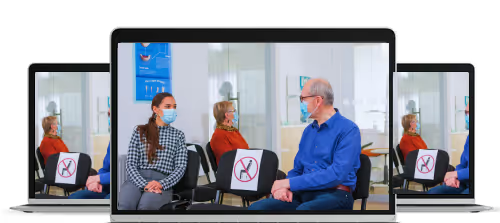
Health Plan Revenue Cycle AI — Predictive CDS for Coding and Risk
A mid‑sized health plan wanted to improve risk adjustment, coding accuracy, and recovery of missed revenue opportunities. Zymr built AI‑driven models that predicted likely under‑coded encounters and generated HCC risk adjustment prompts for clinical and coding workflows, effectively serving as a value‑based care and revenue‑integrity layer of CDS.The solution processed millions of claims with approximately 91% prediction accuracy, supporting recovery of tens of millions of dollars in otherwise missed revenue while improving documentation quality.
Project Details →
Regional Hospital Network FHIR Integration — Foundation for CDS
A regional hospital network operating 18 disparate EMRs needed a unified data layer before rolling out advanced clinical decision support. Zymr delivered a FHIR‑based interoperability platform that normalized patient, encounter, order, and observation data across systems, reducing ADT‑related errors by over half and creating a clean substrate for CDS logic.This interoperability platform now supports multiple CDS initiatives, including value‑based care prompts, quality measure tracking, and future CDS Hooks‑based integration with EHRs.
Project Details →
Who We Build Clinical Decision Support Software For
Zymr’s clinical decision support software development services support a wide spectrum of healthcare and healthtech organizations:
Hospitals and Health Systems
CMIOs, CIOs, and clinical informatics teams partner with Zymr to modernize existing CDSS, reduce alert fatigue, implement predictive CDS, and embed value‑based care logic into everyday workflows.
EHR Vendors and Health IT Platforms
EHR and care management vendors and CDS Hooks / SMART on FHIR expertise to add CDS capabilities, AI modules, and extensible APIs that enhance their core products.
Medical Device and SaMD Companies
Device and SaMD manufacturers engage Zymr to design embedded decision support, companion apps, and cloud‑based AI engines that meet regulatory expectations and integrate with provider workflows.
Health Insurance Payers
Payers use predictive CDS for care gap detection, HCC risk adjustment prompts, utilization management, and case management prioritization.
Precision Medicine and Genomics Companies
Precision medicine platforms rely on CDS to present complex variant interpretations, therapy recommendations, and eligibility rules in ways that clinicians can use at the point of care.
Clinical Research Organizations (CROs)
CROs incorporate CDS logic into trial workflows for eligibility, protocol adherence checks, and safety monitoring, supported by Zymr’s regulatory‑aware engineering practices.
Pharmacy and PBM Organizations
Clinical pharmacy and pharmacy benefit managers use CDSS for formulary management, drug interaction alerts, and medication therapy management prompts integrated with provider systems.
Why Zymr for Clinical Decision Support Software Development
AI/ML‑Powered Predictive CDS (Proven Outcomes)
CDS Hooks & SMART on FHIR‑Native Design
IoMT‑Powered Real‑Time CDS
Value‑Based Care and Revenue‑Aware CDS
Solutions We Deliver
Zymr’s clinical decision support engagements often combine multiple components into cohesive solutions.
Custom CDSS Platform (Rules + AI Hybrid)
Many organizations need a unified CDS platform that integrates rules engines, predictive models, and workflow integration into a single system. Zymr designs hybrid CDSS platforms that:
- Execute rules for deterministic checks and guideline adherence.
- Run AI/ML models for risk prediction and prioritization.
- Expose decision support via CDS Hooks, SMART on FHIR, and APIs.
- Provide tools for rule authoring, content management, and version control.
CDS Hooks / SMART on FHIR Apps
For organizations focused on modern EHR ecosystems, Zymr builds CDS Hooks‑ and SMART‑based apps that plug into existing systems without complex local deployments. These solutions:
- Trigger context‑aware cards in patient, order, or scheduling workflows.
- Provide deep‑dive SMART apps that clinicians can open for richer decision support.
- Use FHIR queries to load and write data as appropriate.
- Follow ONC and EHR vendor guidelines to ensure stable integration over time.
Legacy CDS Modernization
Many organizations still rely on legacy CDS systems built on older rule engines, custom interfaces, and limited analytics. Zymr modernizes these platforms by:
- Migrating rules into contemporary engines and modeling standards where feasible.
- Re‑platforming to cloud‑native architecture.
- Adding FHIR, CDS Hooks, and SMART on FHIR integration capabilities.
- Introducing AI/ML components and improved alert management.
CDS EHR Integration
Zymr provides specialized services to integrate new or existing CDS capabilities with EHRs and other clinical systems:
- Building EHR‑embedded modules.
- Implementing FHIR‑based APIs and HL7 v2 interfaces where needed.
- Leveraging CDS Hooks and SMART on FHIR for standards‑based, upgrade‑friendly integration.
- Coordinating with EHR vendors and internal IT teams to align with change management processes.
AI‑Powered Predictive CDS
Where clients want to add predictive intelligence without re‑architecting everything at once, Zymr delivers AI‑first CDS solutions:
- Predictive models for sepsis, deterioration, readmissions, care gaps, HCC, and more.
- Cloud‑based inference services that plug into existing workflows through APIs or CDS Hooks.
- Model monitoring, retraining, and governance aligned with risk management expectations.
- Coordinating with EHR vendors and internal IT teams to align with change management processes.
IoMT‑Powered Real‑Time CDS
Zymr provides IoMT‑driven CDS implementations:
- Continuous monitoring and automated scoring from bedside monitors, wearable sensors, and home monitoring kits.
- Real‑time alerts and recommendations integrated into EHRs or command centers.
- Rules and AI logic tailored to device data patterns and clinical thresholds.
Value‑Based Care CDS Platform
Zymr also builds platforms specifically tuned to value‑based care and payer‑provider collaboration:
- Multi‑payer, multi‑provider care gap logic engines.
- HCC and quality measure–aware CDS prompts.
- Dashboards and analytics for performance tracking and improvement.
Tech Stack for Clinical Decision Support Software
- Standards:
FHIR R4, CDS Hooks, SMART on FHIR, Arden Syntax, HL7 v2/v3.
- Terminologies and Vocabularies:
SNOMED CT, ICD‑10/11, LOINC, RxNorm, CPT
- AI/ML Tooling:
Python, scikit‑learn, TensorFlow, PyTorch, XGBoost, BioClinicalBERT
HAPI FHIR, Azure API for FHIR, AWS HealthLake, Google Cloud
- Cloud Platforms:
AWS, Azure, and GCP
- DevOps and QA:
Kubernetes, Docker, CI/CD pipelines, IaC with Terraform
FAQs Clinical Decision Support Software
What is clinical decision support software?
Clinical decision support software (CDSS) provides clinicians and care teams with patient‑specific information, recommendations, or alerts to support diagnostic, therapeutic, and workflow decisions. It combines clinical rules, evidence‑based guidelines, and sometimes AI/ML models with real‑time patient data from EHRs and other systems, delivering insights at the point of care rather than in retrospective reports.
What is the difference between knowledge‑based and non‑knowledge‑based CDSS?
Knowledge‑based CDSS use explicit rules and guidelines, often expressed as if/then statements or rule sets, to generate recommendations. Non‑knowledge‑based CDSS use data‑driven machine learning or statistical models to infer patterns and risk scores from historical data without explicit human‑authored rules, which can capture complex relationships but may require more attention to explainability and validation.
How does AI improve clinical decision support?
AI augments clinical decision support by identifying patterns and risk factors in high‑dimensional data that are hard to capture in hand‑crafted rules. Machine learning models can predict deterioration, sepsis, readmissions, coding risk, or diagnostic probabilities, providing risk scores and prioritized worklists that help clinicians focus attention where it is most needed while leaving transparent rules to handle deterministic checks.
Does clinical decision support software require FDA approval (SaMD vs non‑SaMD)?
Some clinical decision support functions are regulated as Software as a Medical Device (SaMD) by the FDA, while others qualify as non‑device CDS and are exempt under criteria in the 21st Century Cures Act. Classification depends on factors such as intended use, whether clinicians can independently review the basis for recommendations, and the seriousness of the conditions being addressed.
What is SMART on FHIR and how is it used for CDS?
SMART on FHIR is a standard for building apps that run within EHRs and other health IT systems using FHIR APIs for data access. For CDS, SMART apps provide richer, interactive experiences such as detailed risk explanations, visualizations, or pathway tools that clinicians can launch from the EHR context while still working with live patient and encounter data.
How do you validate AI‑based CDS models?
Validation of AI‑based CDS involves technical, clinical, and operational evaluation. Teams test models on held‑out datasets and external data, assess calibration and fairness, perform clinical review of outputs, run pilots in controlled settings, and monitor performance and drift over time, often with retraining workflows and governance committees overseeing updates and approvals.
What are the five rights of clinical decision support?
The five rights of CDS describe what makes decision support effective. They are delivering the right information, to the right person, in the right format, through the right channel, at the right time in the workflow. CDSS that follow these principles are more likely to be used, trusted, and to improve outcomes while minimizing alert fatigue.
What are CDS Hooks and how do they work?
CDS Hooks is an HL7 standard that defines how EHRs can call external CDS services at specific points in a workflow using standardized “hooks.” When a hook fires, the CDS service receives context such as patient and order details, runs its logic, and returns “cards” with information, suggestions, or warnings that the EHR displays to the clinician within the native user interface.
What is alert fatigue and how do you reduce it?
Alert fatigue occurs when clinicians receive too many low‑value or poorly timed alerts, leading them to ignore or override even important warnings. Reducing alert fatigue requires better targeting, severity tiers, suppressing non‑actionable alerts, tuning thresholds with local data, and using AI to prioritize only high‑risk situations, combined with user‑centered design and monitoring of override patterns.
How do you integrate CDSS with existing EHR systems?
Integration usually combines standards such as FHIR, HL7 v2, CDS Hooks, and SMART on FHIR with vendor‑specific APIs or extension points. A CDSS needs access to relevant, up‑to‑date patient data and must be able to present recommendations within EHR workflows, which is why close coordination with EHR vendors.
Can clinical decision support systems support value‑based care?
Yes. CDSS can surface care gaps, highlight missing quality measure elements, and prompt accurate coding in ways that directly support value‑based contracts and risk‑bearing programs. By embedding these prompts in everyday workflows and linking them to analytics, organizations can improve outcomes, documentation, and financial performance at the same time.
How does Zymr price clinical decision support software development?
Zymr typically uses project‑based pricing for defined CDSS builds or modernization efforts and dedicated team for ongoing product and platform engineering. Pricing reflects regulatory scope, complexity, AI/ML requirements, integration effort, and team composition, with GCC structures often delivering a 40–60% cost advantage while maintaining healthcare‑grade quality and compliance.
Ready to build CDS that saves lives, not just generates alerts?
Zymr engineers CDSS with AI predictions, CDS Hooks, IoMT data, value‑based care modules, and FDA‑aware regulatory engineering .

.svg)
.svg)
.svg)
.svg)
.svg)
.svg)