
Free GCC Assessment with Experts

ETL Pipelines for Real-Time Analytics
Zymr ETL Pipeline Development Services build scalable, AI-ready data pipelines that extract data from every source, transform it with precision, and load it exactly where your teams need it. From real-time streaming architectures to legacy SSIS modernization, our data engineers deliver HIPAA, GDPR, and PCI-DSS compliant pipelines that are production-hardened, cost-optimized, and built to grow with your data strategy.


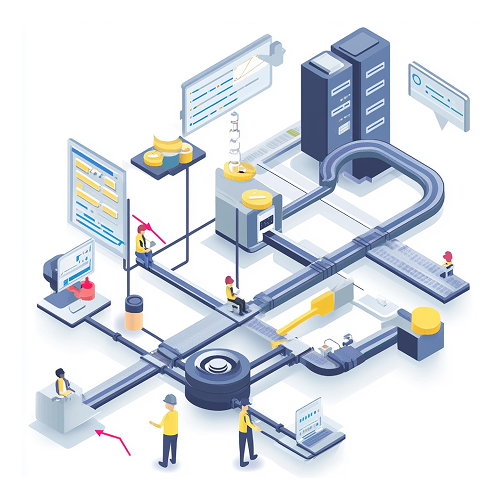
Most organizations do not have a data problem. They have a pipeline problem. Raw data sits in disconnected systems. Transformation logic is buried in brittle scripts that nobody owns. Reporting teams wait hours for numbers that should be available in seconds. Machine learning models starve for clean features while engineers are busy fixing overnight job failures. Zymr ETL Pipeline Development Services solve this at the root. We design and build modern pipelines that treat data movement as an engineering discipline, not a scripting task. As part of our comprehensive data engineering services, we build production-grade pipelines for analytics, AI, and real-time applications. Whether you need a single reliable pipeline connecting two systems or a full data platform supporting real-time analytics and ML model training, we build it to a production standard from day one.
ETL Pipeline Services
ETL Consulting and Strategy
Custom ETL Pipeline Development
Real-Time and Streaming ETL
ETL and ELT Migration and Modernization
ETL Testing and Validation
Managed ETL as a Service
ETL Capabilities
Data Extraction

Data Transformation
Data Loading and Integration
Pipeline Orchestration and Scheduling
Data Quality and Observability
Security and Compliance
MLOps-Integrated ETL (Zymr Differentiator)
FinOps-Optimized Pipeline Design (Zymr Differentiator)
ETL Pipeline Development
Regional Hospital Network Unifies 18 EMRs Through FHIR-Based Interoperability
A regional hospital network partnered with Zymr to unify 18 legacy EMR systems into a FHIR R4–compatible data layer for population health analytics and care coordination. Zymr built HL7-to-FHIR pipelines with automated validation, PHI tokenization, and HIPAA-compliant data lineage tracking. This resulted in a 68% reduction in ADT errors, a unified patient record across all facilities, and real-time access to analytics for clinical teams. The platform also established a strong data foundation for machine learning models predicting readmission risk and high-cost utilization.
Project Details →
Integration Hub Platform Engineering for Global Retail Supply Chain
A global supply chain and retail technology company needed a centralized hub to unify order, inventory, shipment, and supplier data from multiple systems. Zymr built a cloud-native ETL platform using Kafka, Spark, and Snowflake, enabling real-time inventory visibility that reduced stockouts by 34% and cut reporting latency from 24 hours to under 3 minutes. The platform now processes over 800 million events per month with 99.97% uptime.
Project Details →
AI-Powered Financial Document Parsing Pipeline
A financial services technology company needed to extract structured data from unstructured financial documents such as fund statements, brokerage reports, and tax filings to power a secure asset aggregation platform. Zymr built an ETL pipeline using OCR, NLP-based entity recognition, and ML-driven transformation to standardize data across hundreds of formats into a unified schema. This solution reduced manual data entry by 91%, improved accuracy to 99.3%, and cut report generation time from three days to under four hours, while ensuring PCI-DSS compliant tokenization of sensitive financial data.
Project Details →
Industries We Serve
Healthcare
Healthcare ETL carries requirements that no other industry shares. FHIR R4 standards, HL7 message parsing, PHI de-identification, HIPAA audit trails, and EHR extraction variability demand engineers who understand clinical data as well as distributed systems. Zymr has 50 or more healthcare engineers with experience across claims processing, clinical analytics, population health, and real-time patient monitoring pipelines.
Financial Services
Financial pipelines must be accurate to the cent, available to regulatory auditors, and capable of powering both real-time fraud detection and overnight regulatory reporting. We build pipelines for trading analytics, risk aggregation, AML transaction monitoring, customer 360 enrichment, and loan decisioning data flows.
Retail and Logistics
Retail data volumes spike unpredictably. Personalization engines need fresh behavioral data. Inventory systems need real-time demand signals. Zymr builds scalable retail ETL platforms that ingest point-of-sale, web event, loyalty, and supply chain data into analytical environments powering merchandising, forecasting, and customer experience teams.
CybersCybersecurity
Security data pipelines are high-volume, latency-sensitive, and adversarially targeted. We build log ingestion and normalization pipelines for SIEM platforms, threat intelligence feeds, and behavioral analytics systems that process billions of events daily without introducing gaps or delays.
Why Zymr for ETL Pipeline Development
AI-Native ETL Engineering
Healthcare and Multi-Industry Domain Depth
FinOps-First Pipeline Architecture
Silicon Valley DNA and GCC Delivery Model
Full-Stack Ownership from Architecture to 24/7 Operations
Solutions We Deliver
Batch ETL Pipelines
Real-Time Streaming Pipelines
Cloud-Native ETL
Legacy ETL Modernization
Healthcare-Specific ETL (Zymr Differentiator)
AI and ML-Ready Data Pipelines
ETL Pipeline Development FAQs
What is ETL pipeline development?
ETL pipeline development is the process of building software systems that extract data from source systems, apply transformation logic to clean, standardize, and enrich it, and then load it into target systems such as data warehouses, lakehouse platforms, or feature stores. A well-built ETL pipeline is automated, observable, and reliable so that analytical and operational systems always have access to accurate, current data without manual intervention.
How long does it take to build a production-grade ETL pipeline?
Simple pipelines connecting two well-understood systems with clear transformation logic can be production-ready in two to four weeks. Mid-complexity pipelines involving multiple sources, real-time requirements, or custom connectors typically take six to ten weeks. Enterprise-grade pipelines with compliance requirements, extensive testing frameworks, full observability, and managed operations take twelve to twenty weeks depending on scope.
How do ETL pipelines support real-time analytics and decision making?
Real-time ETL uses streaming architectures built on Kafka, Kinesis, or Pub/Sub to ingest events as they occur and process them through stateful computation engines like Apache Flink or Spark Structured Streaming. The result is that dashboards, fraud detection systems, personalization engines, and clinical monitoring platforms see data within seconds of it being generated rather than on a nightly batch schedule.
How do you ensure data quality throughout an ETL pipeline?
We apply a multi-layer quality framework that starts with automated profiling at source to establish baselines, enforces declarative validation rules at each pipeline stage using Great Expectations or Deequ, reconciles row counts and key metrics at load, and monitors for anomalies and freshness violations in production using Monte Carlo or Grafana-based alerting. Data lineage through Apache Atlas or DataHub allows impact analysis when issues are discovered.
How do ETL pipelines integrate with machine learning and AI workflows?
Zymr builds pipelines that produce point-in-time-correct features and register them in feature stores for both offline training and online inference. Pipeline events trigger model retraining workflows in MLflow and Kubeflow when source data distributions shift. For LLM and retrieval-augmented generation applications, we build specialized ETL handling document chunking, embedding generation, vector store management, and provenance tracking using our ZOEY and ZAIQA accelerators.
Do you offer managed ETL as a service?
Yes. Zymr's Managed ETL as a Service covers 24/7 pipeline monitoring, SLA alerting with 15-minute P1 response times, scheduled performance optimization, compliance audit support, and operational dashboards for full client visibility. Clients receive complete operational ownership transfer with transparent reporting on pipeline health, cost trends, and upcoming maintenance activity.
What is the difference between ETL and ELT in data engineering?
ETL transforms data before it reaches the target system, which is the pattern used in legacy on-premises environments and compliance-heavy scenarios where raw data must never reach the analytical layer. ELT loads raw data first and transforms it inside the target system using the elastic compute of modern cloud warehouses like Snowflake, BigQuery, or Databricks. ELT has become the dominant pattern for cloud data engineering because it is faster to build, easier to iterate, and takes advantage of the compute these platforms provide. dbt is the most widely used ELT transformation tool in production today.
What ETL tools and technologies does Zymr use?
Our tool selection is driven by client requirements rather than vendor relationships. For orchestration we primarily use Apache Airflow, Dagster, and Prefect. For ingestion, Kafka, Kinesis, Fivetran, and Airbyte cover most patterns. For processing, Apache Spark via PySpark and dbt cover the majority of transformation workloads. For cloud-native ETL we work across AWS Glue, Azure Data Factory, and GCP Dataflow. For warehousing targets we have deep experience with Snowflake, BigQuery, Redshift, Azure Synapse, and Databricks.
Can Zymr modernize our legacy ETL system?
Yes. We have migrated organizations from SSIS, Informatica PowerCenter, Talend, and COBOL-based batch jobs to modern cloud-native alternatives. Our approach begins with documenting all existing transformation logic, dependency relationships, and downstream consumers. We then implement the equivalent logic in the target platform with full test coverage and run both systems in parallel during a validation period before decommissioning the legacy system.
How are ETL pipelines different for healthcare compared to other industries?
Healthcare ETL must handle HL7 v2 message parsing, FHIR resource validation, PHI de-identification, HIPAA audit requirements, and the extraction variability of dozens of competing EHR platforms. Clinical data also has patient safety implications that mean data quality failures carry consequences beyond reporting inaccuracy. Zymr's healthcare ETL practice includes domain experts who understand clinical workflows, not just database schemas.
Can ETL pipelines scale automatically with data volume growth?
Yes. Cloud-native ETL architectures using Spark on EMR or Databricks, serverless AWS Glue or GCP Dataflow, and Kubernetes-orchestrated jobs all provide automatic scaling that responds to workload size. Zymr designs pipelines to handle ten times their expected normal volume without intervention, using auto-scaling compute, elastic warehouse capacity, and serverless patterns for variable workloads. FinOps instrumentation ensures elastic capacity does not translate into runaway cloud costs.
How does Zymr's GCC model benefit ETL pipeline development?
Zymr's Global Capability Center model allows enterprises to build dedicated ETL engineering squads in India under Zymr management with Silicon Valley architecture oversight and quality standards. Dedicated squads develop deep familiarity with your data environment and business rules over time, which is more effective than rotating consultant teams. The cost advantage versus building equivalent US-based teams is typically 40 to 60 percent, with no compromise on engineering quality or production reliability.
Build Reliable ETL Pipelines Today
Connect with Zymr's data engineering team for a free pipeline architecture review and a 30-day ETL proof of concept. Contact Zymr

.svg)
.svg)
.svg)
.svg)
.svg)
.svg)