
Neobanking for SMEs: Why B2B Digital Banking Is the Next $100B Opportunity
This guide explains how SME neobanking is evolving from digital business accounts into integrated financial operating platforms. It covers B2B banking architecture, corporate cards, treasury, cross-border payments, accounting integrations, embedded finance, lending, vertical banking, revenue models, and the build-vs-buy decisions shaping digital banking platforms in 2026.
Play Voice
Jay Kumbhani
VP of Engineering & General Manager
September 16, 2026
Key takeaways:
- SMEs need business financial operating systems. They avoid passive cash vaults.
- Platforms track live transaction histories. They offer instant, pre-approved loans safely.
- Generic business accounts are disappearing. Niche platforms serve industries like e-commerce.
- Business clients bring larger deposits. They spend more and rarely switch.
- Modern platforms bypass risky middlemen. They connect directly to licensed partner banks.
- Teams buy standard card-processing APIs. They build unique software from scratch.
The world of banking is shifting. For a long time, cool consumer banking apps made all the headlines. But today, the biggest change is happening in the business world. Recent financial reports from firms like McKinsey and Boston Consulting Group show that small and medium enterprises (SMEs) spend over $850 billion a year on banking fees and loans. Because of this, specialized neobanking for SMEs has quietly grown into a massive $100 billion market opportunity in 2026.
This boom is happening because small businesses need more than just a place to store their cash. They need an easy way to manage their entire business. According to data from CB Insights, about 38% of startups fail simply because they run out of money. Traditional big banks are often too slow and old-fashioned to help. They cannot give business owners the real-time view of their money that they need to survive.
That is where modern business platforms come in. They are changing from simple bank accounts into complete financial control centers. If you are a business leader looking to upgrade your systems, or a founder building a new platform, this shift matters. Business banking is no longer just about moving money, it is about smart software, company cards, and easy international payments.
According to McKinsey & Company SMEs remain one of the most underserved banking segments globally despite representing a massive percentage of employment and GDP contribution across major economies. At the same time, platforms like Mercury continue to demonstrate that B2B neobank unit economics can outperform consumer fintech models when product depth and treasury scale align correctly.
That changes how fintech leaders should think about product strategy in 2026.
The $100B SME Banking Opportunity Hiding in Plain Sight
For a long time, traditional banks treated small businesses like oversized personal accounts or stripped-down corporations. This was a huge mistake. Around the world, small businesses make up over 90% of all companies and provide more than half of all jobs. Yet, their financial data is scattered, it is hard for them to get loans, and managing everyday payments is a headache.
This gap is exactly why B2B digital banking is the next 100 billion opportunity. A B2B neobank makes money in a much more stable way than a regular consumer banking app. While consumer apps rely on tiny fees from everyday shopping, an SME digital banking platform handles large business expenses, earns interest on corporate savings, processes international wire transfers, and charges monthly software fees for helpful business tools.
Why SMEs Have Been Underserved by Traditional Banks and Consumer Apps
To build a great SMB banking platform, you have to understand the problems business owners face every day. Traditional banks use computer systems that are decades old. These old systems cannot handle live data, connect easily with other software, or let managers set clear rules for employee spending. If a small business wants a corporate card from a traditional bank, they often have to fill out endless paperwork, wait weeks for approval, and guess what employees are spending until the monthly statement arrives.
At the same time, standard consumer banking apps are not built for this either. A real business neobank needs to do much more than send quick money transfers to friends. Consumer apps lack the tools that businesses need to run smoothly.
A real company needs a platform where multiple employees can log in safely, invoices can be paid and tracked automatically, and taxes can be managed easily across different regions. When a business tries to use a basic consumer app, things break down quickly.
Small businesses move fast, and they cannot afford to wait days for a wire transfer to clear or spend hours manually typing card receipts into accounting software. Traditional players failed to fix these everyday headaches, opening the door for a new wave of smart business banking platforms.
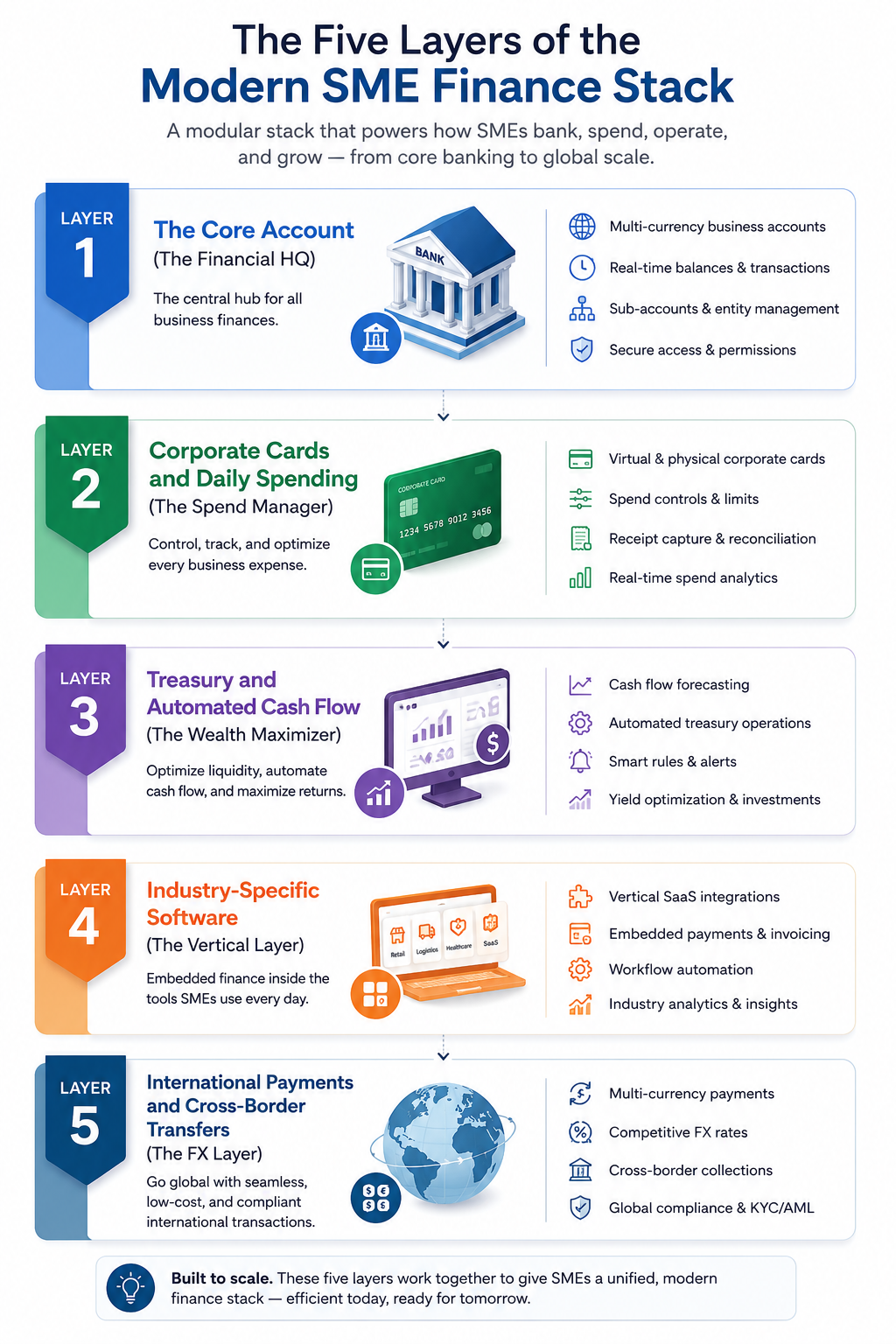
The Five Layers of the Modern SME Finance Stack
To understand how modern business platforms operate, it helps to look at them as a five-layer financial cake. In the past, a business had to buy different software for each of these layers, causing a massive headache when trying to make them talk to each other. Today, top financial platforms use a unified framework to connect software and money workflows seamlessly.
Layer 1: The Core Account (The Financial HQ)
Think of this layer as the digital foundation or the "main engine room" of the business. In the old days, this was just a basic business checking account at a brick-and-mortar bank. Today, it acts as a central command dashboard.
- What it does: It holds the company’s primary cash deposits and handles core banking needs like generating official routing and account numbers.
- The Software Connection: It provides real-time transaction tracking and gives the business owner a clean, instant look at their total cash balance across the entire company.
- Why it matters: Instead of waiting for a monthly bank statement to find out how much money is available, a business owner can log in and see exactly what has cleared, what is pending, and where the company's cash stands in real time.
Layer 2: Corporate Cards and Daily Spending (The Spend Manager)
This layer controls how money leaves the business on a day-to-day basis. Traditionally, employees spent their own money and submitted crumpled paper receipts at the end of the month, or they passed around a single corporate credit card, which was a massive security risk.
- What it does: It issues smart corporate credit or debit cards to employees. These cards can be physical plastic or instant virtual cards generated on a smartphone.
- The Software Connection: A manager can set custom spending rules on any card. For example, you can give a sales representative a card that only works for client dinners and has a strict $200 monthly cap. If they try to buy something else or go over the limit, the card is instantly declined at the register.
- Why it matters: When an employee swipes a card, a notification pops up on their phone asking them to snap a picture of the receipt. The platform’s software reads the receipt, matches it to the card transaction, and logs it under the correct category automatically. This eliminates manual expense reports.
Layer 3: Treasury and Automated Cash Flow (The Wealth Maximizer)
Leaving a large amount of extra cash sitting in a standard checking account earning 0% interest is a missed opportunity for a growing business. However, small business owners rarely have the time to act as corporate stock investors.
- What it does: It functions as an automated savings helper. It safely moves extra cash into very low-risk investments, such as government-backed treasury accounts, that earn a steady return.
- The Software Connection: The platform uses smart automation to watch the business's checking account. It calculates exactly how much money the business needs to keep on hand to cover upcoming bills and employee payroll.
- Why it matters: The system sweeps any extra money above that safety line into a yield-earning account. If the main checking account starts running low before payroll day, the software automatically sweeps the cash right back in, ensuring the business never bounces a check while still maximizing its interest income.
Layer 4: Industry-Specific Software (The Vertical Layer)
A local dental clinic, a digital marketing agency, and an e-commerce website run their daily operations in completely different ways. A standard, one-size-fits-all bank account forces all of them to use manual spreadsheets to track their industry-specific sales.
- What it does: This layer connects the bank account directly to the specialized software tools a specific industry uses every single day.
- The Software Connection: For an online e-commerce store, the bank account links directly with their Shopify storefront or Amazon seller central account. For a medical clinic, it links to their health insurance billing software.
- Why it matters: When a customer buys a product online, the e-commerce banking platform sees the sale instantly. It can automatically calculate how much profit was made after factoring in shipping costs and digital ad spending, giving the owner an industry-specific view of their financial health without requiring manual data entry.
Layer 5: International Payments and Cross-Border Transfers (The FX Layer)
Modern small businesses operate globally from day one. It is very common for a small US-based business to buy inventory from suppliers in Asia, hire customer support teams in South America, and sell to customers in Europe.
- What it does: It handles multiple foreign currencies seamlessly without requiring the business to open separate physical bank accounts in different countries.
- The Software Connection: It provides local banking details in major global currencies like Euros, British Pounds, and Canadian Dollars, allowing international clients to pay the business via local bank transfer rails.
- Why it matters: Instead of paying massive international wire fees and losing money to expensive currency exchange markups hidden by traditional banks, this layer allows businesses to hold multiple currencies simultaneously. They can accept Euros from a client, keep them in their account as Euros, and use those same Euros to pay a European contractor later, avoiding currency conversion fees entirely.
Three Winning Strategies: Mercury, Brex, and Ramp Compared
When you look at SME corporate cards and business finance platforms from the outside, they can easily look exactly the same. They all offer shiny cards, clean mobile apps, and promise to save you time.
However, the market is actually divided into three very different categories. Each platform approaches your business from a different angle. They do not truly compete on the same layer of your business, instead, each one acts as a different doorway into your daily finance operations.
Strategy 1: Mercury (The Core Bank Replacement)
Mercury focuses on replacing your traditional, old-fashioned bank. Instead of making you visit a physical bank branch, they provide a smooth, digital experience to handle your company's main cash funds.
- Business Model: Mercury is a financial technology platform that partners with secure, licensed banks. They make money by earning interest on the large cash balances companies keep in their accounts, along with fees from international currency wire transfers and premium account tiers.
- Primary Audience: New founders, tech startups, e-commerce stores, and digital agencies who need a reliable business account right after starting their company.
- Core Value: Providing a safe, fee-free home for your business cash with up to $5 million in FDIC insurance protection through their partner networks. They make it simple to send wires, deposit investor money, and give clean access to your accounting team.
- The Wedge: Fast, online setup with zero monthly fees. Traditional big banks can take weeks of paperwork to open an account for a new business. Mercury lets founders sign up online and get a fully working business account in just a few hours.
Strategy 2: Brex (The Global Platform & Capital One Powerhouse)
Brex invented the modern corporate card for startups that did not have years of credit history. Now backed by the massive financial strength of Capital One, Brex combines smart software with an elite global card system.
- Business Model: Brex relies on card transactions. Every time an employee swipes a Brex card, the merchant pays a small fee, and Brex keeps a slice of that fee. They also make money from monthly software subscriptions for larger companies that need advanced global settings.
- Primary Audience: Well-funded startups, rapidly growing companies, and teams with employees working in different countries.
- Core Value: Giving companies exceptionally high credit card spending limits without risking the founder's personal savings, backed by premium travel rewards. Their system makes it easy to give cards to employees in over 50 countries.
- The Wedge: The "No Personal Guarantee" corporate card. Historically, if a new founder wanted a business credit card, traditional banks forced them to link their personal credit score and risk their own house or savings if the business failed. Brex changed this completely by looking at the company's funding or cash balance instead, giving startups high-limit cards safely based on the strength of the business.
Strategy 3: Ramp (The CFO Workflow Automation Tool)
Ramp takes a completely different path. They do not care about being your main bank account. Instead, they act as a smart layer of software that sits on top of your existing bank account to help your company stop wasting money.
- Business Model: Ramp is a software-first platform. Their core tools are free, and they make money from the small merchant fees when people use their cards. They also have a paid monthly plan called Ramp Plus for larger companies that need complex global accounting tools.
- Primary Audience: Business owners who want to cut costs, finance managers, and growing companies with high monthly software and vendor bills.
- Core Value: Providing top-tier software that automates your bill payments, tracks receipts instantly, and controls company spending. Ramp’s software actively scans your bills to find duplicate software subscriptions and points out where you are overpaying.
- The Wedge: A simple 1.5% cashback reward combined with software designed to reduce your spending. While other card companies give you points to encourage you to spend more, Ramp won over financial managers by proving their software actively cuts down corporate waste and handles the monthly accounting math automatically.
SME Banking Product Architecture: Multi-User, RBAC, Approval Workflows, and Accounting Integration
Building a successful business platform requires a deep focus on product architecture. While a consumer app only needs to show one person their balance, an enterprise-grade platform must handle multiple team members with completely different access needs.
Multi-User Access and Role-Based Access Control (RBAC)
A business platform must allow multiple employees to log in without sharing passwords. Role-Based Access Control (RBAC) ensures everyone has exactly the access they need to perform their role safely:
- The CEO requires complete control to move money and open new accounts.
- The Accountant needs to view balances and export CSV files but must be restricted from spending money.
- The Employee should only see their own corporate card balance and upload receipts without seeing the company's master savings account.
Automated Approval Workflows
As a business scales, the business owner can no longer review every small purchase manually. Smart product architecture includes programmable approval rules. For example, if a marketing manager wants to spend $200 on an software tool, the platform can auto-approve it. If a developer requests a $5,000 server upgrade, the platform routes the request to the CFO's mobile app for a quick one-tap approval.
Deep Accounting Integration
The absolute worst part of running a business is manual bookkeeping at the end of the month. Modern banking architectures connect directly with accounting platforms like QuickBooks, Xero, and NetSuite. Using advanced optical character recognition (OCR), the system reads physical receipts uploaded by employees, matches them to the corresponding card transaction, and logs them under the correct tax category automatically.
SME Unit Economics: Why B2B Digital Banking Has Better Numbers Than Consumer Neobanking
Many first-generation consumer digital banks struggled to make a profit because their user unit economics were challenging. They spent high amounts on marketing to acquire users who kept small balances and only generated a few cents in interchange fees from buying coffee.
Business neobank unit economics are fundamentally superior for several reasons:
- Larger Account Balances: A typical consumer might keep a couple of thousand dollars in a digital account. A small business regularly holds tens or hundreds of thousand dollars to cover payroll, inventory, and operational costs. The platform can earn meaningful interest on these larger balances.
- Higher Transaction Volume: Businesses spend significantly more money than individuals. Payment volumes for software subscriptions, marketing campaigns, and supplier invoices generate far higher interchange fees for the platform.
- Lower Customer Churn: Moving a business bank account is a major operational hassle because of connected invoicing, payroll, and vendor tools. Once a business finds a platform that integrates into their workflow, they rarely leave, giving B2B platforms a much higher customer lifetime value (LTV).
Revenue Models for SME Neobanks: Interest, Interchange, SaaS, FX, and Lending Mapped
The first generation of neobanks mostly relied on interchange revenue. Swipe a card, earn a fee. Simple model.
But SME banking works differently.
Modern B2B neobank platforms generate revenue across multiple financial layers at the same time. That is one of the biggest reasons SME digital banking has stronger economics than consumer neobanking in 2026. A business account is not just used for payments. It becomes part of treasury operations, payroll, procurement, accounting, vendor management, cross border transfers, and lending workflows. That creates far deeper monetization opportunities.
1. Interest Income and Treasury Revenue
Interest income has become one of the strongest profitability engines in SME banking.
Businesses maintain larger balances than retail users, often across multiple operational accounts. That gives neobanks access to meaningful treasury scale. Platforms like Mercury built major revenue strength around deposits and treasury products. According to Sacra Mercury Financial Analysis, customer deposits crossed $20B+, making interest income a major contributor to profitability.
As interest rates increased globally between 2023 and 2026, treasury economics became even more attractive for SME neobanks.
Interchange and Spend Management
Interchange still plays a major role. But it is no longer the entire business model.
The real value comes from controlling business spend flows through:
- Corporate cards
- Procurement workflows
- Vendor payments
- Expense management systems
Platforms like Ramp and Brex expanded aggressively into spend orchestration because transaction activity creates recurring monetization at scale.
The more deeply embedded the spend infrastructure becomes, the stronger the retention and revenue opportunity.
2. SaaS and Financial Workflow Revenue
Many SME neobanks now operate partly like SaaS companies.
Instead of monetizing only transactions, they charge businesses for financial workflow software that simplifies operations.
That includes:
- Expense automation
- Approval workflows
- Treasury dashboards
- Accounting integrations
- Multi entity controls
- Cash forecasting tools
This recurring subscription model creates far more stable revenue than interchange alone.
3. FX and Cross Border Banking Revenue
SMEs are becoming global much earlier than before.
Even smaller companies now manage overseas contractors, international suppliers, and multi currency payments. That creates constant FX activity.
Platforms like Wise Business and Revolut Business built strong positioning around:
- Currency conversion
- International treasury
- Multi currency wallets
- Cross border payouts
FX infrastructure is no longer a niche feature. For many business neobank platforms, it is now a core monetization layer.
4. Lending and Embedded Credit
Lending remains the biggest long term profit opportunity in SME banking.
Once a neobank understands a business’s cash flow patterns, treasury activity, and operational behavior, it gains a major underwriting advantage.
That enables expansion into:
- Working capital loans
- Revenue based financing
- Credit lines
- Invoice financing
- Embedded lending
This is especially powerful in vertical banking models where industry specific financial data improves lending accuracy significantly.
Why This Revenue Model Is So Powerful
The strongest SME neobanks do not rely on one monetization stream anymore.
They combine treasury, spend management, SaaS workflows, FX infrastructure, and lending into one integrated financial ecosystem.
That diversification creates:
- Higher ARPU
- Better retention
- Stronger profitability
- Lower dependency on interchange alone
It also explains why modern SME banking increasingly behaves less like traditional banking and more like operational finance infrastructure built directly into how businesses run every day.
The Verticalization Trend: Why Vertical Banking Beats One-Size-Fits-All Platforms
The earliest business platforms targeted tech startups because software founders were naturally comfortable using digital tools. Today, the biggest wave of growth in the industry is coming from vertical banking, which means building financial platforms tailored to specific, traditional industries. A generic, one-size-fits-all bank account simply cannot solve the unique, day-to-day operational problems that different types of businesses face.
By embedding financial tools directly into specialized software, platforms are creating a vertical banking strategy SaaS embedded finance model. This combination allows software providers to build deeply customized workflows that traditional commercial bank accounts cannot touch.
Consider how business needs differ across everyday industries:
- E-commerce Businesses: Online stores do not just need a safe place to hold cash, they need a platform that connects directly to digital storefronts like Shopify or Amazon. They require fast inventory financing to stock up before holiday shopping seasons and automated expense tracking to see exactly how much they spend on digital ad campaigns.
- Real Estate and Property Management: A property manager handles rent checks and security deposits from hundreds of different tenants. A vertical banking platform for real estate automatically creates separate sub-accounts for every tenant, tracks who has paid their rent, and routes repair fees to contractors seamlessly.
- Logistics and Trucking: A shipping company requires mobile banking tools designed for drivers on the road. They need real-time fuel card monitoring, instant cash reimbursements for emergency repairs, and cross-border customs payments built right into their main dashboard.
By focusing on a single, specific industry, vertical platforms can build software that solves deep operational headaches. This highly targeted approach creates an incredibly valuable product, allowing platforms to win over highly loyal customers and build defensible, long-term business models.
International Multi-Entity Banking: The Cross-Border SME Banking Stack
As modern companies grow, they frequently expand beyond their local borders. A typical mid-sized business in 2026 might have a parent holding company registered in the United States, a dedicated software development team in Poland, a marketing branch in the United Kingdom, and suppliers based across Asia.
Managing money across this type of global setup using traditional commercial banks is incredibly slow and expensive. It usually forces a corporate finance team to log into multiple separate local banking portals every single day, deal with fragmented token generators, and manually piece together the company's total financial position on an Excel spreadsheet.
.A modern multi-entity business banking architecture solves this problem by providing a single global login. The corporate treasurer or business owner can view total cash balances worldwide on a single screen, or quickly drill down into a specific country's local entity to see daily expenditures.
Behind the scenes, this multi entity international SME banking architecture connects directly into different local real-time payment networks around the world, such as FedNow in the United States, SEPA Instant in Europe, and Pix in Brazil.
This deep infrastructure connectivity delivers several major operational advantages for growing businesses:
- Automated Local Funding: Instead of sending expensive international wires that take days to clear, the platform routes money through local payment networks automatically, making transfers nearly instant and vastly cutting transaction fees.
- Smart Local Currency Wallets: Platforms like Wise Business and Revolut Business allow companies to hold and manage local bank details in over ten major global currencies simultaneously, letting them accept payments from international clients like a local business.
- Unified Global Compliance: The platform automatically syncs all international transactions, local tax filings, and foreign card spending into a central accounting system, keeping the business completely organized and audit-ready.
By wrapping global payment networks into a simple, unified software dashboard, modern B2B neobanks allow small and medium businesses to operate globally without the overhead costs of an enterprise-sized finance department.
Lending Depth as the Profit Driver: How SME Neobanks Reach Sustainable Margins
While charging monthly software fees and collecting small percentages from card swipes provide steady income, lending money is the ultimate profit engine for business platforms. It is the main reason these platforms can grow into highly profitable, stable companies.
Traditional banks have always struggled to lend money to small businesses. If a small business owner walks into a traditional bank for a loan, they are faced with a mountain of paperwork. The bank will ask for tax returns from two years ago, profit statements, and personal credit histories. Then, a human loan officer takes weeks to review the file. By the time the bank says "yes" or "no," the business might have already missed its opportunity.
Modern business neobanks handle this completely differently because they have a massive unfair advantage: live data.
Because a business uses a neobank’s software to run its daily operations, the neobank can see exactly how the company is performing right now. They do not need to look at old tax returns from two years ago. Instead, their software monitors real-time financial health indicators:
- Daily Income: The platform tracks exactly how much money is coming in every single day through connected storefronts like Shopify or payment tools like Stripe.
- Spending Habits: The software sees how well the business manages its regular expenses, such as software tools and supplier bills.
- Cash Buffers: The platform knows exactly how much cash the business keeps in its account to safely cover employee payroll.
Using this live data, the neobank’s software can automatically calculate risk instantly. For example, if an online clothing brand is experiencing a huge surge in sales ahead of the holidays, the platform’s algorithm spots the trend.
The business owner can accept the money with a single click, and the neobank can automatically collect small repayments out of the business's daily sales. This data-driven approach allows modern platforms to offer credit safely, keep loan defaults very low, and earn highly sustainable profit margins that traditional banks simply cannot match.
Embedded Finance for Vertical SaaS: The B2B Opportunity Driving the Next Wave
The next massive wave of business banking growth is driven by embedded finance for vertical SaaS. This model allows software companies that serve specific industries to offer fully branded financial services directly inside their own platforms without becoming a licensed bank themselves.
Think about a software platform built for hair salons. The salon uses this software daily to schedule appointments, track client notes, and run their website. Through embedded finance, the software company can offer a branded business bank account and corporate cards directly inside the salon's existing dashboard.
This creates a powerful win-win-win scenario:
- The Small Business gets a tailored bank account right where they already run their business operations, with zero setup friction.
- The Software Company unlocks brand-new revenue streams like interchange fees and lending spreads, significantly increasing their average revenue per user.
- The Fintech Infrastructure Partner scales their platform rapidly by distributing their services through software providers who already have established relationships with thousands of businesses.
The Synapse Impact and Sponsor Bank Realities for SME Neobank Operators
The collapse of Synapse changed the conversation around Banking as a Service almost overnight.
For years, the middleware model helped fintech startups launch quickly. Instead of building direct sponsor bank relationships and complex banking infrastructure internally, neobanks could plug into middleware providers like Synapse, which handled account orchestration, compliance routing, ledger connectivity, and banking APIs between the fintech app and the regulated bank underneath.
The model became popular because it simplified critical operational layers like:
- Account provisioning
- Payment orchestration
- Compliance connectivity
- Banking API integrations
- Ledger management workflows
That speed helped accelerate the rise of embedded finance and SME digital banking platforms during the early fintech boom years.
But the collapse exposed a deeper structural weakness.
Too many fintechs lacked direct visibility into critical systems such as reconciliation, customer fund tracking, sponsor bank operations, and ledger ownership. Once operational pressure hit the ecosystem, those extra abstraction layers became a serious liability. Businesses relying on these platforms for payroll, treasury operations, vendor payments, and working capital suddenly faced uncertainty around operational continuity and fund access.
That shifted the market very quickly.
Sponsor banks became far more cautious about fintech partnerships, especially within the B2B neobank ecosystem. Infrastructure quality now matters as much as growth metrics. Banks increasingly demand deeper oversight around:
- Compliance systems
- Audit readiness
- Ledger transparency
- Risk monitoring
- Operational resilience
At the same time, many SME neobank operators started reducing dependency on middleware heavy architectures and investing more aggressively in direct sponsor bank relationships, internal ledger systems, and stronger reconciliation infrastructure.
The biggest lesson from the Synapse event is simple.
For SME banking, infrastructure is no longer just a backend integration layer. It has become the product itself. Reliable treasury operations, operational visibility, and compliance resilience are now core competitive requirements for any serious business neobank platform.
Engineering Implications: Build vs Buy Decisions for SME Banking Platforms
If your company wants to launch a business financial platform, your first major technical challenge is deciding whether to build your software from scratch or buy pre-made tools. This is known as the "Build vs Buy" dilemma.
In the early days of fintech, companies felt they had to program every single piece of ledger code and transaction processing software themselves. Today, the approach is much smarter. Modern software architecture relies on a hybrid model: you buy the standard financial utility infrastructure, and you build your unique user experiences.
To make the right choice, it helps to split your platform into two distinct parts: the core financial utilities and your competitive advantage.
What to Buy (Core Financial Utilities)
You should avoid wasting your engineering team's time rebuilding basic financial systems that already exist as secure enterprise APIs. These are heavily regulated, standard utilities that do not make your product unique.
- Card Issuing and Processing: Instead of trying to connect directly to Mastercard or Visa networks, you use services like Stripe Issuing or Marqeta. They handle the physical card printing, shipping, and automated network rules for you.
- Bank Account Connections: Do not write custom code to securely log into thousands of different traditional banks. Use Plaid or Finicity to handle customer bank login verifications and secure data sharing instantly.
- Identity and Compliance Verification: Verifying that a business is real and legal is highly complex. Use pre-built tools like Alloy or Persona to run automated background checks, trace company registration documents, and handle mandatory anti-money laundering compliance.
What to Build (Your Competitive Advantage)
Your engineering team should focus 100% of their energy on building the features that make your platform special and valuable to your specific customers.
- The Industry Dashboard: If you are building a banking platform for restaurants, build a dashboard that connects directly to their point-of-sale cash registers and food distributors.
- Custom Money Approval Rules: Build the software that lets a CEO say: Automatically approve any software bill under $100, but send anything higher to my phone for a quick review.
- Real-Time Data Reports: Create custom algorithms that look at a company's past sales to predict their future cash flow, warning them ahead of time if they might struggle to cover payroll next month.
Summary: The Smart Playbook
The winning engineering strategy in 2026 is simple. Buy your core financial utilities using secure APIs so you can launch your platform safely in months instead of years. Then, Build highly customized industry workflows that make your customers' daily business operations smooth and effortless.
The Path to $100B: Where the Next Wave of SME Neobanks Will Win
The race to capture the massive small business market is changing quickly. The first wave of platforms won by offering basic digital business accounts with clean smartphone interfaces. However, winning a slice of the next $100 billion market requires far more than a glossy card and fee-free wire transfers.
The next generation of market leaders will dominate by focusing on three clear operational strategies:
- Deep Workflow Software: The winning platforms will fully embed themselves into a company's daily operations. They will build tools that automate complex tasks like multi-user payment approvals, localized international tax compliance, and smart invoice collection.
- Predictive Financial Intelligence: Instead of simply showing a list of past transactions, top platforms will use data to look forward. They will provide automated cash flow forecasting systems that warn a business owner weeks in advance if their account balance might run low before payroll day.
- Direct Bank Connections: To survive strict regulatory crackdowns, successful platforms will ditch risky tech middlemen. They will establish direct, secure technical pipelines with licensed partner banks to guarantee maximum safety and uptime for client funds.
By moving away from basic transactional features and focusing on deeply integrated software, the next wave of business platforms will transform from simple financial accounts into indispensable business operating systems.
The 2026 State of Neobanking: Strategic Takeaways and Next Steps
The evolution of modern business banking from a niche tech startup trend into a vital pillar of the global economy is officially complete. As we look across the financial landscape in 2026, the core lessons are clear for every participant in the marketplace.
- Software Over Storage: SMEs need business financial operating systems. They avoid passive cash vaults.
- Data-Driven Credit: Platforms track live transaction histories. They offer instant, pre-approved loans safely.
- Vertical Specialization: Generic business accounts are disappearing. Niche platforms serve industries like e-commerce.
- Premium Unit Economics: Business clients bring larger deposits. They spend more and rarely switch.
- Direct Bank Plumbing: Modern platforms bypass risky middlemen. They connect directly to licensed partner banks.
- Hybrid Engineering: Teams buy standard card-processing APIs. They build unique software from scratch.
Next Steps for Stakeholders
For Neobanks and Fintech Startups
Stop trying to build a generic platform for every type of business. The future belongs to deep industry specialization. Focus your internal product roadmap on creating custom financial workflows for specific, underserved business sectors. Additionally, ensure you protect your business continuity by building direct technical pipelines with your partner banks right from day one.
For Traditional Banks and Incumbents
Legacy institutions must prioritize updating their core technology infrastructure immediately. Upgrading your internal systems with developer-friendly, real-time API capabilities is the only way to keep your highest-value business clients from jumping ship to faster, software-driven digital platforms.
For Consumers and Businesses
Stop wasting valuable staff hours dealing with slow, manual banking paperwork or trying to patch together disconnected accounting tools. Audit your current financial processes and switch to a modern financial platform that combines checking, corporate spending rules, and real-time accounting sync inside a single dashboard.
Conclusion
FAQs
Q1: Why is SME banking a $100B opportunity?
>
Small and medium businesses worldwide spend over $850 billion every year on standard banking fees and financing. Because traditional big banks rely on outdated systems, a massive $100 billion addressable market has opened up for modern platforms that can combine banking access with smart software tools.
Q2: How is SME banking different from consumer neobanking?
>
Consumer apps focus on simple single-user accounts and make money from tiny everyday transaction fees. A business platform handles significantly larger deposits, processes massive transaction volumes, and requires advanced workflows like multi-user permissions, automated expense tracking, and direct accounting integrations.
Q3: Which SME neobanks are profitable in 2026?
>
Mercury has delivered three straight years of GAAP profitability while managing over $20 billion in customer deposits. Other top business-focused platforms like Qonto in Europe have also reached profitability by focusing on high-value business clients and building diverse revenue streams.
Q4: What is the five-layer SME finance stack?
>
It is a framework showing how software and money work together: The Core Account (HQ) for deposits. Corporate Cards (Spend) for daily expense tracking. Treasury Management (Cash) for earning interest on extra funds. Industry Software (Vertical) for connecting business apps. International Payments (FX) for easy cross-border transfers.
Q5: How does vertical banking work for SMEs?
>
Instead of offering a standard, generic bank account, vertical banking platforms design their tools for specific industries. For example, an e-commerce bank account links directly with online storefronts like Shopify to track inventory costs, while a real-estate platform creates separate sub-accounts for individual tenant security deposits automatically.
Have a specific concern bothering you?
Try our complimentary 2-week POV engagement


Our Latest Blogs


October 14, 2026
Multi-Factor Authentication in Healthcare: Balancing Security and Clinical Speed

October 12, 2026


.svg)
.svg)
.svg)
.svg)
.svg)
.svg)
