
Free GCC Assessment with Experts

Engineering Production-Grade Machine Learning
Zymr’s MLOps Services help enterprises move machine learning from experimentation to production with repeatable, secure, and scalable engineering. We build ML pipelines, automate model deployment, implement monitoring and governance, and extend MLOps into LLMOps, GenAIOps, and AI FinOps for teams operationalizing classical ML and generative AI at scale.


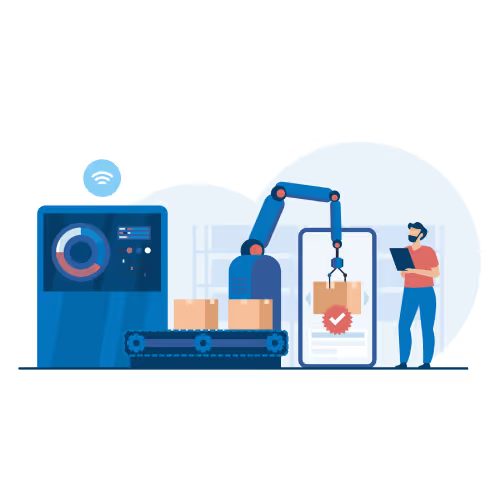
Machine learning often begins as a promising proof of concept, but far too many initiatives fail to become dependable production systems. Data scientists build models that work well in a notebook or sandbox, yet those models stall when teams must deploy them, validate them, monitor them, govern them, or retrain them safely. That gap between experimentation and production is exactly where MLOps creates value.
MLOps, or machine learning operations, is the discipline of applying software engineering, DevOps, data engineering, and platform automation practices to the ML lifecycle. It covers how data is versioned, how experiments are tracked, how models are registered and deployed, how drift is detected, how retraining is triggered, and how governance is enforced. In practice, MLOps transforms ML from a research activity into an operational capability that can be measured, scaled, and improved over time.
This matters because model performance is not static. Data changes, user behavior shifts, business rules evolve, and external conditions move. A model that performed well last quarter may degrade this quarter if the underlying data distribution changes or the assumptions behind the model no longer hold. Without MLOps, those changes often go unnoticed until business results decline. With MLOps, the organization has systems to detect, respond to, and correct the issue before it causes harm.
Zymr engineers MLOps platforms that reduce that risk. We build the automation and governance layer that enables continuous model delivery, reliable performance monitoring, reproducibility, and controlled scale. We also extend the discipline into LLMOps and GenAIOps so enterprises can manage large language models, retrieval pipelines, prompts, vector databases, and AI agents with the same rigor used for classical machine learning. That is increasingly important as generative AI moves from experimentation into real enterprise workflows.
The result is production-grade machine learning that can support real business use cases, from demand forecasting and fraud detection to personalization, clinical decision support, and enterprise copilots. Instead of treating ML as a side project, we help you operationalize it as part of your core technology stack.
Why MLOps Now?
The need for MLOps has never been more urgent. As organizations deploy more AI systems, the complexity of managing them grows exponentially. A single ML model may require data pipelines, feature computation, experiment tracking, environment consistency, secure deployment, observability, retraining logic, access controls, and regulatory documentation. Multiply that by dozens of models, and the absence of a proper MLOps foundation quickly becomes a major business risk.
There are several reasons why MLOps is now a strategic priority rather than a technical nice-to-have.First, machine learning delivery has to become repeatable. If every model deployment depends on custom scripts, manual approval steps, or one-off engineering effort, the organization cannot scale its AI ambitions. The platform needs standardized processes for training, validation, packaging, release, and rollback. Otherwise, the ML team spends more time managing infrastructure than building value.
Second, model drift is now a business issue. Models do not fail only when there is a code bug. They fail when the world changes around them. Customer behavior shifts, fraud patterns evolve, inventory dynamics change, and clinical conditions vary. Drift detection, performance monitoring, and retraining pipelines are therefore essential. Without them, model quality declines silently.Third, governance and compliance expectations are increasing. Organizations in healthcare, finance, insurance, and cybersecurity cannot operate AI systems without clear lineage, explainability, documentation, and approval controls. Even outside regulated industries, executives increasingly want to know where data came from, which version of the model is in use, who approved it, and what business impact it created. MLOps gives teams the auditability and control they need.Fourth, GenAI changes the operating model again. Large language models introduce new concerns that classical MLOps does not fully address. Teams now need prompt management, RAG operations, vector database governance, hallucination monitoring, fine-tuning workflows, agent observability, and cost control for GPU-heavy inference. That means the modern MLOps stack must expand into LLMOps and GenAIOps or risk becoming obsolete. You can also see how this intersects with our Generative AI Development services and AI Agents Development capabilities.Finally, AI cost has become operationally significant. Training and inference workloads can become expensive very quickly, especially when GPU resources are overprovisioned or poorly managed. AI FinOps helps teams measure and optimize the cost of ML and GenAI systems so they can scale intelligently instead of burning budget blindly. For many enterprises, this is the difference between a promising AI initiative and a sustainable platform.In short, MLOps is now the layer that determines whether AI is a durable capability or a series of short-lived experiments. Zymr helps companies build that layer correctly from the start.

MLOps Service Needs
MLOps Strategy & Maturity Assessment

ML Pipeline Engineering & Automation
Model Deployment, Monitoring & Governance
LLMOps & GenAIOps Engineering
AI FinOps & Cost Optimization
MLOps Managed Services & SRE for ML
MLOps Engineering Capabilities
Data & Feature Engineering Layer
Experimentation & Training Layer
Pipeline Orchestration Layer
Model Deployment & Serving Layer
Monitoring, Observability & Governance Layer
Industry-Specific MLOps
Infrastructure & Platform Layer
MLOps Services & Solutions
AI-Native Cybersecurity Platform
Zymr deployed an AI-driven cybersecurity SaaS platform on Google Cloud with end-to-end MLOps engineering, including BigQuery data lakehouse, ML pipelines, automated retraining, and scalable model serving, enabling reliable production AI through integrated cloud, data, and ML infrastructure.
Project Details →
ZOEY Agentic AI Orchestration Engine
Zymr introduced ZOEY, a cloud-native orchestration engine built to accelerate agentic AI adoption with LLM, RAG, multimodal, and distributed task capabilities. ZOEY showcases Zymr’s approach to modern AI operations through orchestration, traceability, versioning, and operational control for enterprise AI systems.
Project Details →
Mid-Sized Health Plan Revenue Cycle AI
Zymr helped a mid-sized health plan recover $24M using AI-driven revenue cycle automation. The solution processed 4.1M claims with 91% prediction accuracy, demonstrating scalable ML deployment, monitoring, and operational integration in a regulated healthcare environment.
Project Details →
Industries We Serve
Healthcare & Life Sciences
Healthcare MLOps becomes particularly powerful when integrated with broader healthcare software, analytics, and compliance needs. Zymr brings the engineering depth to connect those pieces in a way that supports both innovation and control. We also align this work with industry content such as Healthcare, Healthcare Data Analytics, Digital Transformation in Healthcare, and Global Healthcare Outlook Trends
Financial Services & Fintech
Financial institutions use ML for fraud detection, risk scoring, underwriting, personalization, and automation. These use cases need monitoring, retraining, fairness controls, and governance. Zymr’s MLOps services help fintech and financial teams run models in a way that supports business speed without sacrificing accountability.
Cybersecurity
Cybersecurity is a fast-moving environment where ML systems must adapt quickly. Zymr builds detection-focused MLOps workflows that support telemetry ingestion, continuous model updates, alert quality, and operational resilience. The goal is to keep security models effective as threat patterns evolve.
Retail & E-Commerce
Retail and commerce companies rely on ML for recommendations, ranking, demand forecasting, and personalization. Zymr helps them build automated pipelines, controlled deployments, and experiment-driven systems that improve customer experience while supporting scale.
SaaS & AI-First Companies
AI-first companies often need to move quickly from prototype to product. Zymr helps these teams build reliable production systems around their ML and GenAI features so they can ship faster without creating technical debt. For product engineering teams, that often includes the bridge between model development and production deployment.
Manufacturing & IoT
Manufacturing and IoT environments often involve sensor data, streaming pipelines, edge inference, and predictive maintenance. Zymr designs MLOps systems that fit these distributed and operationally sensitive use cases.
Media & Entertainment
Media and entertainment companies use ML for personalization, content moderation, ranking, and audience analytics. Zymr helps build the MLOps layer that keeps those systems responsive and measurable.
Insurance
Insurance organizations use machine learning for claims automation, fraud detection, customer scoring, and workflow optimization. Zymr helps insurance teams deploy and govern those models at enterprise scale.
Why Zymr
LLMOps & GenAIOps Engineering
AI FinOps Embedded in MLOps
Industry-Specific MLOps
Detection-as-Code for ML Governance
GCC MLOps Engineering Squads
Solutions We Deliver
Greenfield MLOps Platform Build
For organizations starting from scratch, we design and build the entire platform. This includes architecture, pipeline design, deployment infrastructure, monitoring, governance, and rollout strategy. The result is a foundation ready to support production ML at scale.
MLOps Maturity Assessment & Roadmap
If your team already has models and tools in place, but not a coherent operating model, we provide a maturity assessment and phased roadmap. This is often the right entry point for organizations that need to modernize without disrupting everything at once.
Legacy ML Stack Modernization
Many teams are still running models through brittle scripts, manual approvals, and undocumented workflows. Zymr helps modernize those stacks with automation, versioning, orchestration, and better controls so they can scale more safely.
MLOps Managed Services
Some organizations need ongoing operational support rather than just implementation. Zymr offers managed MLOps services that cover platform operations, incident response, retraining, monitoring, and continuous optimization.
LLMOps / GenAIOps Platform
For enterprises deploying generative AI, we build the operational stack for prompt management, RAG operations, evaluation, vector databases, and agent orchestration. This is powered by ZOEY and aligned to the needs of modern AI teams.
AI FinOps Platform
We create dashboards and controls for GPU utilization, inference cost, training budget, autoscaling, and workload optimization. This helps teams operate AI systems efficiently and predictably.
Industry-Compliant MLOps
For healthcare, fintech, and other regulated sectors, we build MLOps workflows that include stronger governance, documentation, access control, and compliance-aware processing. This makes it easier to deploy AI responsibly in high-stakes environments.
Tech Stack
- Pipelines: Kubeflow, Airflow, Prefect, Dagster, Metaflow
- Experiment Tracking: MLflow, Weights & Biases, Neptune, Comet
- Feature Stores: Feast, Tecton, Databricks Feature Store
- Data Versioning: DVC, LakeFS, Pachyderm
- Accelerators: ZOEY for agentic AI orchestration, ZAIQA for QA automation
- Model Serving: NVIDIA Triton, TorchServe, KServe, vLLM, TGI, Ray Serve
- Cloud MLOps: AWS SageMaker, Azure ML, GCP Vertex AI, Databricks
- LLM / RAG" LangChain, LlamaIndex, Hugging Face, Pinecone, Weaviate, pgvector
- Monitoring: Arize AI, WhyLabs, Fiddler, Evidently, custom dashboards
- Infrastructure: Kubernetes, Terraform, Helm, Docker, Ray
FAQs MLOps Services & Solutions
What are MLOps services?
MLOps services help organizations build, automate, deploy, monitor, and govern machine learning systems in production. They usually cover pipeline automation, model deployment, monitoring, retraining, versioning, and governance.
What does an MLOps platform include?
An MLOps platform usually includes data pipelines, feature management, experiment tracking, model registry, orchestration, deployment automation, monitoring, governance, and observability. More advanced platforms may also include LLMOps, AI FinOps, and policy automation.
How do you monitor and prevent model drift?
Model drift is monitored by tracking input data changes, prediction behavior, and performance over time. Prevention typically involves data validation, monitoring alerts, retraining triggers, and strong lifecycle governance.
How do you ensure HIPAA compliance in ML pipelines?
HIPAA compliance in ML pipelines usually requires access controls, encryption, audit logging, secure data handling, and PHI-safe workflows. The exact setup depends on the use case and data sensitivity.
How do you implement CI/CD for machine learning models?
CI/CD for ML includes automated testing, data validation, model evaluation, registry updates, deployment automation, and release controls. Many teams also add retraining workflows and promotion thresholds.
Can you provide MLOps managed services?
Yes. Zymr can provide managed MLOps support that covers monitoring, deployment operations, retraining, incident response, and platform maintenance. This is ideal for teams that want long-term operational support.
What is the difference between DevOps and MLOps?
DevOps focuses on software delivery, while MLOps extends those principles to machine learning systems. MLOps has to manage data, features, model drift, retraining, and lifecycle monitoring in addition to code and infrastructure.
What is LLMOps and how is it different from MLOps?
LLMOps is the operational layer for large language models and GenAI systems. It adds prompt management, RAG operations, vector database lifecycle, output evaluation, hallucination monitoring, and agent orchestration to the traditional MLOps stack.
What is AI FinOps?
AI FinOps is the practice of managing AI infrastructure cost with the same rigor used in cloud financial operations. It helps teams monitor GPU usage, forecast cost, control spend, and optimize training and inference workloads.
Should we use SageMaker, Azure ML, or Vertex AI?
The right platform depends on your cloud strategy, data location, team skills, governance needs, and integration requirements. Managed services can accelerate delivery, but they still need a disciplined operating model.
What is a feature store and when do we need one?
A feature store is a system for managing reusable ML features consistently across training and inference. It is especially useful when multiple teams use the same features, or when training and serving parity is critical.
How does Zymr price MLOps services?
Pricing depends on the scope, complexity, cloud environment, regulatory requirements, model count, and delivery model. A maturity assessment is typically the best first step for scoping.
Ready to Scale ML Into Production?
Zymr’s MLOps engineering teams can help you design the right platform, automate delivery, govern models, and operationalize classical ML, LLMOps, and GenAIOps across your enterprise.

.svg)
.svg)
.svg)
.svg)
.svg)
.svg)