
Insurance Workflow Automation: From RPA to Straight-Through Processing - The 2026 Maturity Model
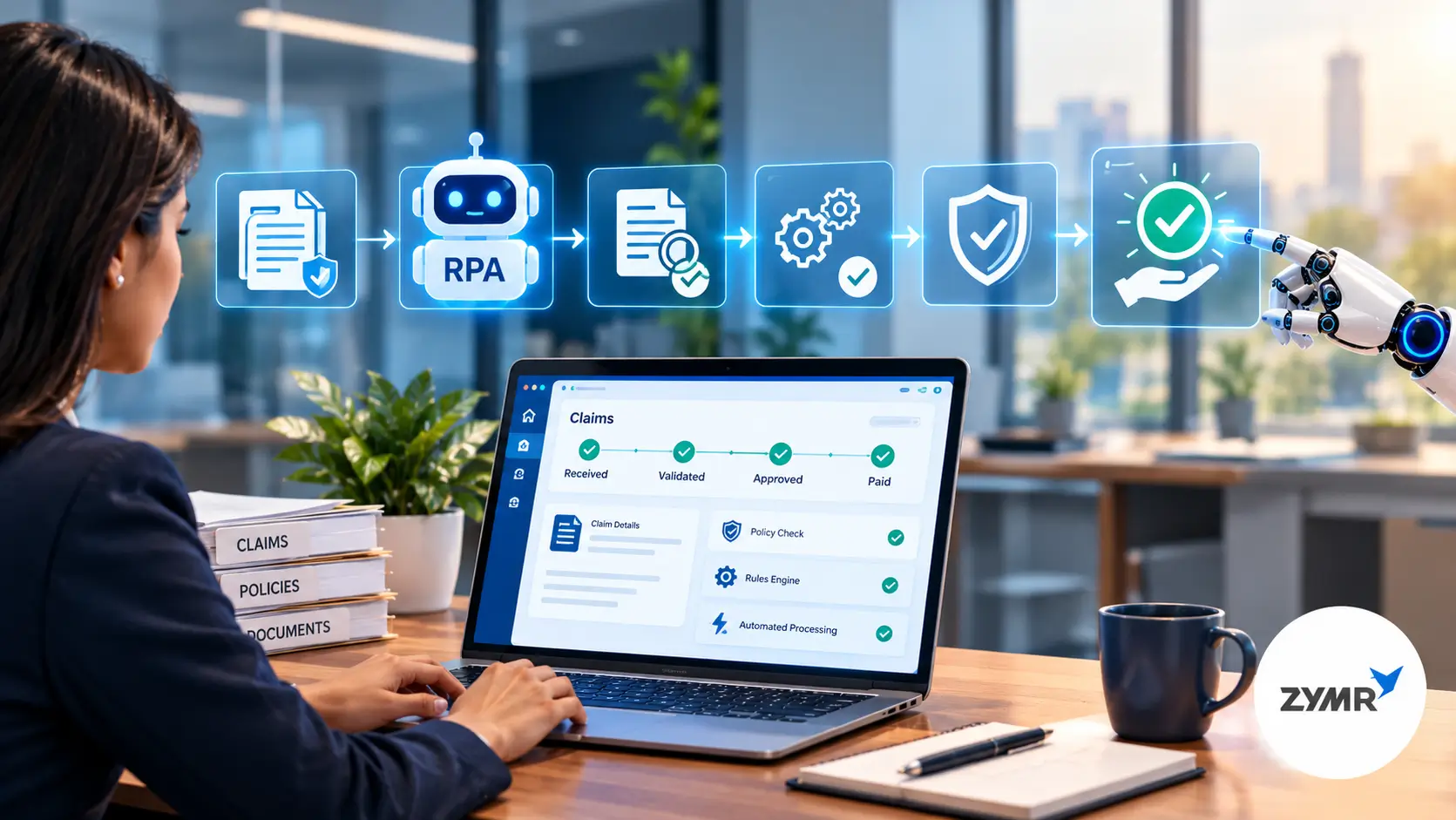
This guide maps the four-stage maturity model insurers are using to move from basic RPA to agentic straight-through processing. It covers where automation applies across claims, underwriting, policy administration, billing, and customer service, plus the technology stack, ROI, and challenges involved.
Play Voice
Sitanshu Joshi
Associate Director of Engineering
September 21, 2026
Key Takeaways
- Insurance workflow automation connects data, systems, rules, approvals, and teams across operations.
- Automation maturity progresses from RPA to orchestration, AI augmentation, and agentic straight-through processing.
- Claims, underwriting, policy administration, billing, and customer service offer strong automation opportunities.
- APIs, BPM, AI, analytics, and governance form the foundation of scalable insurance workflows.
- Successful automation requires reliable data, legacy integration, regulatory controls, and defined human oversight.
Why Insurance Workflow Automation Matters in 2026
Insurance workflow automation connects data, applications, business rules, and approvals across insurance operations. It reduces manual handoffs across claims, underwriting, billing, and policy servicing the same discipline behind Zymr’s work in the adjacent fintech and BFSI space.
RPA automates repetitive tasks but cannot manage complex, end-to-end decisions independently. Insurers now require BPM, APIs, document intelligence, AI models, and human oversight to move beyond isolated RPA insurance deployments.
This integrated approach improves processing speed, accuracy, scalability, and regulatory traceability. It also establishes the foundation for controlled straight-through processing insurance programs.
What Is Insurance Workflow Automation?
Insurance workflow automation uses connected technologies to manage insurance processes with minimal manual intervention. It combines RPA, BPM, APIs, AI, and decision engines within governed insurance workflow orchestration.
The system collects data, validates information, applies business rules, routes exceptions, and updates core platforms. It supports processes across claims, underwriting, policy administration, billing, and customer service.
Unlike basic task automation, it coordinates complete processes across teams and applications. This enables consistent decisions, faster processing, stronger auditability, and controlled straight-through processing.
The 4 Stages of Insurance Workflow Automation Maturity
Insurance automation progresses from isolated task execution to intelligent, end-to-end orchestration. Each stage of this insurance automation maturity model expands process coverage, decision intelligence, integration, and operational autonomy.
Stage 1: RPA for Task Automation
Brief Overview
Robotic Process Automation uses rule-based bots to perform repetitive, structured RPA insurance tasks, most commonly deployed on platforms such as UiPath.
What RPA Automates
- Data entry and system updates
- Policy information validation
- Document downloads and uploads
- Claims status notifications
- Routine compliance checks
Business Benefits
- Reduces manual effort, processing delays, and data-entry errors
- Improves productivity without replacing existing core systems
Example
A bot extracts claim details from emails and enters them into Guidewire ClaimCenter. Employees review exceptions while standard submissions move forward automatically.
Stage 2: Workflow and Process Orchestration
Brief Overview
Workflow orchestration connects tasks, systems, teams, and approvals within one managed process the backbone of mature insurance BPM.
How Workflows Are Connected
BPM platforms such as Pega use APIs, business rules, events, and queues to coordinate process steps.
Business Benefits
- Fewer manual handoffs
- Faster processing cycles
- Consistent process execution
- Better operational visibility
- Clearer audit trails
Example
A claims workflow validates coverage, assigns adjusters, requests documents, and routes approval automatically.
Stage 3: AI-Augmented Workflow
Brief Overview
AI-augmented workflows combine process orchestration with intelligent document analysis and predictive decision support.
How AI Supports Decisions
AI extracts data, identifies anomalies, predicts risk, and recommends appropriate workflow actions often built on document intelligence services such as AWS Textract or Azure Document Intelligence. This is the same layer covered in Zymr’s breakdown of AI in claims processing.
Business Benefits
- Faster document processing
- Improved decision accuracy
- Earlier fraud identification
- Reduced employee workload
- Better exception prioritization
Example
AI analyzes underwriting documents and recommends risk classifications. Underwriters review complex or uncertain cases.
Stage 4: Agentic AI and Straight-Through Processing
Brief Overview
Agentic AI insurance deployments enable workflows to plan, execute, monitor, and adjust tasks across connected systems the direction Zymr’s AI Agents Development practice is built for.
How Autonomous Workflows Operate
AI agents interpret requests, retrieve data, apply rules, call APIs, and manage exceptions the same approach specialist platforms such as Cytora apply to agentic underwriting intake. Human approval remains mandatory for high-risk or uncertain decisions.
Business Benefits
- Higher straight-through processing rates
- Faster end-to-end completion
- Lower operational effort
- Continuous workflow monitoring
- Scalable process execution
Example
An AI agent processes a low-risk claim from submission through validation and payment. Complex cases automatically move to experienced claims professionals.
4. Where Insurance Workflow Automation Applies
Insurance workflow automation supports insurance value chain automation across the entire operation. It connects data, decisions, systems, and employees within governed processes.
1. Claims Workflow Automation
Key Use Cases
- First Notice of Loss intake
- Coverage and policy validation
- Document classification and extraction
- Fraud risk screening
- Claims assignment and payment routing
Business Benefits
- Reduces processing time, manual effort, and inconsistent handling
- Improves claim visibility, accuracy, and customer communication
Example
The workflow validates policy coverage, extracts claim details, and evaluates fraud indicators. Standard claims proceed automatically, while complex cases move to adjusters the pattern covered in depth in Zymr’s guide to insurance claims automation and in claims administration.
2. Underwriting Workflow Automation
Key Use Cases
- Application data collection
- Document extraction and validation
- Risk assessment and scoring
- External data verification
- Quote and approval routing
Business Benefits
- Accelerates risk assessment and improves decision consistency
- Reduces manual reviews and helps underwriters prioritize complex submissions
Example
The workflow gathers applicant data, validates documents, and applies underwriting rules. Standard applications receive automated decisions, while complex risks move to underwriters the focus of Zymr’s insurance underwriting automation guide.
3. Policy Administration and Billing
Key Use Cases
- Policy issuance and renewals
- Endorsement and coverage updates
- Premium calculation and invoicing
- Payment reconciliation
- Cancellation and reinstatement processing
Business Benefits
- Improves policy accuracy and reduces servicing delays
- Strengthens billing control, payment visibility, and operational consistency
Example
A workflow validates endorsement requests, recalculates premiums, updates policy records, and generates revised documents as part of broader policy servicing automation. Exceptions move to policy servicing teams for review.
4. Customer Service and Agency Workflows
Key Use Cases
- Customer request classification
- Policy and claims status updates
- Agent onboarding and verification
- Service ticket routing
- Renewal and follow-up notifications
Business Benefits
- Shortens response times and improves service consistency
- Provides agents with accurate information across customer interactions
Example
A workflow identifies a policyholder’s request, retrieves relevant records, and initiates the correct action. Complex requests move to service teams with complete context, supported by UI/UX Design built for high-volume service interfaces.
Technology Behind Modern Insurance Workflow Automation
Modern automation requires connected technologies that manage tasks, decisions, data, integrations, and governance.
Together, these technologies create scalable workflows while maintaining security, traceability, and human oversight.
Business Benefits of Insurance Workflow Automation
Common Challenges
The Future of Insurance Workflow Automation
- AI-Driven Workflows: AI will improve document processing, risk prediction, fraud detection, and decision support.
- Agentic AI: Governed AI agents will coordinate tasks, systems, rules, and exceptions across complete workflows.
- Greater Straight-Through Processing: More suitable transactions will move from intake to completion without manual intervention.
- Human-AI Collaboration: Employees will oversee complex decisions while AI manages routine execution and recommendations.
Future-ready insurers will combine automation, orchestration, and governance within one scalable operating model.
Conclusion
Insurance workflow automation helps insurers connect fragmented processes, systems, data, and decisions. It improves processing speed, accuracy, scalability, and operational visibility across the insurance value chain.
The next phase depends on intelligent orchestration, governed AI, and reliable system integration. Insurers adopting this approach can increase straight-through processing while maintaining human oversight and regulatory control.
Conclusion
FAQs
1. What Is the Difference Between RPA, BPM, and Agentic AI in Insurance?
>
RPA automates repetitive, rule-based tasks within existing systems. BPM coordinates complete workflows across applications, teams, approvals, and business rules. Agentic AI adds autonomous planning, contextual decision support, and dynamic task execution. It can retrieve information, call APIs, manage exceptions, and escalate high-risk decisions. Human oversight remains essential for regulated and consumer-impacting processes.
2. What Is Straight-Through Processing (STP) in Insurance?
>
Straight-through processing completes eligible insurance transactions without manual intervention. It uses validated data, predefined rules, integrations, and automated decision engines. Insurers commonly apply STP to simple claims, policy updates, renewals, payments, and standard underwriting cases. Complex, high-risk, or incomplete transactions move to employees for review.
3. Where Does Insurance Workflow Automation Apply Across the Value Chain?
>
Insurance workflow automation supports underwriting, claims, policy administration, billing, renewals, and customer service. It also improves fraud screening, compliance checks, document processing, and agency operations. Connected workflows coordinate data, decisions, approvals, and system updates across each business function.
4. What Is the Reference Architecture for Insurance Workflow Automation in 2026?
>
A sound insurance workflow architecture includes core insurance platforms, BPM, RPA, AI services, integration APIs, and governance controls. These layers connect policy, claims, billing, document, and customer systems. The architecture should also support security, monitoring, audit trails, human approvals, and exception management. This structure enables scalable automation without weakening regulatory control.
5. How Should Insurers Sequence Their Workflow Automation Journey?
>
RPA automates repetitive, rule-based tasks within existing systems. BPM coordinates complete workflows across applications, teams, approvals, and business rules. Agentic AI adds autonomous planning, contextual decision support, and dynamic task execution. It can retrieve information, call APIs, manage exceptions, and escalate high-risk decisions. Human oversight remains essential for regulated and consumer-impacting processes.
Have a specific concern bothering you?
Try our complimentary 2-week POV engagement


Our Latest Blogs
September 21, 2026
Insurance Workflow Automation: From RPA to Straight-Through Processing - The 2026 Maturity Model


September 16, 2026


.svg)
.svg)
.svg)
.svg)
.svg)
.svg)
