
How to Improve EHR Interoperability: Strategies for Provider IT Teams (2026)
This guide explains how to improve EHR interoperability through eight practical strategies. It covers maturity assessment, vendor tools, identity resolution, FHIR adoption, governance, and measurable outcomes. Provider IT teams researching how to improve EHR interoperability for provider IT usually start with an honest maturity assessment before touching a single interface and that ordering matters more than most roadmaps admit.
Play Voice
Suhas Phartale
AVP of Engineering
September 16, 2026
Key Takeaways
- Assess maturity first. Skip the baseline and you fix symptoms, not causes and can't measure progress later.
- Fix patient identity upstream. Mismatched records are far costlier to untangle once they spread downstream.
- Use vendor-native tools first. Most teams underuse what Epic/Oracle Health already offer. Custom build should be the fallback.
- Automate the clinician's manual work. Every manual reconciliation task is a sign the systems aren't really interoperable.
- Treat governance as infrastructure, not a checkbox. SMART on FHIR vetting, TEFCA, and Information Blocking compliance only work if they're ongoing.
EHR interoperability enables secure, accurate clinical data exchange across healthcare systems. It requires aligned APIs, patient identity, data standards, security, and governance.
In 2026, provider IT teams must support FHIR (Fast Healthcare Interoperability Resources), USCDI (United States Core Data for Interoperability), TEFCA (Trusted Exchange Framework and Common Agreement), and evolving CMS requirements including CMS's Interoperability and Prior Authorization Final Rule (CMS-0057-F) and the earlier Interoperability and Patient Access Final Rule. They must also reduce manual workflows that force clinicians to reconcile fragmented records.
This guide explains how to improve EHR interoperability through eight practical strategies. It covers maturity assessment, vendor tools, identity resolution, FHIR adoption, governance, and measurable outcomes. Provider IT teams researching how to improve EHR interoperability for provider IT usually start with an honest maturity assessment before touching a single interface and that ordering matters more than most roadmaps admit.
Zymr's healthcare engineering teams work through these same strategies with hospital systems, health plans, and healthtech vendors, so the guidance below reflects patterns that hold up in production, not just on a whiteboard.
Why EHR Interoperability Matters for Provider IT Teams
EHR interoperability gives clinicians timely access to complete, usable patient information. It also reduces fragmented records across departments, facilities, laboratories, pharmacies, and external providers.
For provider IT teams, interoperability improves more than data exchange. It strengthens care coordination, patient identity accuracy, security governance, reporting, and operational efficiency.
Poor interoperability creates duplicate records, manual reconciliation, delayed decisions, and integration maintenance costs. It also turns clinicians into the connection point between disconnected systems.
A strong interoperability program treats the EHR as shared digital infrastructure. Provider IT teams must align interfaces, APIs, data standards, vendor tools, and governance around measurable clinical outcomes.
This approach supports safer workflows and creates a scalable foundation for future healthcare applications. The next section assesses EHR interoperability maturity across consistent technical and operational dimensions.
How Do You Assess Your EHR Interoperability Maturity?
Provider IT teams should assess interoperability across six core dimensions:
- Data exchange: Review HL7, FHIR, API, and interface coverage.
- Patient identity: Measure duplicate records and matching accuracy.
- Data quality: Check completeness, consistency, and terminology alignment.
- Workflow integration: Identify manual reconciliation and duplicate data entry.
- Security: Evaluate access controls, consent, auditing, and third-party risks.
- Governance: Review ownership, standards, policies, and performance reporting.
This assessment helps teams identify technical gaps and operational bottlenecks. It also establishes a baseline for the EHR interoperability roadmap. Data quality checks in particular benefit from dedicated data engineering support, since inconsistent terminology and incomplete records are usually pipeline problems, not interface problems.
Teams should prioritize issues affecting clinical safety, data availability, and workflow efficiency.
Set Clear Goals for Improving EHR Interoperability
Provider IT teams should define measurable goals before selecting technologies or vendors. Each goal must connect technical improvements with clinical and operational outcomes.
Common interoperability goals include:
- Reduce duplicate patient records.
- Increase external data availability within clinician workflows.
- Replace manual reconciliation with automated data exchange.
- Expand FHIR API coverage across priority applications.
- Improve vendor-supplied interoperability adoption.
- Strengthen third-party application governance.
- Reduce interface failures and maintenance effort.
Teams should assign baselines, targets, owners, and delivery timelines for every goal. This creates accountability and prevents interoperability programs from becoming open-ended integration projects.
Goals should also reflect clinical risk, regulatory priorities, and infrastructure readiness. Because these goals cut across architecture, data, and workflow, they are best sequenced as part of a broader digital transformation effort rather than treated as a series of disconnected interface projects.
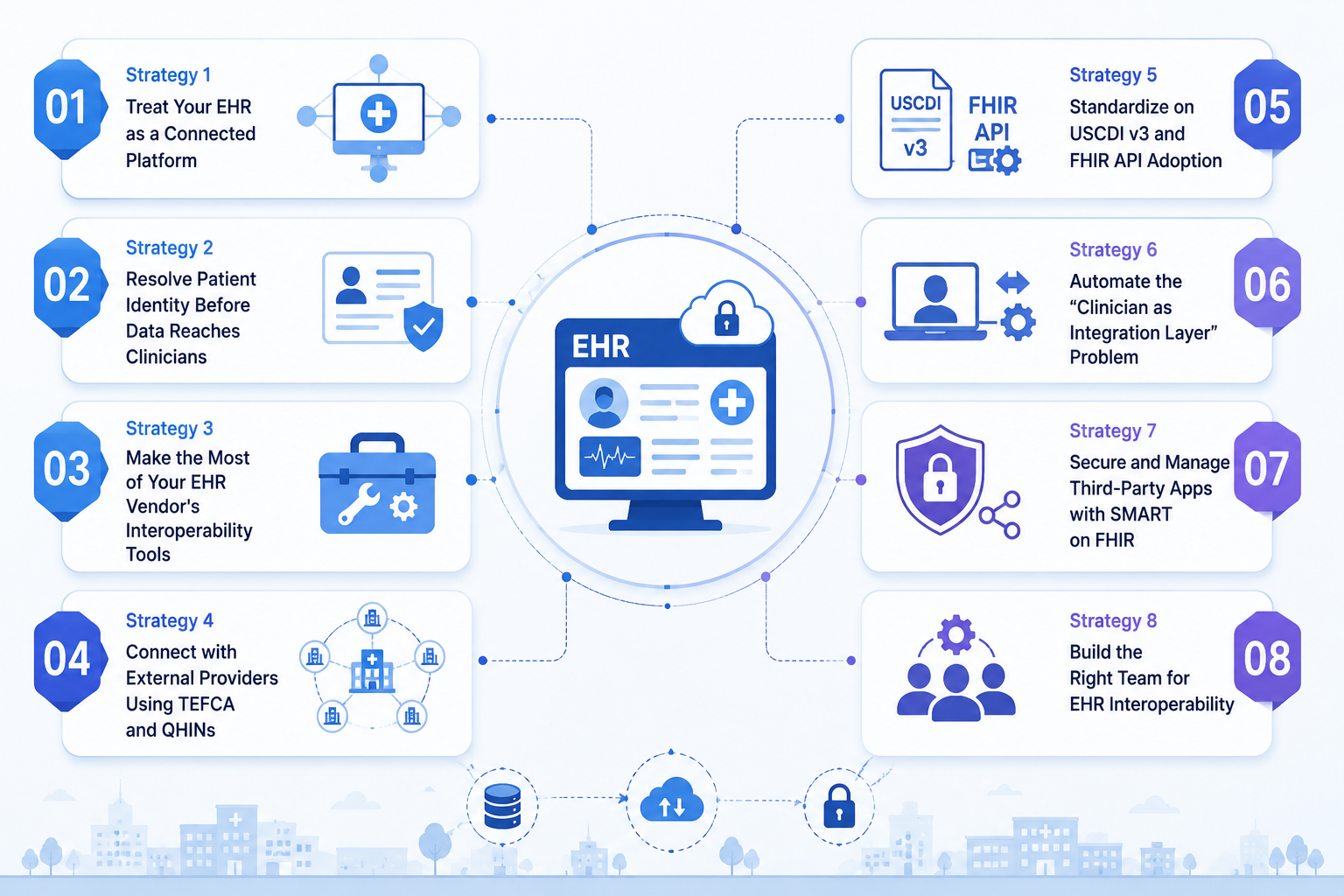
Strategy 1: Treat Your EHR as a Connected Platform
Provider IT teams should treat the EHR as a connected clinical platform. It should not operate as an isolated system of record.
A connected EHR architecture integrates clinical applications, laboratories, imaging systems, pharmacies, payers, and external providers. APIs and interface engines must support consistent, secure data exchange.
Key priorities include:
- Map every interface, API, and external connection.
- Replace fragile point-to-point integrations where possible.
- Standardize data formats across connected applications.
- Monitor interface failures and data delivery delays.
- Establish ownership for integration performance and maintenance.
This platform approach improves scalability and reduces long-term integration complexity. Getting it right typically requires dedicated API development expertise interface engines and point-to-point connections rarely hold up once the number of connected systems grows.
Strategy 2: Resolve Patient Identity Before Data Reaches Clinicians
Patient identity resolution links records belonging to the same person across healthcare systems. Accurate matching gives clinicians a more complete and reliable patient record.
Provider IT teams should address identity errors before integrating external clinical data. Otherwise, duplicate or mismatched records can spread across connected applications and workflows.
Key priorities include:
- Standardize names, addresses, phone numbers, and demographic fields.
- Apply deterministic and probabilistic patient-matching rules.
- Use an enterprise master patient index across connected systems.
- Route uncertain matches to controlled manual review.
- Track duplicate rates, merge accuracy, and unresolved exceptions.
- Audit identity rules whenever new data sources are connected.
USCDI patient demographic elements also support patient matching across interoperable records. These elements should remain consistently formatted across interfaces and applications.
Strong identity resolution prevents clinicians from manually comparing fragmented records. It also improves data quality, care coordination, and downstream interoperability.
Strategy 3: Make the Most of Your EHR Vendor's Interoperability Tools
Provider IT teams should fully evaluate vendor-native interoperability before building custom integrations. These tools often support established workflows, security controls, APIs, and external data exchange.
Key priorities include:
- Review available FHIR, HL7, and proprietary APIs.
- Measure adoption of vendor-supported exchange networks.
- Enable external records within existing clinician workflows.
- Identify licensed capabilities that remain unused.
- Compare vendor-native tools against custom integration costs.
- Track data availability, response times, and workflow adoption.
Epic provides FHIR APIs for connecting applications with its electronic health record. Oracle Health also offers FHIR APIs and interoperability tools for clinical data exchange.
Vendor-native interoperability can reduce maintenance and implementation complexity. However, provider IT teams must still validate data quality, workflow fit, scalability, and governance.
Strategy 4: Connect with External Providers Using TEFCA and QHINs
TEFCA supports nationwide electronic health information exchange through Qualified Health Information Networks. It helps providers exchange records beyond proprietary networks and regional connections.
Provider IT teams can connect directly through a QHIN or its participating organizations, coordinated through ONC.
Key priorities include:
- Assess current health information exchange connections.
- Compare designated QHIN coverage, services, costs, and technical requirements.
- Define treatment, payment, operations, public health, and patient-access use cases.
- Map TEFCA data into existing clinician workflows.
- Validate patient matching and document reconciliation processes.
- Monitor exchange availability, response times, and record usability.
TEFCA participation should complement existing EHR and regional exchange capabilities. It should not create another isolated destination for external records.
Provider IT teams must ensure exchanged information reaches clinicians in usable formats. Strong workflow integration converts nationwide connectivity into measurable clinical value.
Strategy 5: Standardize on USCDI v3 and FHIR API Adoption
USCDI defines standardized health data classes and elements for interoperable exchange. FHIR provides structured resources and APIs for accessing that information across healthcare applications.
Provider IT teams should align data models, interfaces, and APIs with consistent implementation standards.
Key priorities include:
- Map existing clinical data to required USCDI v3 elements.
- Identify missing, incomplete, or inconsistently coded information.
- Standardize FHIR R4 resources across connected applications.
- Follow US Core profiles for United States implementations.
- Validate terminology, search parameters, and API responses.
- Test data completeness across real clinical workflows.
- Monitor API performance, errors, and conformance continuously.
The US Core Implementation Guide defines reusable FHIR profiles and implementation requirements. It helps systems exchange common clinical information consistently. Teams building or testing FHIR endpoints often prototype against an open-source FHIR server such as HAPI FHIR before connecting to production EHR APIs.
Standardization reduces custom mapping and inconsistent integration behaviour. It also improves application onboarding, regulatory readiness, and data usability across provider networks.
Strategy 6: Automate the ‘Clinician as Integration Layer’ Problem
Clinicians often compensate for disconnected systems by searching, comparing, and re-entering patient information. This manual work increases cognitive burden and delays clinical decisions.
Provider IT teams should automate data movement before information reaches the point of care.
Key priorities include:
- Route external records into relevant EHR workflows.
- Automate document classification and clinical data extraction.
- Reduce duplicate data entry across connected applications.
- Apply matching rules before presenting external information.
- Trigger alerts only for clinically relevant changes.
- Track manual reconciliation time and workflow interruptions.
- Review automation accuracy through controlled clinical validation.
Automating document classification and clinical data extraction increasingly relies on applied AI development and generative AI techniques to pull structured data out of scanned records, faxed referrals, and free-text notes work that used to fall entirely on clinicians.
Automation should support clinicians without hiding data quality issues. Provider IT teams must retain audit trails, exception handling, and human review controls.
This approach reduces dependency on clinicians as the connection between systems. It also improves workflow speed, data consistency, and clinical usability.
Strategy 7: Secure and Manage Third-Party Apps with SMART on FHIR
SMART on FHIR enables third-party applications to access EHR data through standardized authorization workflows. It uses OAuth 2.0 patterns to authenticate apps and control FHIR resource access.
Provider IT teams should apply consistent governance before deploying any connected application.
Key priorities include:
- Register and validate every application before production access.
- Grant only the minimum required FHIR scopes.
- Review patient-level, user-level, and system-level permissions.
- Test authorization, token handling, and session controls.
- Monitor API activity, access failures, and unusual usage patterns.
- Define application ownership, support, and retirement procedures.
- Reassess security whenever scopes or workflows change.
SMART applications can launch inside or outside the EHR interface. Provider IT teams should apply the same discipline they use for cloud security to every connected application, since a poorly scoped FHIR app carries the same practical risk as an open cloud bucket.
Testing authorization flows, token handling, and session controls before production access is where dedicated healthcare software testing earns its keep.
Centralized app governance reduces unauthorized access and integration risk. It also supports safer innovation across connected healthcare ecosystems.
Strategy 8: Build the Right Team for EHR Interoperability
EHR interoperability requires coordinated expertise across architecture, clinical workflows, security, data, and compliance. Provider IT teams should assign clear ownership across every delivery stage.
Key roles include:
- Integration architects: Design scalable interface and API architectures.
- FHIR specialists: Implement FHIR R4, US Core, and terminology standards.
- Data engineers: Manage mapping, validation, transformation, and data quality.
- Security teams: Govern access, authentication, consent, and third-party risks.
- Clinical informaticists: Align integrations with real clinical workflows.
- Quality engineers: Test interoperability, performance, reliability, and conformance.
- Program leaders: Manage priorities, budgets, vendors, and measurable outcomes.
Smaller teams can combine responsibilities, but accountability must remain clear. Where the specialist gap is real rather than temporary, an embedded product engineering partner can close it faster than a multi-quarter hiring plan.
The right team reduces integration delays and improves long-term maintainability. It also helps provider IT teams execute interoperability goals without adding unnecessary permanent headcount.
Planning Your EHR Interoperability Budget
EHR interoperability budgets should cover technology, implementation, governance, testing, and ongoing maintenance. Provider IT teams must plan beyond initial interface development costs.
Key budget categories include:
- Platform costs: Interface engines, API gateways, FHIR servers, and monitoring tools.
- Vendor fees: EHR modules, exchange services, licensing, and implementation support.
- Engineering costs: Integration development, data mapping, testing, and modernization.
- Security costs: Identity controls, application reviews, audits, and threat monitoring.
- Operational costs: Interface support, incident management, upgrades, and performance tracking.
- Training costs: Clinical workflow adoption, technical enablement, and governance processes.
Teams should prioritize investments using clinical risk, maintenance burden, and business value. High-cost legacy interfaces should be assessed for replacement or consolidation.
Platform costs interface engines, API gateways, FHIR servers are increasingly cloud infrastructure costs as teams move interoperability workloads off on-premises hardware. A phased budget supports faster delivery and clearer performance measurement, and it helps provider IT leaders connect spending with specific points on the EHR interoperability roadmap.
How to Measure EHR Interoperability Success
Provider IT teams should measure interoperability through technical, clinical, and operational outcomes. Metrics must show whether exchanged data improves care delivery and system performance.
Key success metrics include:
- Data availability: Percentage of required records available within clinician workflows.
- Patient matching: Duplicate record rates and unresolved identity exceptions.
- Interface reliability: Message failures, downtime, and delayed transactions.
- API performance: Response times, error rates, and successful FHIR requests.
- Workflow efficiency: Reduction in manual reconciliation and duplicate data entry.
- Data quality: Completeness, consistency, and coding accuracy across systems.
- User adoption: Clinician usage of external records and integrated applications.
- Operational cost: Maintenance effort, support tickets, and interface expenses.
Teams should establish baseline values before implementation. They should then review performance monthly or quarterly.
These metrics help provider IT leaders identify gaps, justify investments, and refine their interoperability program.
Common EHR Interoperability Mistakes to Avoid
Interoperability programs often fail because teams focus on connectivity without addressing workflow, governance, and data quality.
Common mistakes include:
- Building isolated interfaces: Point-to-point connections increase maintenance and limit scalability.
- Ignoring patient identity: Duplicate records reduce trust in exchanged clinical information.
- Underusing vendor tools: Available EHR capabilities often remain unconfigured or poorly adopted.
- Skipping workflow validation: Technically successful integrations may still disrupt clinical operations.
- Treating compliance as strategy: Regulatory alignment does not guarantee usable data exchange.
- Neglecting third-party governance: Uncontrolled applications can introduce security and privacy risks.
- Tracking only technical uptime: Success also depends on clinical usage and operational outcomes.
- Avoiding long-term ownership: Interfaces require continuous monitoring, upgrades, and performance reviews.
Treating compliance as strategy is its own trap regulatory alignment with rules like the Information Blocking provisions does not guarantee usable data exchange, only the absence of penalties.
Provider IT teams should evaluate interoperability as ongoing infrastructure work. Strong governance, standardized architecture, and measurable outcomes prevent repeated integration failures.
Conclusion
Improving EHR interoperability requires coordinated progress across architecture, identity, standards, security, workflows, and governance.
Provider IT teams should begin with a maturity assessment and measurable goals. They should then modernize integrations, strengthen patient matching, expand FHIR adoption, and improve external exchange.
Vendor-native tools, TEFCA connections, and SMART on FHIR governance can accelerate implementation. However, every capability must support real clinical workflows and measurable operational outcomes.
For provider IT teams weighing how to improve EHR interoperability for provider IT specifically as opposed to interoperability as an abstract mandate the sequence matters more than any single technology choice. A successful interoperability program treats integration as continuous infrastructure work, improving data usability, reducing clinician burden, and supporting scalable digital health delivery.
Conclusion
FAQs
1. How do you improve EHR interoperability?
>
Assess current maturity, standardize data, strengthen identity matching, expand FHIR APIs, and improve governance.
2. What are the top strategies for provider IT teams in 2026?
>
Prioritize connected architecture, patient identity, vendor-native tools, TEFCA, USCDI, automation, security, and skills.
3. How do you assess EHR interoperability maturity?
>
Review data exchange, patient identity, data quality, workflows, security controls, and governance processes.
4. How do vendor-native interoperability networks help?
>
They reduce custom development, support established workflows, and simplify external clinical data exchange.
5. How much does EHR interoperability cost?
>
Costs depend on platform licensing, interface complexity, security, engineering, testing, and ongoing maintenance.
Have a specific concern bothering you?
Try our complimentary 2-week POV engagement


Our Latest Blogs



.svg)
.svg)
.svg)
.svg)
.svg)
.svg)
