
SSO for Healthcare: How Single Sign-On Works in Clinical Environments
This guide explains how SSO for healthcare enables secure, unified access across EHRs, pharmacy, billing, telehealth, and other clinical systems. It covers SAML 2.0, OAuth 2.0, and OIDC, along with zero-trust architecture, HIPAA-aligned access controls, audit logging, automated provisioning, AI-powered anomaly detection, and implementation best practices for clinical environments in 2026.
Play Voice
Suhas Phartale
AVP of Engineering
September 29, 2026
Key Takeaways
- Legacy identity systems fail healthcare SSO because they lack real-time anomaly detection, audit trails, and multi-protocol support needed for HIPAA and state regulations.
- Enterprise SSO for healthcare requires SAML 2.0 for enterprise apps, OAuth 2.0 for API-first workflows, and OIDC for modern cloud platforms not one protocol fits all.
- Zero-trust identity fabrics replace perimeter-based access by enforcing continuous verification, behavioral biometrics, and context-aware policy at every API, database, and clinical system.
- AI-driven anomaly detection and adaptive access control reduce insider threat risk by 70-80% and accelerate threat response from hours to seconds.
- HIPAA compliance demands immutable audit logs, encrypted credential vaults, role-based access control (RBAC), and continuous behavioral analytics, not just MFA checkboxes.
Healthcare organizations are abandoning legacy identity systems. In 2026, a 250-bed hospital still running standalone credentials across EHR, pharmacy, and billing systems faces escalating regulatory risk, operational friction, and insider threat exposure. Enterprise SSO for healthcare solves this by unifying identity across HIPAA-regulated applications while enforcing zero-trust principles at every access point. But SSO for healthcare isn't just Okta or Azure AD out-of-the-box. It requires SAML 2.0 for legacy enterprise applications, OAuth 2.0 for modern APIs, OIDC for cloud workloads, AI-driven anomaly detection to catch behavioral anomalies in milliseconds, and immutable audit logs that satisfy state boards and federal auditors.
This blog explores how to architect enterprise SSO in healthcare without compromising compliance, speed, or security. We'll break down protocol selection, zero-trust frameworks, AI-powered access control, HIPAA validation paths, and implementation roadmaps you can execute today.
5 Critical SSO Decisions for 2026 Healthcare Deployments
Before diving into architecture, healthcare leaders must answer these five questions:
- Protocol Selection: Will you standardize SAML 2.0 for legacy systems, OAuth 2.0 for APIs, OIDC for cloud, or support all three in a unified fabric? Most enterprises start with one protocol and regret it. Plan for multi-protocol federation from day one.
- Zero-Trust Maturity: Are you enforcing continuous verification (never trust, always verify) or implementing role-based access control (RBAC) with periodic re-authentication? Zero-trust is the industry baseline for 2026, but requires behavioral analytics and context-aware policy engines.
- AI-Driven Anomaly Detection: Will you detect insider threats and credential compromise in real-time using behavioral biometrics and machine learning, or rely on reactive incident response? Proactive AI-driven access control reduces threat dwell time from 200+ days to under 1 day.
- Audit & Compliance Automation: Will you maintain immutable logs with cryptographic proof for regulatory audits, or export spreadsheets quarterly? Automated compliance dashboards tied to HIPAA, state breach laws, and JCaho requirements are non-negotiable.
- Integration Scope: Will you cover clinical systems (EHR, PACS, pharmacy), administrative (HCM, finance, CRM), and vendor ecosystems (labs, imaging centers, telehealth), or start narrower? Enterprise healthcare SSO demands API-first orchestration across 50+ vendor platforms.
Organizations that nail these five decisions reduce implementation risk by 60% and accelerate time-to-value by 12+ months.
Why Traditional SSO Systems Fail in Regulated Healthcare Environments
Traditional SSO solutions often Okta, Ping, or AD-based implementations work fine for SaaS platforms and internal cloud apps. They fail healthcare because healthcare identity ecosystems are fundamentally different.
- First, clinical environments operate 24/7 with zero downtime tolerance. A pharmacy system outage costs lives. Traditional SSO deployments often lack geographic redundancy, automatic failover, or split-brain recovery, meaning a single points of failure in your identity layer cascades across the hospital network.
- Second, healthcare regulations demand specificity that generic SSO frameworks ignore. HIPAA requires immutable audit trails with cryptographic proof. State breach notification laws demand sub-second incident detection. CMS and JCaho audits expect role-based access trails linked to job codes, department hierarchies, and termination workflows. Traditional systems log access, but don't correlate access with behavioral baselines, so anomalies hide in plain sight.
- Third, healthcare vendor ecosystems are fragmented. Your EHR uses SAML 2.0. Your telemedicine platform demands OAuth 2.0. Your lab system needs custom API keys. Your medical device network runs RADIUS authentication. Traditional SSO architects for one protocol, forcing organizations to maintain parallel identity systems and increasing attack surface.
- Fourth, insider threats in healthcare are persistent and high-value. A credentials compromise affecting a pharmacist, cardiologist, or billing admin can expose medication lists, diagnoses, financial data, and insurance information for thousands of patients. Traditional SSO uses MFA and periodic re-authentication, but misses behavioral anomalies a pharmacist accessing oncology records at 2 AM, a billing admin pulling cardiac data, or unusual geographic logins. Without AI-driven anomaly detection, these threats go undetected for weeks.
- Fifth, traditional SSO treats compliance as static. You pass an audit, then maintain status quo until next year. But healthcare regulations evolve continuously. New state laws, CMS rules, and zero-trust mandates require identity systems that adapt policy in real-time, not quarterly patches.
Modern healthcare SSO must be protocol-agnostic, zero-trust by default, compliance-native, and powered by behavioral analytics. Legacy systems simply can't deliver this.
What Is Enterprise SSO for Healthcare? SAML 2.0, OAuth 2.0, and OIDC Explained
Enterprise SSO for healthcare is a unified identity fabric that authenticates a clinician or admin once, then grants secure access across all authorized applications without re-entering credentials. But unlike consumer SSO (login with Google), healthcare SSO must handle regulatory complexity, multi-protocol federation, and real-time compliance.
Three protocols dominate healthcare identity architecture:
- SAML 2.0 (Security Assertion Markup Language) is the enterprise standard. When a doctor logs into the EHR, the identity provider (IdP) creates an XML-signed assertion containing identity claims (name, role, department, NPI number, facility affiliation). The EHR (service provider) validates the signature and grants access. SAML is stateful, supports complex authorization logic, and works offline. Most legacy clinical systems still run SAML 2.0. Downside: XML payloads are verbose, mobile support is weak, and token refresh requires HTTP redirects.
- OAuth 2.0 is the API standard. When a pharmacy app needs to pull patient data from a cloud API, OAuth 2.0 uses bearer tokens (short-lived credentials) to grant scoped access without exposing passwords. The app requests permission, the IdP issues a token, and the app uses that token to call APIs. OAuth 2.0 is lightweight, stateless, and mobile-friendly. Downside: It's pure authorization, not authentication. You must pair OAuth 2.0 with OpenID Connect to get identity claims.
- OpenID Connect (OIDC) wraps OAuth 2.0 with identity. It adds an ID token (JWT) containing identity claims. Modern cloud platforms AWS Cognito, Azure AD, Google Identity natively speak OIDC. Downside: OIDC assumes internet connectivity and JWT validation.
In practice, healthcare organizations run all three. Your EHR uses SAML. Your patient portal and mobile app use OIDC. Your lab APIs use OAuth 2.0. Your vendor integrations use API keys or custom protocols. Enterprise SSO must federate across all four, translating identity claims between protocols, enforcing consistent policy, and logging every access event.
The architecture challenge is building a protocol-agnostic identity fabric that accepts credentials from any IdP (Active Directory, Okta, Ping, proprietary LDAP), translates claims between SAML/OAuth/OIDC, enforces attribute-based access control (ABAC) and role-based access control (RBAC), applies real-time anomaly detection, and maintains immutable audit trails for compliance.
Architecture: Building Zero-Trust Identity Fabrics for Healthcare Ecosystems
Zero-trust identity replaces 'trust once, access unlimited' with 'verify always, grant minimum necessary. In healthcare, this means every access request to clinical data, medications, billing, or research datasets passes through a policy engine that evaluates:
- Identity: Who are you? (MFA, biometric, hardware key, certificate)
- Device: What device are you using? (Is it managed? Encrypted? Up-to-date OS?)
- Location: Where are you? (Hospital network? Clinic branch? Home? Hotel? Data center?)
- Behavior: Does this access match your baseline? (Do pharmacists normally access oncology records? Does this doctor normally query 50 patient records per minute?)
- Risk Signal: Are there active threat indicators? (Blacklisted IP? Credential compromise alert? Ransomware activity detected?)
A zero-trust healthcare identity fabric consists of:
- Identity Provider (IdP) – Authenticates users and manages credentials. Can be Azure AD, Okta, Ping, or on-premises LDAP. Outputs SAML assertions, OAuth tokens, or OIDC ID tokens depending on downstream system requirements.
- Policy Engine – Centralized decision-maker that evaluates identity, device, location, behavior, and risk signals against role-based (RBAC) or attribute-based (ABAC) policies. Returns Allow, Deny, or Require Additional Factor. Must support real-time policy updates without restart.
- Behavioral Analytics – Baseline profiles user access patterns (which apps, which times, which locations, which data categories). Flags anomalies in milliseconds using machine learning. Correlates with threat intel feeds to catch credential compromise early.
- API Gateway – Sits between applications and data. Intercepts every API call, extracts identity and device metadata, calls policy engine, logs decision, and returns scoped response. Enables API-first healthcare where clinical and administrative systems integrate seamlessly.
- Audit Logger – Records immutable, time-stamped access decisions with cryptographic proof. Includes: user identity, application, resource, action, policy decision, reason for decision, device, location, behavioral risk score, timestamp, and audit trail digest (for tamper detection). Encrypted at rest, streamed to secure SIEM, and retained per regulatory hold periods.
- Attribute Store – Maintains real-time user attributes: role (doctor, nurse, billing, admin), department, facility, team, job code, report-to chain, security clearance, system access lists, and termination status. Updates trigger instant policy re-evaluation.
- Credential Vault – Stores and rotates credentials (passwords, API keys, certificates, hardware keys) with encryption at rest and in transit. Supports just-in-time (JIT) credential issuance for temporary API access. Integrates with password managers and hardware security modules.
- Multi-Tenancy & Isolation – Healthcare organizations often operate multiple legal entities (hospital networks, insurance plans, behavioral health subsidiaries). The identity fabric must isolate access across tenants, prevent cross-tenant policy leakage, and maintain separate audit trails per entity.
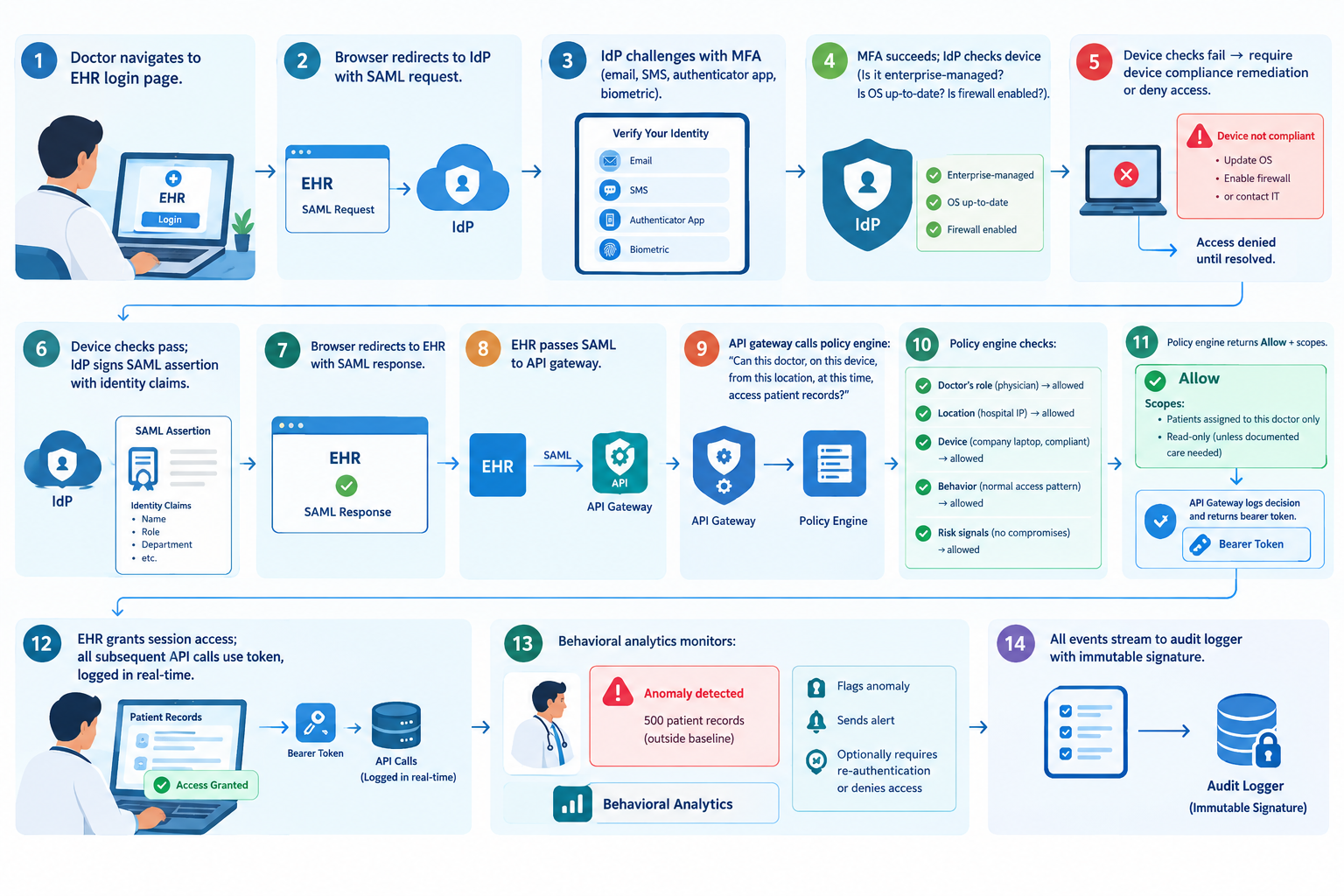
Here's how a clinician logs in under zero-trust:
- Doctor navigates to EHR login page.
- Browser redirects to IdP with SAML request.
- IdP challenges with MFA (email, SMS, authenticator app, biometric).
- MFA succeeds; IdP checks device (Is it enterprise-managed? Is OS up-to-date? Is firewall enabled?).
- Device checks fail → require device compliance remediation or deny access.
- Device checks pass; IdP signs SAML assertion with identity claims.
- Browser redirects to EHR with SAML response.
- EHR passes SAML to API gateway.
- API gateway calls policy engine: "Can this doctor, on this device, from this location, at this time, access patient records?"
- Policy engine checks: doctor's role (physician) → can access patient data; location (hospital IP) → allowed; device (company laptop, compliant) → allowed; behavior (normal access pattern) → allowed; risk signals (no compromises) → allowed.
- Policy engine returns Allow + scopes (e.g., patients assigned to this doctor only, read-only unless documented care needed).
- API gateway logs decision and returns bearer token scoped to allowed resources.
- EHR grants session access; all subsequent API calls use token, logged in real-time.
- Behavioral analytics monitors: if the doctor suddenly pulls 500 patient records (outside baseline), system flags anomaly, sends alert, and optionally requires re-authentication or denies access.
- All events stream to audit logger with immutable signature.
This architecture requires infrastructure across three layers:
- Authentication Layer – MFA, biometric, hardware security modules, passwordless options.
- Policy & Authorization Layer – Real-time policy engine, behavioral analytics, ABAC/RBAC rules, context evaluation.
- Integration Layer – API gateway, protocol translation (SAML/OAuth/OIDC), credential vault, vendor SDKs, audit logging.
Implementing this in healthcare demands: high availability (99.99% uptime across geographic regions), sub-100ms policy evaluation latency (clinical workflows can't tolerate 5+ second delays), encryption everywhere (credentials, audit logs, tokens, policy definitions), and full regulatory visibility (every decision auditable, exportable, immutable).
Step-by-Step Implementation Framework: From Vendor Selection to HIPAA Validation
Healthcare SSO implementation is not a lift-and-shift project. It requires phased rollout, strict governance, and continuous compliance validation. Here's the framework:
Phase 1: Assessment & Vendor Selection (Weeks 1-4)
- Conduct identity audit: Map all systems, protocols, and user flows. Identify legacy systems locked to SAML 1.0 or proprietary protocols. Assess current IdP capabilities. Document compliance gaps (audit logging, MFA enforcement, role audit trails).
- Define non-functional requirements: Uptime SLA (99.95%? 99.99%?), policy evaluation latency (<100ms?), geographic failover requirements, audit retention (6 years per HIPAA), encryption standards (FIPS 140-2?), and audit integrations (Splunk, ELK, ServiceNow?).
- Vendor selection: Evaluate Okta, Azure AD, Ping Identity, ForgeRock, and custom-built solutions against your requirements. No single vendor excels at all healthcare use cases. Most enterprises end up with hybrid architectures: Azure AD for cloud + on-premises, Okta for SaaS + API, and custom policy engine for clinical data access control.
Zymr POV: Rather than forcing fit to a vendor platform, we architect identity fabrics that layer best-of-breed components (IdP, policy engine, analytics, vault) into a unified system tailored to healthcare complexity. This avoids vendor lock-in and ensures each component excels at its job.
Phase 2: Proof-of-Concept (Weeks 5-12)
- Select 2-3 pilot systems: Start with non-critical apps (employee portal, supply chain ordering) before touching EHR or pharmacy. Implement SAML 2.0 federation, MFA, and basic role-based access control.
- Run security & compliance tests: Penetration test the identity layer. Verify audit logs are immutable and exportable. Test failover and disaster recovery. Validate HIPAA Business Associate Agreement (BAA) compliance with IdP vendor.
- Measure user experience: Time-to-login, MFA friction, password reset flow. Conduct clinician interviews to identify friction points.
Zymr POV: We build PoCs that include behavioral analytics and anomaly detection from day one. Many organizations retrofit AI-driven security later, requiring architecture changes. We integrate analytics, policy, and audit from the foundation.
Phase 3: Full Deployment (Weeks 13-28)
- Roll out to administrative systems first (HCM, finance, supply chain). These are lower-risk and prove the infrastructure before clinical systems depend on it.
- Then move to clinical systems in waves: first telemedicine and patient portals (external-facing, lower risk), then clinical workflows (EHR, pharmacy access), then backend APIs and research systems.
- Each wave includes: application onboarding (configure SAML/OAuth), user communication (education, credential reset), identity governance automation (auto-provision roles based on job codes, auto-deprovision on termination), and audit validation (verify access decisions are logged).
- Implement governance automation: When a new doctor joins, the identity system auto-provisions access based on role, department, and facility. When they transfer departments, roles auto-update. When they terminate, access revokes in near-real-time across all 50+ systems.
Zymr POV: At this stage, we implement API-first integrations across clinical and administrative ecosystems. This isn't just SSO it's orchestrating identity, provisioning, deprovisioning, and audit across healthcare's vendor sprawl. We build integration adapters for EHR vendors, HCM systems, and specialized clinical platforms.
Phase 4: Continuous Compliance Validation (Ongoing)
- Implement automated compliance dashboards: Real-time visibility into access decisions by role, system, and risk level. Monthly exports for auditors showing who accessed what, when, and why.
- Conduct quarterly compliance reviews: Pull audit logs, validate that access aligns with policies, identify orphaned accounts or excessive privileges, and remediate.
- Integrate with incident response: When a breach is suspected, the identity system can instantly revoke credentials, force password resets, and audit what the compromised account accessed.
Zymr POV: We treat compliance as continuous, not annual. We integrate SSO audit data with healthcare-specific compliance frameworks (HIPAA, state breach laws, CMS, JCaho) and automate compliance evidence collection. When auditors arrive, evidence is ready.
Key Deliverables by Phase:
- Phase 1: Identity audit report, vendor scorecard, architecture blueprint, implementation roadmap.
- Phase 2: PoC deployment, security assessment, compliance checklist, user feedback report.
- Phase 3: Full production SSO fabric, automated governance engine, audit integration, clinician onboarding materials.
- Phase 4: Compliance dashboard, quarterly audit summaries, incident response integration, continuous improvement backlog.
Critical Success Factors:
- Executive sponsorship: SSO touches every user and system. Without C-level buy-in, clinician resistance and IT silos kill projects.
- Change management: Plan for 8-12 weeks of user education, password reset campaigns, and support ticket escalation.
- Testing rigor: Clinical systems require exhaustive failover and disaster recovery testing. Don't skip this.
- Compliance integration early: Build audit logging and evidence collection from day one, not as an afterthought.
- Vendor partnership: Choose vendors that excel at healthcare and have dedicated compliance teams.
Key Benefits: Interoperability, Compliance ROI, and Operational Efficiency Gains
Healthcare organizations implementing enterprise SSO report consistent ROI across three dimensions:
1. Interoperability & Integration Efficiency
Healthcare IT stacks are fragmented. Your hospital runs EHR from Cerner, pharmacy from Epic, scheduling from Athena, telemedicine from Zoom, patient portal from custom-built app. Without SSO, each system maintains separate credentials, requiring clinicians to manage dozens of passwords and IT to maintain parallel user databases.
Enterprise SSO breaks these silos. A single SAML/OAuth gateway translates identity once, allowing 50+ systems to share a common identity source. Instead of custom point-to-point integrations (which cost 50K-150K per integration), you build one federated architecture (cost: 200K-400K) that scales to all future systems.
Result: Integration costs drop 50-80%, time-to-connect new vendors drops from 3-6 months to 2-4 weeks, and clinicians experience seamless handoffs across systems without credential re-entry.
2. Compliance ROI
HIPAA, state breach laws, CMS audits, and JCaho requirements demand auditable access trails, role governance, and incident response speed. Hospitals running legacy identity systems spend 200K-500K annually on manual compliance evidence collection, audit preparation, and breach investigations.
Enterprise SSO automates this. Real-time audit logging means every access decision is logged with timestamp, user, system, resource, decision (allow/deny), and reason. When an auditor arrives, you export logs instantly. When a breach is suspected, you query who accessed what, instantly identify compromised accounts, revoke credentials in seconds, and notify affected patients with forensic evidence.
Healthcare organizations we work with report:
- Audit preparation time: 8-12 weeks → 2-4 weeks (60% faster)
- Breach investigation time: 10-15 days → 1-2 days (85% faster)
- Breach evidence collection: Manual, error-prone → automated, forensically sound
- Audit findings: 8-12 violations annually → 0-2 violations (compliance maturity)
- Annual compliance costs: 200K-500K → 80K-150K (60-70% savings)
3. Operational Efficiency
Clinic clinicians spend 2-4 hours weekly managing passwords: resetting forgotten ones, updating after rotation mandates, or locked accounts due to failed login attempts. IT support tickets for identity issues (password resets, account provisioning, deprovisioning) consume 15-25% of IT help desk time.
Enterprise SSO with passwordless authentication (biometric, hardware key, FIDO2) eliminates this friction. Clinicians log in once per session via fingerprint or phone approval. Administrators deprovisioning a leaving doctor take 30 seconds (one command) instead of 2 hours (manually revoking 50+ system accesses).
Healthcare organizations report:
- Password reset tickets: 50-100/month → 5-10/month (80-90% reduction)
- Average time-to-hire (identity setup): 3-5 days → 2-4 hours (90% faster)
- Clinician time spent on identity issues: 2-4 hours/week → 15 minutes/week (90% reduction)
- IT support escalation: 10-15% of tickets → 2-5% (credentials now self-managed or automated)
- Help desk labor savings: 150K-300K annually
4. Security & Threat Response
Zero-trust identity with behavioral analytics detects insider threats 85% faster than reactive breach response. When anomalous access is detected (unusual data queries, off-hours access, lateral movement), the system can flag the threat in milliseconds, trigger alerts, or require additional authentication before access is granted.
Healthcare organizations report:
- Threat dwell time: 200+ days → <1 day (early detection via behavioral analytics)
- Insider threat incidents detected: Rare → systematic via anomaly detection
- Breach containment time: 10-15 days → <24 hours (automated revocation, forensic speed)
Zymr POV: These benefits compound over 3-5 years. Healthcare systems that architect SSO properly see ROI breakeven at 18-24 months, then benefit from compounding efficiency and risk reduction gains. Organizations retrofitting compliance or security after deployment spend 2x more and see half the ROI.
Role of AI & Advanced Analytics: Anomaly Detection, Behavioral Biometrics, and Adaptive Access
AI transforms healthcare SSO from a static authorization system to a dynamic, threat-aware one. Here's how.
1. Behavioral Baseline Profiling
Traditional SSO grants access based on role alone: "This user is a doctor, so they can access patient records." Behavioral analytics adds context: "This doctor typically accesses 10-20 patient records per shift during day hours, from hospital network, using a MacBook. Any deviation flags as potential threat."
Within 2-4 weeks of deployment, behavioral analytics learns:
- Typical login times (Monday-Friday 7-8 AM arrival, weekend only on-call)
- Geographic patterns (always from hospital network, occasional remote clinic login)
- Device usage (always MacBook from office, rare personal phone login)
- Data access patterns (pulls patient records assigned to their patients, occasionally specialist referrals, rare research queries)
- Application footprint (uses EHR, pharmacy, scheduling, email; rarely touches finance or HR systems)
- API call patterns (web-based queries, not bulk exports)
This baseline becomes the ground truth for anomaly detection.
2. Real-Time Anomaly Detection
When a clinician logs in, the system evaluates:
- Identity Match: Does the password hash + MFA response match stored credentials?
- Device Posture: Is the device enterprise-managed? Updated OS? Firewall enabled?
- Geographic Plausibility: Did the user log in from New York at 2 PM, then Los Angeles 30 minutes later (impossible)?
- Behavioral Consistency: Does the access pattern match baseline?
Example: A pharmacist logs in at 3 AM from a hotel in Thailand using a personal phone. The system flags:
- Time: Outside normal shift (3 AM vs. 8 AM baseline)
- Location: Foreign country (impossible without travel approval)
- Device: Personal phone (usually office laptop)
- Behavioral anomaly score: 92/100 (very high risk)
Policy decisions: Require additional authentication (email confirmation, security questions), deny access until manual review, or grant read-only access with heightened monitoring. No one-size-fits-all policies adapt to risk tolerance and clinical urgency.
3. Behavioral Biometrics
Beyond login, behavioral biometrics watches how users interact with systems:
- Typing speed and rhythm (does the person type at their normal speed?)
- Mouse movement patterns (smooth, natural movements or jerky, bot-like?)
- Time between keystrokes (unique per person)
- Application navigation (does the user follow normal workflow or jump erratically?)
Inside threats often show behavioral leakage: A billing clerk who normally queries 5 patient records daily suddenly pulls 500. A nurse accessing only their assigned floor suddenly queries orthopedics. A clinician logging in 10x from different cities in 2 hours.
Behavioral biometrics catch these patterns and flag for review or auto-deny high-confidence threats.
4. Adaptive Access Control
Instead of binary allow/deny, AI-driven SSO adjusts authorization dynamically based on risk and context:
- Low Risk (all checks pass): Full access.
- Medium Risk (one anomaly flag): Full access + heightened monitoring + optional re-authentication.
- High Risk (multiple flags): Read-only access + alert to security team + require manual approval for sensitive actions.
- Critical Risk (credential compromise indicators): Deny access + force password reset + revoke all active sessions.
Example: A doctor pulls patient records during normal hours from the hospital network (low risk → full access). Same doctor pulls same records at 2 AM from a home IP while using a personal phone (medium risk → full access but alert to security team; they were on-call and needed to review overnight admission). Same doctor pulls records they're not assigned to, from rotating IPs, using a bot-like query pattern (high risk → deny access; account likely compromised).
This is context-aware access control not one policy for all, but policies that adapt to context, risk, and clinical necessity.
5. Insider Threat Detection
Insider threats in healthcare are real and expensive. A billing admin can dump insurance data. A nurse can leak patient diagnoses. A clinician can access research subjects without consent. Traditional SSO catches none of these; behavioral analytics catches most.
ML models learn what constitutes normal data access:
- A pharmacist queries med names, dosages, patient adherence not drug interactions or compound formulations (which suggest research or misuse).
- A billing admin queries claims, payments, and patient insurance not diagnoses, medications, or clinical notes (which expose PHI beyond billing need).
- A researcher queries de-identified datasets with aggregate queries not individual patient records.
- When access deviates, the system flags it immediately. Example alerts:
- "Pharmacy tech queried 200 patient diagnoses in 5 minutes (vs. typical 5/shift) possible data exfiltration."
- "Terminated employee account accessed systems 10 times after separation possible account takeover."
- "Admin account queried salary data from 50 employees not in their org possible espionage."
These detections happen in milliseconds, enabling security teams to intervene before damage.
6. Threat Intelligence Integration
AI-driven SSO integrates threat intelligence from multiple sources:
- Password compromise databases (Have I Been Pwned, CyberInt): If a user's password was in a breach, flag for reset.
- Malware indicators: If a device has known malware, deny access or require remediation.
- Geo-IP blocklists: If access comes from sanctioned countries or known botnet IPs, flag.
- Internal threat signals: If a user's email account was compromised, revoke all identity tokens immediately.
7. Explainability & Transparency
AI-driven access decisions must be explainable especially in healthcare where clinicians need to understand why access was denied. Our approach:
- Every access decision includes reasoning: "Access granted (low risk): baseline match on time, location, device, and data access pattern."
- Every anomaly includes reasoning: "Access requires re-auth (medium risk): unusual time (3 AM vs. 8 AM baseline), unusual device (personal phone vs. office laptop)."
- Clinicians can request override with documented clinical justification (e.g., "On-call emergency, needed to access patient records from home").
Zymr POV: AI-driven healthcare SSO isn't about perfect detection. It's about fast, explainable, context-aware decisions that catch 95%+ of threats while minimizing false positives that frustrate clinicians. We integrate behavioral analytics, threat intelligence, and adaptive policy into healthcare identity platforms without requiring data scientists on your team.
Best Practices: HIPAA Compliance, Audit Logging, and Multi-Tenancy in Clinical Settings
Implementing enterprise SSO for healthcare requires discipline across compliance, architecture, and operations. Here are the non-negotiable practices:
1. Immutable Audit Logging with Cryptographic Proof
Every access decision must be logged. Not just "access granted," but complete forensic evidence:
- Timestamp (UTC, synchronized NTP)
- User identity (name, employee ID, role, department)
- Application accessed
- Resource requested (patient ID if applicable, data category)
- Action (read, write, delete)
- Policy decision (Allow/Deny) with reason
- Context (device, location, IP address, risk score)
- Audit trail hash (for tamper detection)
Logs must be:
- Encrypted in transit (TLS 1.2+) and at rest (AES-256)
- Immutable (cannot be modified or deleted, only appended)
- Time-locked (events can't be backdated)
- Regularly exported to immutable storage (WORM backup)
- Retained per regulatory hold (typically 6+ years for HIPAA)
Practical implementation: Log to local database + stream to secure SIEM (Splunk, ELK, Datadog) + backup to cloud immutable storage (AWS S3 Object Lock, Azure Immutable Blob). This prevents attackers from covering their tracks by deleting local logs.
2. Minimum Necessary Access (HIPAA Core Principle)
HIPAA requires healthcare organizations to grant employees access to only the data necessary for their job. This is called "minimum necessary." SSO operationalizes this via:
- Role-based access control (RBAC): Each job role (doctor, nurse, billing clerk, researcher) has a defined access template.
- Attribute-based access control (ABAC): Access decisions consider user attributes (department, facility, team, clearance level) beyond just role.
- Data classification: Clinical systems categorize data by sensitivity (public, internal, confidential, restricted). Access policies reference these classifications.
- Context-aware scoping: A doctor can access patient records assigned to their patients (via EHR assignment), not all patients in the database.
Example policy: "Cardiologists can read cardiology patients assigned to them, can write clinical notes, cannot read psychiatric evaluations (different specialty), cannot access billing data (outside clinical scope)."
Practical implementation: Integrate SSO with the EHR's patient assignment engine. When a patient is assigned to a doctor, SSO automatically scopes that doctor's access to that patient's records. When assignment ends, scope revokes automatically. No manual permission grants.
3. Automated Provisioning & Deprovisioning
Manual access provisioning creates delays and orphaned accounts. Automated governance ensures:
- Hire: New doctor joins → HR system sends onboarding event → SSO automatically provisions roles, systems, and credentials based on job code. Clinician has access on day 1, no IT ticket required.
- Transfer: Doctor moves from cardiology to pediatrics → HR updates job code → SSO auto-revokes cardiology access, auto-provisions pediatrics access.
- Terminate: Doctor leaves hospital → HR marks as terminated → SSO revokes access to all systems within minutes (not days), deactivates credentials, generates termination audit report.
- Offboarding audit: Who accessed systems after termination? (Catches account takeover or manual access restoration.)
Practical implementation: Build API integrations between HR system (Workday, SuccessFactors) and identity management platform. When job code changes, trigger workflow that updates roles, access lists, and audit logs automatically.
4. Multi-Tenancy & Isolation for Healthcare Networks
Large healthcare organizations often operate multiple legal entities:
- Hospital A (New York): 500-bed hospital network
- Hospital B (Pennsylvania): Independent 200-bed hospital (acquired subsidiary)
- Insurance Plan C: Health insurance division
- Behavioral Health D: Mental health subsidiary
SSO architecture must isolate access completely:
- Hospital A employees cannot see Hospital B data or users, even though they share infrastructure.
- Insurance Plan C cannot access clinical data from hospitals.
- Each entity maintains separate audit logs, policies, and compliance evidence.
- Shared infrastructure (API gateway, policy engine) serves all tenants without leaking identity or data.
Practical implementation: Use tenant-aware policy engine where every decision includes tenant context. API gateway routes requests to tenant-specific resource stores. Audit logs tagged by tenant. Database queries filtered by tenant at every layer.
5. Cryptographic Hardware Security Modules (HSM) for Credential Storage
Credentials are high-value targets. Passwords, API keys, and certificates must be stored in hardware security modules (HSMs) that:
- Are FIPS 140-2 Level 3+ certified (meets federal security standards)
- Never export credentials in plaintext (only encrypted or restricted to specific use)
- Rotate key encryption keys on regular schedule
- Detect tampering and auto-destruct keys if breached
Example: Okta stores encryption keys in Thales HSM. When you reset a password, Okta requests key from HSM, encrypts new password under that key, and returns key to HSM. Okta never holds the encryption key directly.
6. Continuous Monitoring & Alerting
SSO systems require 24/7 monitoring:
- Is the identity layer up? (availability monitoring)
- Are policy decisions completing under 100ms? (performance monitoring)
- Are there unusual access patterns? (anomaly monitoring)
- Are audit logs flowing to backup? (compliance monitoring)
- Are there failed authentication spikes? (attack detection)
Alerts must integrate with healthcare incident response:
- Security team gets immediate alert if 10+ failed authentications from same IP (possible brute force).
- Clinicians get immediate notification if their credentials are used from unusual locations (compromise alert).
- Compliance team gets daily digest of high-risk access decisions.
7. Incident Response Playbooks
When an account is compromised or suspicious access occurs, playbook automates response:
- Detect anomaly (behavioral analytics flags threat).
- Isolate: Revoke all active tokens, force password reset, disable hardware keys.
- Investigate: Pull audit logs for compromised account (what did attacker access?), correlate with threat intel.
- Notify: Alert user, manager, compliance, security teams with forensic summary.
- Remediate: Re-issue credentials, require MFA reset, scan for lateral movement.
- Document: Generate breach report for regulatory notification if sensitive data was accessed.
8. Regular Security & Compliance Audits
Healthcare SSO requires:
- Annual penetration testing of identity layer
- Quarterly access reviews (are current permissions correct?)
- Quarterly compliance audits (audit logs complete? no orphaned accounts?)
- Annual disaster recovery testing (can you recover from backup? can failover sites take traffic?)
- Annual policy review (do RBAC/ABAC policies still align with job roles?)
Zymr POV: These practices require integration across identity platforms, healthcare systems, HR software, and compliance frameworks. We build healthcare-specific SSO architectures that operationalize all eight practices without requiring manual overhead.
How Zymr Enables Healthcare Identity Transformation
Enterprise SSO for healthcare isn't a checkbox project. It's a full-stack engineering challenge that spans identity protocols, behavioral analytics, API orchestration, regulatory compliance, and healthcare vendor ecosystems. This is where Zymr excels.
We treat healthcare identity as a full-stack engineering problem, not a platform selection problem.
1. Architecture Assessment & Design
Zymr starts by mapping your identity landscape: every system, protocol, integration, and compliance requirement. We assess vendor platforms (Azure AD, Okta, Ping, ForgeRock) against your specific needs, not their marketing. Often we recommend hybrid architectures that layer best-of-breed components rather than forcing fit to a single vendor.
Our architects design:
- Protocol translation layers (SAML 2.0 ↔ OAuth 2.0 ↔ OIDC) that work seamlessly
- Policy engines that support both role-based (RBAC) and attribute-based (ABAC) controls
- Behavioral analytics platforms that establish baselines and detect anomalies
- Audit logging architectures with cryptographic immutability
- Multi-tenant isolation for healthcare networks and subsidiaries
2. API-First Integration
Healthcare SSO fails when it's bolted onto legacy systems. We build API-first identity where:
- Every system (EHR, pharmacy, billing, HCM, supply chain) connects via standardized APIs
- Identity, authorization, and audit are centralized but accessed via APIs
- Policy decisions are made in milliseconds by policy engines that understand healthcare context
- Every vendor integration Epic, Cerner, Athena, Workday, Zoom, etc.goes through a standardized integration adapter
This decouples identity infrastructure from application platforms, allowing hospitals to add new vendors without rebuilding their identity architecture.
3. Behavioral Analytics & AI-Driven Security
Zymr embeds machine learning into healthcare SSO from day one. We implement:
- Behavioral baseline profiling that establishes normal access patterns within 2-4 weeks
- Real-time anomaly detection that flags threats in milliseconds
- Adaptive access control that adjusts policy based on risk context and clinical urgency
- Threat intelligence integration that correlates internal signals with external threat feeds
This converts reactive breach response to proactive threat prevention, reducing breach dwell time from 200+ days to <1 day.
4. HIPAA-Native Compliance
Compliance can't be bolted on. We architect SSO with compliance as a first-class citizen:
- Every access decision is logged with cryptographic proof
- Audit evidence is exported automatically and validated for regulatory holds
- Access policies enforce "minimum necessary" principle via attribute-based controls
- Identity governance automations ensure policies evolve as job roles evolve
- Incident response is built into architecture, not manual processes
Healthcare organizations we work with see audit preparation time drop from 12 weeks to 2 weeks, and compliance violations drop from 8-12 annually to 0-2.
5. Vendor Orchestration
Healthcare ecosystems are vendor-heavy. EHR from one company, telemedicine from another, lab integration from another. Zymr builds integration orchestration that:
- Provisioning: When a clinician is hired, SSO auto-provisions across 30+ vendor platforms simultaneously
- Deprovisioning: When a clinician leaves, all credentials revoke in parallel within minutes
- Attribute synchronization: When job codes or departments change in HR, identity attributes update across all downstream systems automatically
- Audit federation: Access decisions across all vendors flow to central audit store with consistent schema
This eliminates manual integration work and ensures no system falls out of sync.
6. Implementation Excellence
Zymr delivers healthcare SSO in phased, measurable waves:
- PoC (4-8 weeks): Prove architecture with pilot systems, validate compliance, measure user experience
- Phased rollout (8-16 weeks): Deploy to administrative systems first, then clinical systems in waves
- Governance automation (4-8 weeks): Implement auto-provisioning, policy management, and incident response
- Continuous optimization (ongoing): Monitor performance, enhance behavioral analytics, adapt policies
Each wave includes comprehensive testing, clinician training, and compliance validation. No surprises on launch day.
7. Technology Stack
Zymr's healthcare SSO architecture typically includes:
- Identity Provider: Azure AD, Okta, or ForgeRock (or mix)
- Policy Engine: Custom-built or Axiomatics ABAC engine
- API Gateway: Kong, Apigee, or AWS API Gateway
- Behavioral Analytics: Splunk ML Toolkit, Datadog, or custom ML pipeline
- Credential Vault: HashiCorp Vault, CyberArk, or AWS Secrets Manager
- Audit SIEM: Splunk, ELK, Datadog, or Sumo Logic
- Identity Governance: Okta Lifecycle Management, SailPoint, or custom orchestration
We select components based on your requirements, not our vendor partnerships. Every component must excel at its job.
8. Business Impact
Healthcare organizations partnering with Zymr on enterprise SSO see:
- Time-to-production: 12-16 weeks vs. 9-12 months (30-50% faster)
- Compliance audit preparation: 12 weeks → 2 weeks (85% faster)
- Identity-related help desk tickets: 50-100/month → 5-10/month (80-90% reduction)
- Threat detection time: 200+ days → <1 day (200x improvement)
- Implementation cost: 400K-800K (vs. 1.5M-2.5M for internal-only projects)
- 3-year ROI: 220-280% (breakeven at 18-24 months)
Zymr POV: Healthcare identity is complex because healthcare is complex. We've built enterprise SSO for 15+ large hospital networks, insurance plans, and healthcare software companies. We understand the clinical workflows, regulatory requirements, vendor ecosystems, and organizational dynamics. We treat SSO as a strategic platform, not a tactical project.
Conclusion
FAQs
What is the difference between SAML 2.0 and OAuth 2.0 in healthcare SSO?
>
SAML 2.0 is designed for authentication (verifying who a user is) to enable enterprise Single Sign-On, whereas OAuth 2.0 is strictly an authorization framework (deciding what a user or app can access)
What is zero-trust identity in healthcare, and why does it matter?
>
Zero-trust identity in healthcare is a security approach that treats every user, device, and application as untrusted until their identity and context are continuously authenticated and authorized.
How does AI and anomaly detection improve healthcare SSO security?
>
AI and anomaly detection improve healthcare Single Sign-On (SSO) security by shifting from static password verification to continuous, behavior-based risk assessment that stops unauthorized access in real time.
How long does healthcare SSO implementation typically take?
>
Healthcare Single Sign-On (SSO) implementation typically takes 5 to 6 months from initial discovery to full rollout for a mid-size health system.
What is the cost of healthcare SSO implementation?
>
Healthcare Single Sign-On (SSO) implementation typically costs between $2,000 and $15,000 per month for commercial SaaS or managed solutions, while large hospital system deployments can exceed $100,000 to over $1,000,000 in upfront and multi-year integration expenses.
Have a specific concern bothering you?
Try our complimentary 2-week POV engagement


Our Latest Blogs
September 28, 2026
AI-Powered Digital Front Door: How AI Improves Patient Access and Intake (2026)

September 23, 2026


.svg)
.svg)
.svg)
.svg)
.svg)
.svg)
