
AI-Powered Digital Front Door: How AI Improves Patient Access and Intake (2026)
This guide explains how an AI-powered digital front door improves patient access and intake through AI-powered provider matching, conversational scheduling, adaptive forms, insurance verification, document capture, symptom triage, and EHR integration. It covers the architecture, healthcare interoperability, HIPAA, AI governance, human oversight, and emerging agentic AI capabilities shaping connected patient access and intake workflows in 2026.
Play Voice
Sitanshu Joshi
Associate Director of Engineering
September 28, 2026
Key Takeaways
- AI makes the digital front door active, matching patients, verifying coverage, and completing intake on their behalf.
- Mature LLMs, proven ROI, and clearer regulation have made 2026 the real inflection point for AI in patient access.
- Patient access improves through provider matching, conversational scheduling, predictive optimization, and real-time coverage discovery.
- Patient intake improves through adaptive forms, document capture, health history extraction, and symptom triage with human oversight.
- The impact is measurable: lower call volume, fewer no-shows, faster intake, and fewer eligibility denials.
- Success depends on integration and governance, AI without EHR connectivity and built-in compliance tends to stall after the pilot.
- Retrofitting compliance after launch costs three to five times more than designing for it upfront.
- The next phase is agentic, predictive AI that acts on its own and reaches patients before a gap turns urgent.
The digital front door is moving beyond portals, online forms, and basic appointment booking. In 2026, AI is making patient access more responsive by helping patients find the right provider, schedule care, verify coverage, complete intake, and prepare for visits through connected digital workflows.
The shift comes as healthcare organizations move AI from experimentation into real operations. McKinsey's 2026 healthcare AI research found that 50 percent of surveyed US healthcare leaders said their organizations had implemented generative AI, up from 25 percent in 2023.
This changes how AI digital front doors improve patient access. Instead of asking patients to navigate disconnected systems, an AI powered digital front door can understand intent, automate routine steps, personalize interactions, and route complex needs to staff. For healthcare organizations, building these experiences also requires connected healthcare software engineering across patient applications, data, APIs, AI models, and existing clinical systems.
The result is a digital front door that does more than provide access. It actively helps patients move through it.
What Is an AI-Powered Digital Front Door?
An AI-powered digital front door is the layer of intelligence sitting on top of a health system's existing access tools, scheduling, intake forms, portals, and contact centers, that lets those tools understand context, make decisions, and act on a patient's behalf instead of just displaying information. It is not a single product. It is a capability that gets woven through the entire access and intake journey.
How AI fits into the digital front door
Think of the traditional digital front door as a set of doors and hallways: a scheduling widget here, a form there, a portal somewhere else. AI does not add another door. It adds a guide who walks the patient through all of them, answering questions along the way, filling in what it already knows, and flagging anything that needs a human. Under the hood, this usually means large language models handling conversation and language understanding, predictive machine learning models handling scheduling and risk scoring, and computer vision handling document and insurance card capture. Building that stack well is less about picking one flashy tool and more about architecting how these pieces talk to each other and to the EHR; that is the kind of work our AI development team spends most of its time on.
Traditional Digital Front Door vs AI Powered Digital Front Door
A Simple Example
Consider a patient looking for a dermatologist. Instead of searching directories, calling the health system, confirming insurance, booking an appointment, and filling out a long intake form separately, the AI powered experience can guide the patient through these steps in one connected journey.
The AI identifies the patient's need, surfaces suitable providers, checks relevant appointment options, supports coverage verification, and adapts intake questions based on the information already provided.
That is the fundamental shift. The digital front door is no longer just where the patient starts. AI helps determine what should happen next.
How AI Improves Patient Access
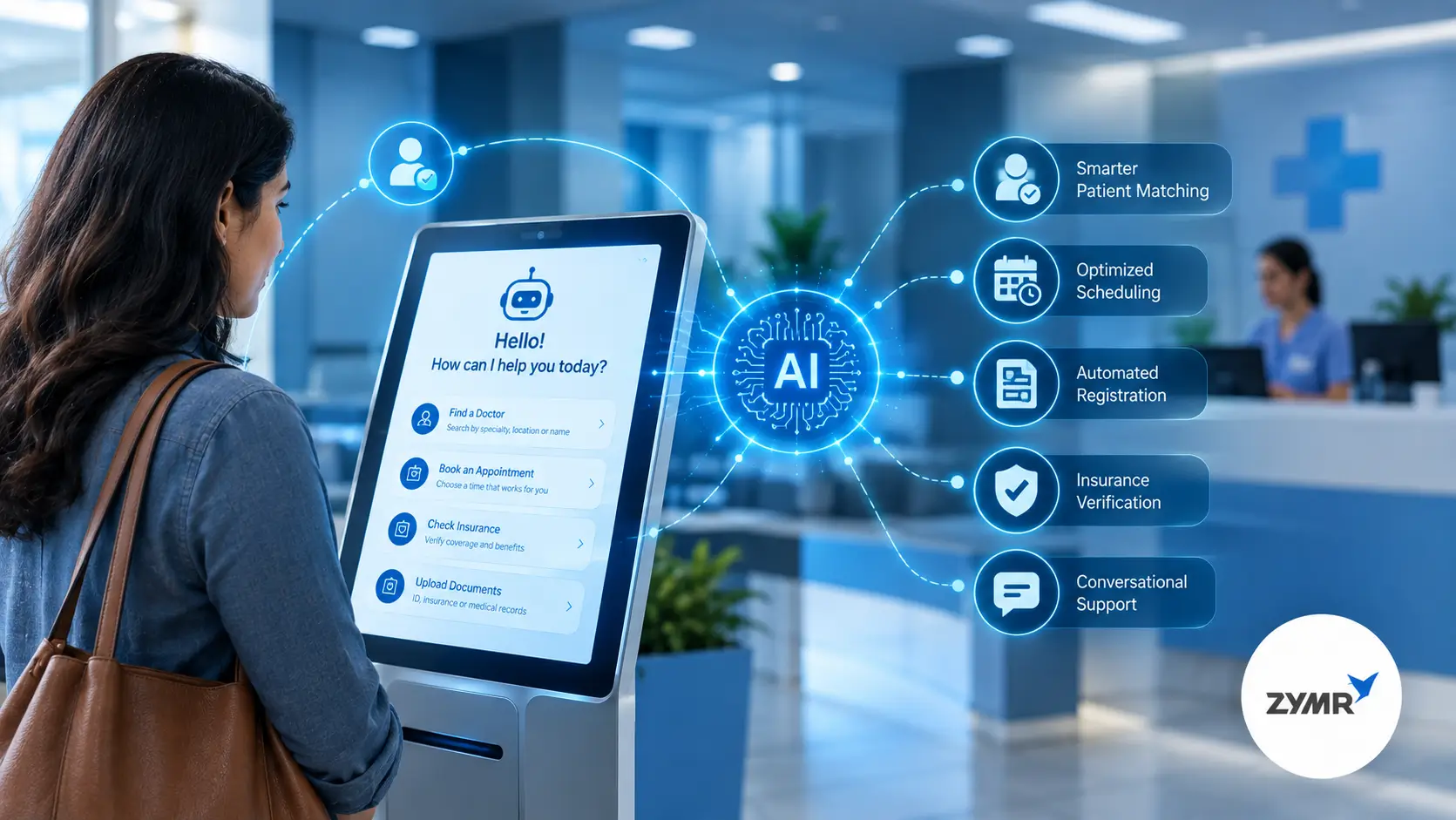
An AI powered digital front door reduces friction at the earliest stages of care. It helps patients find the right provider, get answers, book suitable appointments, and verify coverage without moving between disconnected systems.
1. AI Powered Provider Search and Matching
AI makes provider discovery more contextual by matching patient needs with specialty, location, insurance, and availability. Natural language search also lets patients describe what they need without knowing the exact clinical specialty.
Platforms such as Kyruus Health use intelligent search and provider data to support more relevant care navigation.
Example: A patient describing recurring knee pain can be guided toward appropriate orthopedics, sports medicine, or physical therapy options based on their needs.
2. Conversational AI for Scheduling and Patient Inquiries
Conversational AI healthcare allows patients to ask questions, find providers, schedule or reschedule appointments, and access pre visit information through natural language interactions.
With Generative AI development, these experiences can connect AI with enterprise data, healthcare workflows, and human escalation paths.
Example: A patient can ask for the earliest available cardiology appointment, book a suitable slot, and receive preparation instructions within the same interaction.
3. AI Powered Scheduling Optimization
AI in patient scheduling can evaluate appointment type, provider availability, location, patient preferences, and scheduling rules to recommend suitable slots. Predictive models can also support reminders and rescheduling workflows where no show risk is higher.
Example: Instead of searching multiple provider calendars, a patient can receive appointment options that already match their care needs and preferences.
4. AI for Insurance Verification and Coverage Discovery
AI can extract insurance information, identify missing data, validate details, and initiate eligibility checks. Through connected API development, these workflows can exchange information with payer systems, EHRs, and revenue cycle platforms.
Example: When a patient uploads an insurance card, the system can capture the details, verify coverage, and flag discrepancies for staff review before the visit.
Together, these capabilities show how AI digital front door improves patient access by turning separate access tasks into a more connected, guided patient journey.
How AI Improves Patient Intake
Patient intake often involves repetitive forms, manual document entry, and fragmented health information. AI powered patient onboarding can automate these steps while improving the quality of information available before the visit.
1. Adaptive Digital Forms
AI can adjust intake questions based on the patient’s previous responses, visit type, and available records. Instead of presenting every patient with the same form, the workflow asks only relevant questions.
Example: A returning patient may only need to confirm changed information rather than complete the entire intake process again.
2. AI Powered Document and Insurance Card Capture
Computer vision and intelligent document processing can extract information from insurance cards, IDs, referrals, and other documents. Services such as Google Cloud Document AI can support document extraction and structured data processing.
Example: A patient uploads an insurance card, and key details are automatically captured and prepared for validation.
3. Health History Extraction and Structuring
AI and NLP can extract relevant information from forms, uploaded records, and clinical documents, then organize it into structured fields for downstream workflows.
Through Data Engineering, healthcare organizations can build pipelines that move this information securely into EHRs and other clinical systems.
Example: Medication, allergy, and medical history information can be extracted from submitted records instead of being manually reentered.
4. AI Assisted Symptom Triage and Pre Visit Preparation
AI can collect symptoms, ask relevant follow up questions, and prepare information before an appointment. It can also support routing while keeping clinical decisions and higher risk situations under human oversight.
Example: A patient reporting worsening symptoms can be escalated to the appropriate clinical workflow rather than continuing through routine digital intake.
Together, these capabilities make intake faster and more adaptive while giving care teams better structured information before the patient arrives.
Real World Examples of AI Powered Digital Front Doors
Healthcare organizations are increasingly combining AI with scheduling, navigation, intake, and patient engagement. Here is what those implementations can look like in practice.
i. Providence
Providence is a large nonprofit health system that has invested in digital tools to simplify how patients find information, navigate services, and access care. Its digital strategy includes the Providence app, MyChart, and AI supported patient navigation.
What was implemented: Providence has expanded digital patient access through online care navigation, scheduling, virtual care, and digital engagement capabilities.
How AI was used: AI supports patient navigation and digital interactions, helping patients find relevant information and move toward appropriate services.
Reported outcomes: Providence has positioned digital access and automation as part of its broader effort to simplify how patients interact with its care ecosystem.
Key takeaway: AI becomes more useful when it connects patient navigation with the wider digital care journey.
ii. Cleveland Clinic
Cleveland Clinic combines a broad digital access ecosystem with a growing portfolio of AI initiatives. Patients can use MyChart and MyClevelandClinic to find providers, schedule appointments, complete pre visit tasks, access virtual visits, and manage their care online.
What was implemented: Cleveland Clinic has expanded digital access through online scheduling, virtual care, patient portals, and AI enabled healthcare initiatives.
How AI was used: AI supports broader clinical and operational workflows, while digital access tools help patients discover and connect with care.
Reported outcomes: These initiatives have expanded the ways patients can access services digitally while supporting more connected healthcare experiences.
Key takeaway: An AI digital front door works best when access capabilities connect with existing clinical and operational systems.
iii. Notable
Notable is an AI platform built specifically for healthcare operations. Its platform focuses on automating patient access, revenue cycle, and care workflows while integrating with healthcare data and EHR ecosystems.
What was implemented: Notable provides an AI powered platform for automating patient workflows across scheduling, registration, outreach, and intake.
How AI was used: AI agents and automation coordinate repetitive patient access tasks, collect information, and move workflows forward with less manual intervention.
Reported outcomes: Healthcare organizations using the platform have reported reduced administrative work and greater automation across patient access workflows.
Key takeaway: AI can connect multiple front door activities into a continuous workflow instead of automating each interaction separately.
Across these examples, the pattern is consistent. The strongest AI powered digital front doors do not simply add AI to an existing portal. They connect intelligence with patient workflows, healthcare data, existing systems, and human oversight.
Key Benefits of an AI Powered Digital Front Door
An AI powered digital front door improves more than the patient interface. By connecting AI with access, intake, and operational workflows, healthcare organizations can create a faster and more coordinated experience from the first interaction.
1. Faster patient access:
AI-powered provider matching and conversational scheduling cut the time between a patient's first search and their booked appointment, replacing multi-call runarounds with a single guided interaction, often available 24/7 instead of only during office hours.
2. Reduced administrative workload:
Conversational AI absorbs the repetitive share of contact center volume, call center reductions of 30 to 50 percent, while adaptive intake and automated document capture eliminate the manual re-entry that used to consume registration staff time.
3. More personalized patient experiences:
Instead of a one-size-fits-all form or a static provider list, AI tailors the journey to the individual, adjusting intake questions, surfacing relevant providers, and flagging urgent symptoms based on what the patient actually says, not a generic script.
4. Better data quality:
Computer vision and NLP extraction push accuracy well above manual entry, insurance card capture above 90 percent versus 60 to 75 percent for manual keying, which means fewer downstream errors in claims, scheduling, and clinical records.
5. More efficient intake and scheduling:
Adaptive forms and predictive scheduling together cut intake time by 50 to 70 percent and reduce no-show rates by 15 to 25 percent, freeing up appointment slots that would otherwise sit empty or get filled with mismatched patients.
6. Reduced revenue leakage:
Real-time eligibility verification and coverage discovery catch errors before a claim is ever filed, cutting eligibility-error denials by 40 to 60 percent and recovering coverage on 20 to 30 percent of previously self-pay accounts.
The larger benefit is continuity. Instead of optimizing individual touchpoints, an AI digital front door helps connect the entire journey from finding care to arriving prepared for it.
Challenges and Considerations
An AI powered digital front door handles sensitive patient data and can influence how patients navigate care. That makes integration, security, accuracy, accessibility, and governance as important as the AI itself.
i. EHR and System Integration
AI workflows need reliable connections with EHRs, scheduling systems, payer platforms, and patient applications. Standards such as FHIR can support interoperability, but healthcare organizations still need strong APIs, data mapping, and workflow orchestration across legacy systems.
ii. Data Privacy and Security
Patient interactions may contain protected health information, making privacy and security fundamental. Organizations need appropriate access controls, encryption, audit trails, data governance, and compliance with HIPAA requirements.
iii. AI Accuracy and Human Oversight
AI responses can be incomplete or incorrect, particularly when patient requests are ambiguous. High risk interactions should include validation, clear escalation paths, and human review rather than relying entirely on automated decisions.
iv. Patient Accessibility and Trust
Not every patient has the same digital skills, language preferences, accessibility needs, or comfort with AI. Digital front doors should therefore provide understandable experiences and alternative ways to reach human support.
v. Governance and Compliance
Healthcare AI requires ongoing governance across model performance, data use, risk, security, and accountability. Cross functional oversight involving clinical, technology, compliance, legal, and operational teams can help establish where AI operates independently and where human intervention is required.
Ultimately, effective AI governance in healthcare should be designed into the digital front door from the beginning, not added after deployment.
The Future of AI-Powered Digital Front Doors
Looking ahead, personalization is going to get less reactive and more anticipatory. Instead of adjusting a form after a patient answers a question, AI-powered digital front doors will start shaping the entire journey before the patient even asks, factoring in social determinants of health, past visit patterns, and preferred communication channels from the very first touchpoint. Alongside this, agentic AI is quietly taking over the multi-step tasks that used to need a human trigger at every stage. Rather than just answering questions, these systems will verify eligibility, reschedule around a cancellation, and confirm a provider match on their own, acting within defined guardrails on a patient's behalf instead of simply responding to them.
Access itself is also shifting from passive to predictive. Instead of waiting for a patient to seek care, models will increasingly flag who's likely to need an appointment soon, based on chronic condition patterns, missed preventive screenings, or seasonal risk, and reach out before a small issue becomes an urgent one.
Underneath all of it is a broader move toward convergence. Scheduling, intake, billing, virtual care, and post-visit follow-up are steadily merging into one connected system instead of separate tools stitched together after the fact, and the health systems that treat this convergence as core infrastructure, not a bolt-on, are the ones positioned to lead. That kind of end-to-end architecture is exactly the work covered under Digital Transformation and Product Engineering.
Conclusion
AI has moved the digital front door from a passive set of tools into something that actively works on a patient's behalf, matching them to the right provider, answering questions at 2 a.m., verifying coverage before they arrive, and pulling scattered health history into something a clinician can actually use in seconds. The gains are not theoretical; they show up in fewer no-shows, shorter intake times, cleaner claims, and patients who get answers instead of hold music.
None of that value shows up on its own, though. It depends on AI being wired into connected digital workflows rather than dropped in as an isolated chatbot, and on health systems treating integration, governance, and human oversight as part of the build, not an afterthought bolted on once something breaks. The systems getting real results are the ones that are designed for compliance and clinical safety from day one, not the ones scrambling to retrofit it later at three to five times the cost.
The practical takeaway for 2026 is simple: an AI-powered digital front door works when it's built as measurable, governed infrastructure, not a standalone feature. For health systems, health plans, and digital health teams thinking through that build, from healthcare strategy to generative AI development to seeing how it's played out for others in our case studies, that's the foundation worth getting right before adding another capability on top.
Conclusion
FAQs
Q1: What is an AI-powered digital front door?
>
It's the layer of intelligence added to a health system's existing access tools, scheduling, intake, portals, and contact centers, that lets those tools understand context and act on a patient's behalf instead of just displaying information. Rather than a single app, it's a set of AI capabilities, conversational, predictive, and computer vision based, woven through the entire patient journey from first search to first visit.
Q2: What are the main AI capabilities in a digital front door?
>
On the access side, four capabilities matter most: AI-powered provider search and matching, conversational AI for scheduling and inquiries, predictive scheduling optimization, and real-time insurance verification and coverage discovery. On the intake side, the core four are adaptive digital forms, AI-powered document and insurance card capture, health history extraction and structuring, and AI-assisted symptom triage with human oversight built in.
Q3: What are the risks of using AI in a digital front door?
>
The biggest risks are poor EHR integration that forces staff to redo work AI already completed, gaps in HIPAA and HITRUST-level data security, and AI making unsupervised clinical judgments where a human should be in the loop. Accessibility is another concern; not every patient wants or can use a chatbot, so a human path always needs to stay available alongside the AI option.
Q4: What health systems have implemented AI-powered digital front doors?
>
Cleveland Clinic is the most visible 2026 example, backed by a $50 million initiative to build AI-driven, pre-arrival care routing that matches patients to the right site of care before they show up. Vendors like Notable and Luma Health have also enabled similar capabilities, check-in automation and insurance card capture, across multiple health systems, with reported check-in time reductions above 90 percent in some deployments.
Q5: What compliance requirements apply to AI in healthcare digital front doors?
>
It's the layer of intelligence added to a health system's existing access tools, scheduling, intake, portals, and contact centers, that lets those tools understand context and act on a patient's behalf instead of just displaying information. Rather than a single app, it's a set of AI capabilities, conversational, predictive, and computer vision based, woven through the entire patient journey from first search to first visit.
Have a specific concern bothering you?
Try our complimentary 2-week POV engagement


Our Latest Blogs
September 28, 2026
AI-Powered Digital Front Door: How AI Improves Patient Access and Intake (2026)

September 23, 2026
Data Interoperability vs Healthcare Interoperability: Definitions, Differences, and Why Both Matter - The 2026 Comparison Guide
September 21, 2026


.svg)
.svg)
.svg)
.svg)
.svg)
.svg)
