
Best 10 Platforms for Care Journey Orchestration in Healthcare
This blog compares 10 care journey orchestration platforms, covering their capabilities and healthcare use cases. It helps healthcare organizations evaluate options based on workflow needs, integration, automation, and business value.
Play Voice
Suhas Phartale
AVP of Engineering
September 30, 2026
Key Takeaways
- Healthcare organizations should select platforms based on their specific care workflows and patient needs.
- Connected patient data should support clear task ownership, timely interventions, and reliable completion tracking.
- Effective automation should execute workflows, handle exceptions, and escalate unresolved tasks to appropriate teams.
- Buyers should verify available modules, integrations, network coverage, and staff responsibilities before selecting a platform.
- Organizations should pilot one care journey and measure staff effort, completion rates, and time to care before scaling.
Why Care Journey Orchestration Matters in 2026
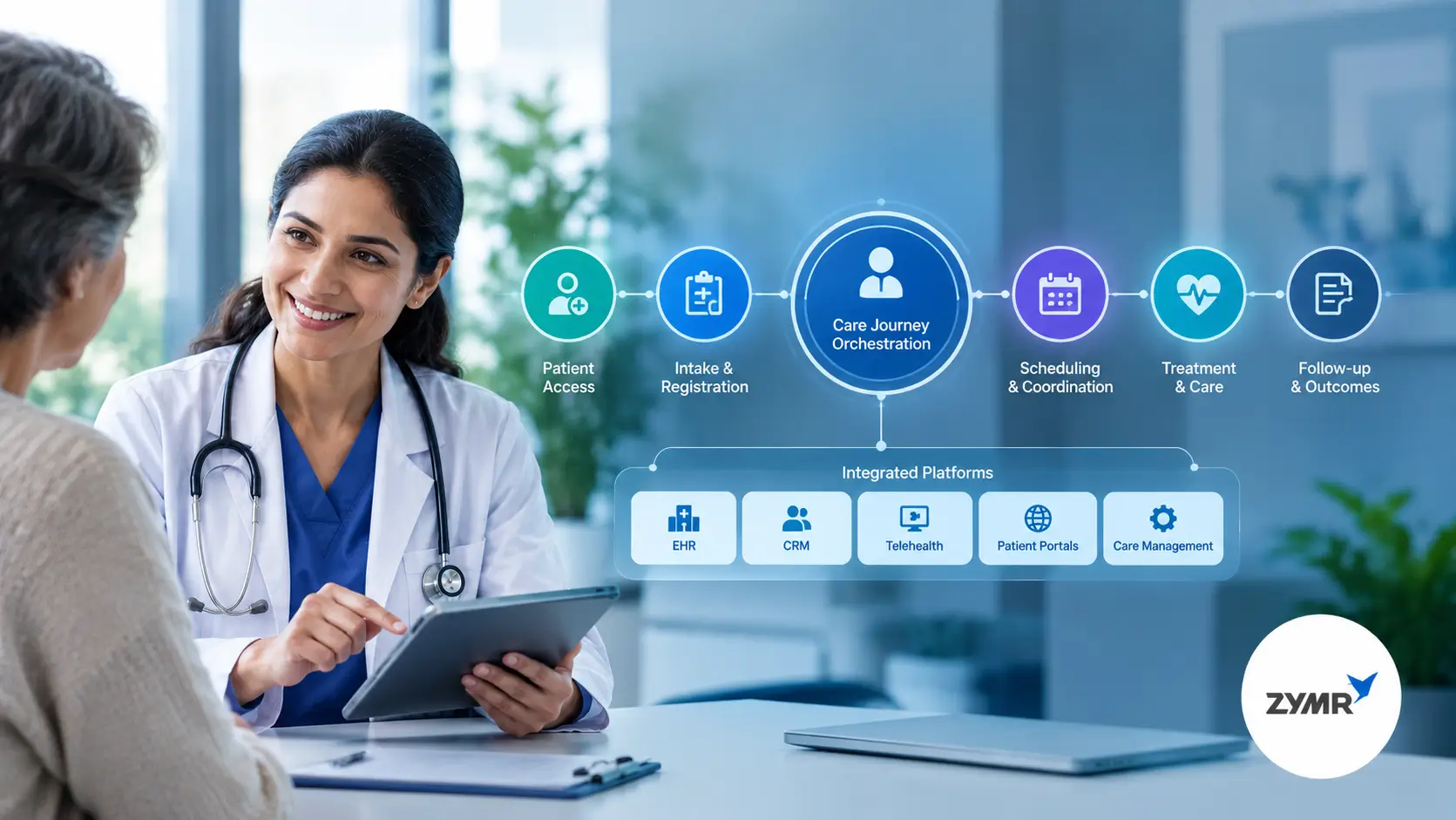
Platforms for care journey orchestration connect patient data, clinical rules, and automated workflows. They coordinate tasks across healthcare systems, assign responsibilities, and track each step through completion. These capabilities help teams translate clinical plans into timely actions across the patient journey.
For healthcare organizations evaluating care journey orchestration platforms in 2026, business value depends on specific workflow improvements:
- Reduce administrative work: Automate routine reminders, information collection, and task routing across care teams.
- Strengthen care continuity: Track pending actions and trigger follow-ups when expected steps remain incomplete.
- Personalize patient support: Adjust workflows using clinical information, patient responses, and predefined decision rules.
- Connect existing systems: Exchange relevant information across applications to support coordinated decisions and actions.
Platform selection should start with a defined operational problem, such as delayed follow-ups. Buyers should measure task completion, staff time, and patient progression before expanding deployment. This approach ties care orchestration technology investment to observable improvements in care delivery and operational performance.
What Is Care Journey Orchestration in Healthcare?
Care journey orchestration, also called patient journey orchestration, uses patient data and clinical rules to coordinate care delivery. It connects information across systems, triggers appropriate tasks, and monitors progress through defined workflows. The process adapts as patient needs change or new clinical information becomes available.
It builds on care coordination, which the Agency for Healthcare Research and Quality (AHRQ) describes as deliberately organizing patient care activities and sharing information among everyone involved in a patient's care. Orchestration adds automation to that foundation: configured rules determine the next step, and the platform checks whether that step was completed.
Its core functions include:
- Data integration: Collect relevant patient information from connected clinical and administrative systems.
- Workflow execution: Assign tasks, send communications, and sequence actions using predefined care pathways.
- Decision logic: Use clinical rules and patient responses to determine appropriate next steps.
- Completion tracking: Check outstanding actions and trigger follow-ups when required steps remain incomplete.
For example, a preoperative workflow can check whether required patient information is complete. Missing details can trigger automated requests before the scheduled appointment, supporting timely preparation.
For healthcare buyers, the distinction matters: connected records alone do not execute care workflows. Orchestration adds task ownership, timing, and completion checks to make those workflows actionable. That is also what separates it from many care coordination platforms, which share information and tasks but do not always verify that each step is completed.
How We Selected the Best Care Journey Orchestration Platforms
This comparison uses four criteria to assess the best care journey orchestration platforms against specific healthcare use cases. The approach prioritizes workflow fit, integration requirements, and measurable operational value over feature counts.
i. Healthcare Focus and Use Cases
Assess the care settings, patient populations, and workflows each platform supports. Consider whether its capabilities match provider operations, health plan programs, or care transitions.
ii. Core Orchestration Capabilities
Review how each platform assigns tasks, sequences actions, and tracks outstanding care activities. Distinguish complete workflow orchestration from capabilities focused primarily on communication or data aggregation.
iii. AI and Automation Capabilities
Examine documented capabilities for automated outreach and task routing, prioritization, and decision support. Assess where human review remains necessary and whether organizations can configure workflow rules.
iv. Integration and Interoperability
Evaluate connections with electronic health records, payer systems, and existing patient engagement platforms. Check supported interfaces, data exchange methods, and requirements for writing information back into systems.
The comparison draws on publicly documented capabilities rather than hands-on testing or independent scoring. "Best suited for" identifies likely use-case alignment; buyers should validate suitability through workflow demonstrations.
Structuring your vendor evaluation around healthcare focus, orchestration depth, AI and automation, and interoperability? Zymr's engineering team runs vendor assessments and proof-of-concept designs mapped to your specific care journeys.
Top Care Journey Orchestration Platforms
The ten platforms below span EHR-native applications, healthcare care management platforms for providers and health plans, and specialists in engagement, care transition alerts, and digital program delivery.
i. Innovaccer
Platform Overview
Innovaccer combines healthcare data integration with care management, population health, and patient outreach applications. Its offering supports organizations connecting patient information with coordinated care activities across teams.
Key Capabilities
- Care management: Supports patient assessments, care plan suggestions, and access to patient histories.
- AI assistance: Automates documentation and provides summaries and predictive patient risk insights.
- Patient outreach: Supports personalized communications, appointment scheduling, and tracking of follow-through.
- Population health: Connects care management with analytics supporting value-based care programs.
Why It Stands Out
Innovaccer connects care management and outreach with a broader healthcare data foundation. This combination can support organizations managing patient needs alongside population-level quality and financial objectives. Buyers should confirm which applications and integrations their proposed implementation includes.
Best Suited For
Based on these capabilities, Innovaccer merits consideration for health systems and provider networks pursuing value-based care. It is particularly relevant when evaluation priorities include patient risk identification, care management, and coordinated outreach.
ii. Lumeon by Health Catalyst
Platform Overview
Lumeon by Health Catalyst automates care workflows using patient data and configurable clinical rules. Its orchestration engine works alongside existing systems to coordinate tasks and monitor completion.
Key Capabilities
- Workflow configuration: Defines care pathways with decision rules, task sequences, and timing requirements.
- Task automation: Automates patient reminders, information requests, and routine coordination activities.
- System integration: Exchanges clinical and administrative information to guide actions within connected workflows.
- Completion monitoring: Checks expected outcomes and triggers follow-ups when required steps remain unfinished.
Why It Stands Out
Lumeon emphasizes executing care processes and checking whether each required action actually happens. Its workflows accommodate patient responses, pending results, and collaboration across different care teams. This approach can help organizations address operational gaps between care planning and delivery.
Best Suited For
Based on these capabilities, Lumeon merits consideration for health systems automating complex clinical pathways. Relevant evaluation scenarios include preoperative preparation and workflows requiring timely actions across multiple teams. Buyers should test exception handling, integration dependencies, and escalation rules against their chosen pathway.
iii. Salesforce Health Cloud
Platform Overview
Salesforce Health Cloud combines healthcare customer relationship management with care planning and patient services. Its Integrated Care Management capabilities organize patient needs, goals, and interventions within structured care plans.
Key Capabilities
- Care planning: Links patient problems, care goals, and intervention tasks within coordinated plans.
- Patient services: Supports referral management, appointment management, and contact center workflows.
- Clinical data integration: Uses application programming interfaces to map external clinical information into healthcare records.
- Interoperability: Provides a care plan data model aligned with Fast Healthcare Interoperability Resources Release 4 (FHIR R4).
Why It Stands Out
Health Cloud connects care management with patient service workflows within the Salesforce ecosystem. This combination supports organizations coordinating clinical needs alongside access, communication, and service requests. However, standards alignment alone does not establish working connections with every clinical system. Buyers should validate data mappings and integration requirements during evaluation.
Best Suited For
Based on these capabilities, Salesforce Health Cloud merits consideration for providers and health plans coordinating care and patient services. It is particularly relevant when organizations already use Salesforce and need connected healthcare workflows.
iv. Epic
Platform Overview
Epic supports care coordination through its electronic health record (EHR) and related applications. Healthy Planet supports population health, while Compass Rose addresses care management and social needs.
Key Capabilities
- Care management: Tracks patient enrollment, needs assessments, outreach calls, tasks, and program outcomes.
- Population health: Supports proactive management of patient populations using clinical and payer claims data.
- Social care: Supports screening for social needs and connecting patients with community resources.
- Payer collaboration: Enables information exchange between providers and health plans to support coordinated care.
Why It Stands Out
Epic places care coordination within the clinical environment where teams already document treatment. Its applications connect patient records with population health programs and community support workflows. This structure can support care management within existing clinical operations. Capabilities depend on the applications and connections implemented by each organization.
Best Suited For
Based on these capabilities, Epic merits consideration for health systems already using its EHR. Relevant priorities include population health, complex care management, and coordination of clinical and social services. Buyers should validate module availability and workflows involving external partners before selecting their configuration.
v. Oracle Health
Platform Overview
Oracle Health offers population health solutions that combine patient data, analytics, and care coordination. These solutions build longitudinal records from multiple sources to support individual and population-level decisions.
Key Capabilities
- Data integration: Aggregates, cleanses, and normalizes information into comprehensive longitudinal patient records.
- Care coordination: Supports patient record summaries, outreach, and workflows for addressing care gaps.
- Patient prioritization: Uses AI-assisted insights to identify patients requiring attention within population health programs.
- Performance management: Connects quality measures, contract performance, and patient outreach opportunities.
Why It Stands Out
Oracle Health connects care coordination with quality management and value-based contract performance. This combination helps teams evaluate patient needs alongside broader clinical and financial priorities. Its documented capabilities include insights delivered alongside different electronic health record systems. Buyers should verify supported connections and workflow execution within their proposed deployment.
Best Suited For
Based on these capabilities, Oracle Health merits consideration for health systems managing population health programs. Relevant priorities include combining fragmented patient information, targeting care gaps, and monitoring value-based care performance. Evaluation should establish how identified needs become assigned, tracked, and completed care activities.
vi. Bamboo Health
Platform Overview
Bamboo Health supports care coordination through patient event notifications and behavioral health referral tools. Pings provides care transition alerts, while OpenBeds supports treatment availability checks and referral tracking.
Key Capabilities
- Care transition alerts: Uses admission, discharge, and transfer (ADT) data to notify care teams.
- Workflow integration: Makes notifications available within connected clinical systems and web or mobile interfaces.
- Treatment availability: Shows available behavioral health beds and services to support referral decisions.
- Referral coordination: Enables two-way communication and tracking between referring and receiving treatment providers.
Why It Stands Out
Bamboo Health focuses on moments when patients move between care settings or need treatment placement. Its tools connect event visibility with coordination across participating organizations. This makes network coverage and timely facility updates central considerations during vendor evaluation.
Best Suited For
Based on these capabilities, Bamboo Health merits consideration for providers and health plans managing care transitions. OpenBeds is particularly relevant for behavioral health networks coordinating treatment access. Buyers should confirm participating facilities, notification coverage, and referral status tracking for their target populations.
vii. Notable
Platform Overview
Notable uses AI-powered automation to connect patient access, engagement, and care operations workflows. Its capabilities include referral intake, appointment scheduling, digital registration, and care gap outreach.
Key Capabilities
- Referral processing: Extracts information from faxed referrals and routes requests using configured rules.
- Appointment management: Supports scheduling, rescheduling, and waitlist management through connected patient communication channels.
- Patient engagement: Uses voice AI, text messages, and digital forms for routine interactions.
- Care gap outreach: Automates patient notifications and records outreach results for reporting and follow-up.
Why It Stands Out
Notable connects patient conversations with operational actions, including booking appointments directly within integrated systems. Its focus extends beyond sending messages to completing routine access and administrative tasks. Buyers should validate supported workflows, integration depth, and escalation to staff for complex requests.
Best Suited For
Based on these capabilities, Notable merits consideration for providers addressing referral backlogs and access bottlenecks. Relevant priorities include reducing manual intake, coordinating outreach, and converting referrals into scheduled appointments. Evaluation should measure task completion, time to appointment, and staff intervention requirements.
viii. HealthEdge Wellframe
Platform Overview
HealthEdge Wellframe supports digital member engagement and care management for health plans. It connects members with care teams through messaging, assessments, and personalized clinical programs.
Key Capabilities
- Member communication: Provides two-way chat and communication across channels to support ongoing engagement.
- Digital care programs: Offers personalized clinical content, assessments, biometric tracking, and self-service resources.
- Care team alerts: Flags reported care gaps and unmet needs to support timely outreach.
- Care management integration: Connects with HealthEdge GuidingCare through the Care-Wellframe offering to consolidate workflows.
Why It Stands Out
Wellframe emphasizes ongoing relationships between health plan members and their care teams. Its integration with GuidingCare connects digital engagement with broader care management activities and member information. Buyers should distinguish Wellframe's engagement capabilities from those included through the combined Care-Wellframe implementation.
Best Suited For
Based on these capabilities, Wellframe merits consideration for health plans expanding support between clinical encounters. Relevant priorities include chronic condition support, care transitions, and engagement of members with complex needs. Evaluation should test member accessibility, alert routing, and integration with existing care management processes.
xi. VirtualHealth HELIOS
Company update: VirtualHealth, the original developer of HELIOS, combined with HealthEC in January 2025 to form Elligint Health. HELIOS is now offered as VirtualHealth by Elligint Health.
Platform Overview
VirtualHealth HELIOS combines care management, disease management, and utilization management within one platform. It supports coordinated workflows addressing physical health, behavioral health, and long-term services and supports.
Key Capabilities
- Care management: Provides member views, assessments, and collaborative workflows for managing complex care needs.
- Workflow configuration: Offers configurable templates, rules, and automated workflows for different care programs.
- Utilization management: Supports utilization reviews, prior authorization workflows, appeals, and grievances through dedicated capabilities.
- Care team access: Provides mobile tools for field-based coordination and integrated telehealth communication.
Why It Stands Out
HELIOS connects care coordination with utilization management in a configurable medical management environment. This breadth is relevant when organizations need aligned workflows across multiple programs and disciplines. Its product family also includes FHIR-compatible data integration capabilities through HELIOShub. Buyers should confirm the modules, interfaces, and configuration included in their proposal.
Best Suited For
Based on these capabilities, HELIOS merits consideration for health plans managing complex member populations. Relevant use cases include Medicaid programs, behavioral health, and long-term services and supports. Evaluation should test cross-program coordination, field usability, and the handoff between care and utilization management.
x. Xealth
Platform Overview
Xealth connects digital health programs with clinical workflows inside electronic health record systems. It enables clinicians to prescribe digital resources and monitor engagement through an integrated platform.
Key Capabilities
- Digital program ordering: Enables clinicians to prescribe digital health tools from existing clinical workflows.
- Workflow automation: Supports automated education, assessments, care navigation, and follow-up communications.
- Program monitoring: Brings engagement and outcome information together to support oversight of digital interventions.
- System integration: Connects EHRs, digital health vendors, and devices through a shared integration framework.
Why It Stands Out
Xealth focuses on coordinating multiple digital health tools within the health system's clinical environment. This approach helps organizations connect program delivery, patient communication, and monitoring across their vendor portfolio. Its relevance increases when fragmented digital tools create separate workflows and reporting requirements.
Best Suited For
Based on these capabilities, Xealth merits consideration for health systems expanding digital care programs. Relevant priorities include remote monitoring, digital therapeutics, patient education, and coordination across multiple vendors. Buyers should validate supported integrations, data returned to clinical records, and responsibility for responding to program alerts.
Care Journey Orchestration Platforms: Quick Comparison
These platforms address different parts of care delivery. Use this comparison to shortlist options by workflow needs, then validate integration and implementation requirements.
Focus areas reflect the documented capabilities reviewed in the preceding profiles; evaluation scenarios are use-case assessments.
Before selecting, test task ownership, exception handling, data exchange, and completion tracking against one priority journey.
Combining platforms, such as an EHR-native care management module with a transition-alert network or a digital program layer? Zymr engineers the FHIR-based integrations and payer-provider data flows that connect care journey orchestration platforms into one working system.
Conclusion
Selecting platforms for care journey orchestration starts with identifying the workflow that needs improvement. Clinical pathway automation, member engagement, care transitions, and digital program delivery require different capabilities.
Interoperability should connect relevant data with assigned tasks, timely actions, and completion tracking. Evaluate automation and AI against specific needs, including exception handling and appropriate human oversight.
Start with one priority journey and establish baseline measures before implementation. Track completion rates, staff effort, and time to care to assess business value. Expand when the platform demonstrates reliable performance within your operating environment.
Conclusion
FAQs
What is care journey orchestration?
>
Care journey orchestration connects patient data, clinical rules, and workflows to coordinate care activities. It triggers tasks, monitors completion, and adapts next steps as relevant information changes.
What is the difference between care journey orchestration and care coordination software?
>
Care coordination software typically supports shared information, communication, and task management across teams. Orchestration adds automated sequencing, decision rules, and checks that required steps reach completion. Capabilities overlap, so evaluate actual workflows rather than relying on product labels.
What should you look for in a care journey orchestration platform?
>
Prioritize workflow fit, interoperability, task ownership, exception handling, and completion tracking. Assess privacy controls, implementation costs, and measurable outcomes alongside automation and AI capabilities.
Do I need one platform or several for care journey orchestration?
>
One platform may cover your priority workflows; broader requirements may need connected solutions. Validate coverage first, then define data flows and responsibilities across any additional platforms.
What are the main implementation risks with care journey orchestration?
>
Key risks include incomplete data, integration failures, poorly configured rules, and unclear task ownership. Test exceptions, escalation paths, staff workflows, and patient accessibility before expanding deployment.
Have a specific concern bothering you?
Try our complimentary 2-week POV engagement


Our Latest Blogs
September 28, 2026


.svg)
.svg)
.svg)
.svg)
.svg)
.svg)
