Modernizing Legacy Healthcare Systems: Risks, Strategies, and a Phased Roadmap (2026)
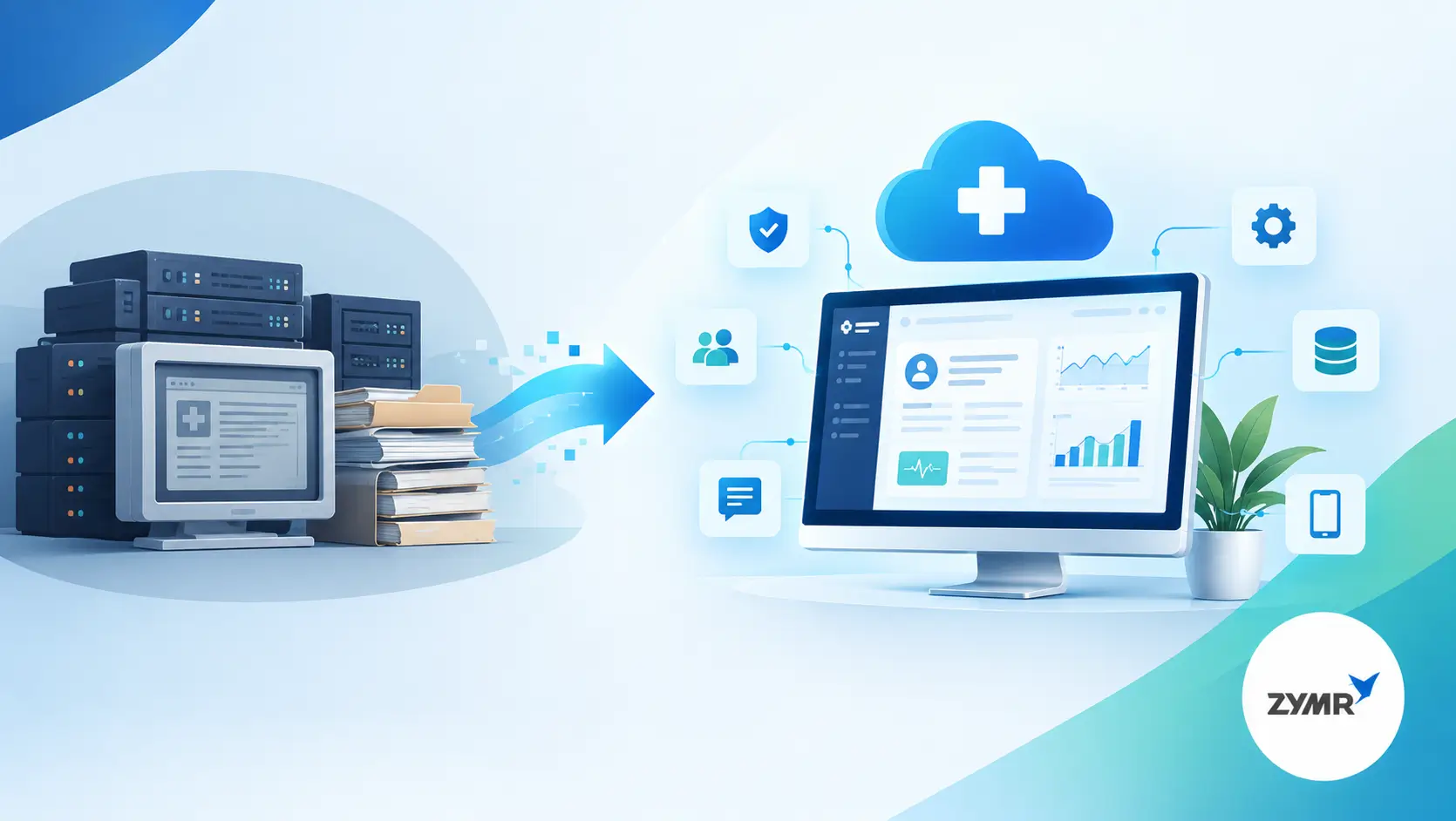
This blog explains how healthcare organizations can modernize legacy systems through phased, risk-aware strategies without disrupting critical operations. It covers modernization approaches, implementation roadmaps, common challenges, and AI-driven acceleration for long-term scalability and business value.
Play Voice
Suhas Phartale
VP of Engineering
October 23, 2026
Key Takeaways
- Legacy system modernization in healthcare should be treated as a phased business transformation, not a simple technology replacement.
- The right modernization strategy depends on business value, technical health, strategic relevance, and cost of change.
- Incremental approaches reduce disruption by allowing legacy and modern systems to operate together during migration.
- Successful modernization requires strong foundations across cloud, APIs, data, identity, security, DevSecOps, and FinOps.
- AI can accelerate code analysis, documentation, testing, dependency discovery, and migration planning, but governance and clinical validation must remain human-led.
Healthcare legacy software modernization transforms aging clinical and operational systems into scalable, interoperable, and maintainable platforms. It addresses technical debt without compromising patient care, data integrity, or critical healthcare workflows.
Legacy healthcare systems often remain deeply embedded across EHRs, billing, scheduling, diagnostics, integrations, and administrative processes. Replacing them in one step can introduce significant operational and financial risk.
Modernization therefore requires a portfolio-based approach. Organizations must assess each system against business value, technical health, strategic relevance, and cost of change.
Common modernization paths include:
- Rehosting or replatforming stable applications
- Refactoring high-value legacy components
- Rearchitecting tightly coupled platforms
- Rebuilding strategically important systems
- Replacing software that no longer supports business needs
- Retiring redundant applications
Phased modernization reduces disruption by allowing old and new systems to operate together. It also creates space for cloud infrastructure, APIs, interoperability, automation, and AI capabilities.
Why Modernizing Legacy Healthcare Systems Matters in 2026
Modernizing legacy healthcare systems matters because aging systems increasingly limit scalability, interoperability, security, and digital growth. The pressure is not only technical. It directly affects operational efficiency, care delivery, compliance, and long-term cost.
Several forces make modernization more urgent:
i. Rising Technical Debt
Legacy platforms often depend on outdated codebases, unsupported infrastructure, and tightly coupled integrations. Maintenance costs rise as specialist skills become harder to retain.
ii. Interoperability Pressure
Healthcare organizations need stronger data exchange across EHRs, APIs, payer systems, and digital applications. Older architectures often make these integrations slow and expensive. In the US, the CMS Interoperability and Prior Authorization Final Rule (CMS-0057-F) requires impacted payers to implement FHIR-based APIs, with those API requirements due by January 1, 2027.
iii. Security and Compliance Risk
Unsupported systems can weaken patching, identity controls, auditability, and vulnerability management. That makes it harder to maintain the administrative, physical, and technical safeguards the HIPAA Security Rule requires. Modernization helps organizations apply stronger controls across infrastructure and applications.
iv. Cloud and AI Readiness
Legacy platforms often cannot support modern data pipelines, automation, or AI workloads efficiently. Modern architecture creates the foundation for these capabilities.
v. Business Agility
Healthcare organizations need faster feature delivery, better patient experiences, and more responsive operations.
Modernization therefore becomes a business transformation decision, not only an IT upgrade. The goal is to reduce technical constraints while protecting clinical continuity and strategic flexibility.
What Are Legacy Healthcare Systems?
Legacy healthcare systems are older applications, platforms, or infrastructure that remain critical to daily operations. They often support clinical, administrative, financial, or data-management workflows despite increasing technical limitations.
These systems may include:
- Older EHR platforms
- Mainframe-based hospital applications
- MUMPS-based clinical systems
- Legacy billing and revenue cycle software
- Custom scheduling and registration platforms
- Point-to-point integration engines
- Older data warehouses and reporting systems
Legacy status does not depend only on system age. A platform becomes legacy when it is difficult to maintain, integrate, secure, scale, or modify.
i. Common Technical Characteristics
Legacy healthcare systems often use tightly coupled architectures, proprietary interfaces, outdated databases, or unsupported operating environments. These characteristics make modernization slower and more complex. MUMPS modernization is a common example, because MUMPS combines the programming language and the database in a single environment.
ii. Common Business Characteristics
They may still support essential workflows that cannot tolerate disruption. This is why healthcare application modernization usually requires phased migration rather than immediate replacement.
The main challenge is balancing technical improvement with operational continuity. Healthcare organizations must modernize carefully while preserving data integrity, clinical workflows, and system availability.
What Are the Risks of Keeping Legacy Healthcare Systems?
Legacy healthcare systems create business and technical risks when aging architecture limits reliability, security, integration, and change. These risks become more serious when critical workflows depend on unsupported technology.
i. Security Risk
Older platforms may be harder to patch, monitor, and protect. Windows Server 2012 R2, for example, reached the end of extended support in October 2023, and its paid Extended Security Updates end in October 2026. Unsupported infrastructure can also weaken identity, access, and audit controls.
ii. Interoperability Risk
Legacy systems often depend on rigid or proprietary interfaces. This can slow integration with EHRs, cloud services, APIs, and external healthcare platforms.
iii. Operational Risk
Aging systems can create downtime, slow performance, and difficult recovery processes. These issues directly affect clinical and administrative continuity.
iv. Cost Risk
Maintenance costs increase when organizations rely on specialized skills, custom fixes, and outdated infrastructure.
v. Scalability Risk
Legacy platforms may struggle with larger data volumes, new digital services, and changing user demand.
vi. Transformation Risk
Older architectures can delay healthcare cloud migration, automation, AI adoption, and broader healthcare digital transformation.
Together, these risks of legacy software in healthcare make modernization a phased program rather than a simple system replacement.
Why Are Healthcare Organizations Modernizing Legacy Systems?
Healthcare organizations modernize legacy systems to improve resilience, interoperability, scalability, and long-term operational efficiency. The decision is usually driven by both business priorities and technical limitations.
i. Reduce Operational Risk
Modern systems are easier to maintain, monitor, and recover. This helps reduce downtime across clinical and administrative workflows.
ii. Improve Interoperability
Modern architectures support APIs, cloud services, and structured healthcare data exchange. This makes integration across EHRs, payer systems, and digital platforms easier.
iii. Strengthen Security
Modern platforms support stronger identity controls, patching, monitoring, and infrastructure security. This reduces exposure created by unsupported technologies.
iv. Improve Cost Efficiency
Legacy systems often require specialist support and custom maintenance. Modernization can reduce these long-term operating costs.
v. Support Cloud and AI Adoption
Modernized applications are easier to connect with cloud infrastructure, analytics, automation, and AI services.
vi. Increase Business Agility
Modular architecture makes it easier to launch new features, integrations, and digital healthcare services.
The business case for hospital software modernization should connect each technical improvement to measurable operational value. Healthcare organizations should prioritize systems where risk, cost, and strategic importance are highest.
What Are the Main Strategies for Modernizing Legacy Healthcare Systems?
Healthcare application modernization uses different strategies depending on system health, business value, and migration risk. These choices are often framed through the 7 Rs modernization model. AWS defines the 7 Rs as retire, retain, rehost, relocate, repurchase, replatform, and refactor; for application modernization, this guide uses rehost, replatform, refactor, rearchitect, rebuild, replace, and retire.
i. Rehosting and Replatforming
Rehosting moves applications to new infrastructure with minimal code changes. Replatforming makes limited changes to use modern cloud services and managed environments.
These approaches suit stable applications that need infrastructure improvement without major redesign. A healthcare mainframe migration can start here, moving workloads off aging hardware before deeper code changes begin.
ii. Refactoring and Rearchitecting
Refactoring improves code quality while preserving core functionality. Rearchitecting restructures the system into modular cloud-native applications with APIs and stronger integration.
These approaches suit applications with high business value but outdated technical foundations.
iii. Rebuilding or Replacing Legacy Systems
Rebuilding creates a new application around current workflows and architecture goals. Replacement introduces a commercial product or a modern custom-built platform.
These options suit systems with severe technical debt, unsupported technologies, or limited strategic value.
The right strategy should be chosen per system. Healthcare organizations should avoid using one modernization approach across the entire portfolio.
How to Choose the Right Modernization Strategy for Each System
The right modernization strategy should match each system’s business value, technical condition, future role, and migration cost. There is no single best modernization strategy for hospital systems; the decision has to be made per system, not as a portfolio-wide default.
i. Business Value
Assess how strongly the system supports clinical, financial, or operational outcomes.
Example: A core EHR used across multiple hospitals has high business value, so EHR modernization may justify refactoring or rearchitecting instead of simple replacement.
ii. Technical Health
Evaluate code quality, infrastructure age, integration complexity, security gaps, and maintainability.
Example: A billing system running on unsupported infrastructure with frequent outages may require replatforming or rebuilding.
iii. Strategic Future
Determine whether the system supports future digital initiatives and operating models.
Example: A patient portal planned for AI-assisted engagement may need rearchitecting around APIs and modular services.
iv. Cost of Change
Estimate migration effort, downtime risk, integration impact, and specialist skill requirements.
Example: A stable legacy scheduling system with many dependencies may be rehosted first, then modernized gradually.
The best strategy balances all four dimensions before selecting the final modernization path.
Key Approaches to Modernizing Legacy Healthcare Systems
Healthcare organizations should modernize legacy platforms incrementally when full replacement creates excessive operational risk. Three approaches stand out: gradual replacement, controlled coexistence, and non-disruptive feature introduction.
i. Gradually Replace Legacy Components
Replace high-risk or high-value components first while keeping stable modules operational. This is the Strangler Fig pattern, where new components take over functionality step by step until the legacy system can be retired.
Example: A hospital can modernize its patient-facing scheduling layer before replacing the core registration system.
ii. Keep Existing Systems Running During Change
Legacy and modern components can operate together during migration. This reduces disruption across clinical and administrative workflows. Inside a single codebase, Branch by Abstraction serves the same goal by placing an abstraction layer in front of the component being replaced, so old and new implementations can coexist.
Example: A new API layer can connect with an older EHR while backend modernization continues.
iii. Introduce New Functionality Without Disruption
New capabilities should be added around existing systems before deeper replacement begins.
Example: A modern patient portal can launch on top of existing clinical systems through secure APIs.
These approaches support phased modernization. They reduce cutover risk, protect care continuity, and allow modernization teams to validate changes before retiring older components.
A 4-Phase Roadmap for Healthcare Legacy Modernization
A phased roadmap reduces the risk of legacy software migration in healthcare by separating assessment, foundation building, system transition, and retirement. The four sequential phases below form a phased legacy modernization roadmap for healthcare organizations.
Phase 1: Assess and Prioritize
Evaluate systems across business value, technical health, strategic relevance, and cost of change.
Example: Prioritize an unstable billing platform before a low-risk internal reporting tool.
Phase 2: Build the Modernization Foundation
Establish the cloud, API, data, security, and DevOps capabilities required for migration.
Example: Create an API gateway and identity layer before replacing tightly coupled integrations.
Phase 3: Modernize in Controlled Waves
Move applications, services, and integrations incrementally while existing systems remain operational.
Example: Replace one patient-facing workflow first, then expand to connected backend services.
Phase 4: Retire and Optimize
Decommission legacy components after validation, data migration, and operational handover.
Example: Retire an old scheduling application only after the replacement proves stable in production.
This phased roadmap shows how to modernize legacy healthcare software without a single risky cutover. It reduces disruption, improves governance, and gives healthcare organizations measurable checkpoints throughout the modernization program.
Phase 1: Assess Existing Systems and Set Priorities
Phase 1 identifies which systems should be modernized first and why. It is the starting point of the roadmap.
i. Assess Business Criticality
Measure how strongly each system supports patient care, revenue, compliance, or operational workflows.
Example: A claims platform affecting revenue collection should rank above a low-use internal reporting tool.
ii. Assess Technical Health
Review architecture, code quality, infrastructure age, support status, integration complexity, and security exposure.
Example: An unsupported hospital application with recurring downtime should receive a higher modernization priority.
iii. Map Dependencies
Identify upstream and downstream systems, data flows, interfaces, and user groups.
Example: An EHR integration engine may connect scheduling, billing, laboratory, and patient portal systems.
iv. Estimate Modernization Effort
Evaluate migration cost, required skills, testing effort, downtime risk, and data complexity.
Example: MUMPS modernization may require deeper planning than modernizing a standalone web portal.
v. Set Portfolio Priorities
Rank systems using business value, technical risk, strategic importance, and cost of change.
This assessment creates a defensible modernization roadmap and prevents teams from prioritizing systems based only on age or visibility.
Phase 2: Build the Foundation for Modernization
Phase 2 creates the technical foundation required for safe, scalable modernization. This stage covers cloud, APIs, data, identity, DevSecOps, and FinOps capabilities.
i. Build the Cloud Foundation
Before any healthcare cloud migration, establish secure cloud infrastructure, landing zones, network controls, and environment standards.
Example: A health system can create separate development, testing, and production environments before migrating applications.
ii. Build the API Foundation
Create an API gateway and a reusable API integration layer for modern and legacy systems.
Example: A new patient portal can access scheduling data through APIs instead of direct database connections.
iii. Build the Data Foundation
Standardize healthcare data flows, storage, governance, and interoperability requirements, using standards such as HL7 FHIR R4 for data exchange.
Example: Clinical data can move into a modern data platform while legacy source systems remain operational.
iv. Build the Identity Foundation
Implement consistent authentication, authorization, and access controls across applications.
Example: Centralized identity can replace separate login systems across patient and staff applications.
v. Build DevSecOps and FinOps Controls
Automate deployment, security testing, and monitoring, and govern cloud costs using FinOps practices.
This foundation reduces migration risk and creates reusable capabilities for every modernization wave.
Phase 3: Modernize Systems in Phases Without Disrupting Care
Phase 3 moves applications and workflows into modern architecture through controlled migration waves. The objective is to reduce disruption while legacy and modern systems coexist.
i. Modernize High-Priority Workflows First
Start with systems where technical risk and business value justify early action.
Example: In hospital software modernization, a team may modernize patient scheduling before replacing the entire administrative platform.
ii. Use Incremental Replacement
Replace individual services or modules instead of performing a single large cutover.
Example: A new API-based eligibility service can replace one legacy function while the core system remains active.
iii. Maintain Parallel Operations
Keep legacy and modern components running together until production stability is proven.
Example: A new claims workflow can operate beside the existing platform during validation.
iv. Validate Every Migration Wave
Run healthcare software testing across functionality, data integrity, integrations, performance, security, and rollback procedures before expanding.
v. Protect Clinical Continuity
Migration schedules should avoid disrupting patient care, clinician workflows, and critical operational services.
A phased approach gives healthcare organizations measurable checkpoints. It also allows teams to resolve integration problems before they affect the wider environment.
Phase 4: Retire Legacy Systems and Maintain Modernized Platforms
Phase 4 completes the modernization program by retiring outdated systems and stabilizing the new environment. It is the final stage of the roadmap.
i. Validate Production Stability
Confirm that modernized systems meet performance, security, integration, and business requirements before retiring legacy platforms.
Example: Keep the old scheduling system available until the replacement completes several stable production cycles.
ii. Complete Data Migration
Verify that required clinical, operational, and historical data is transferred or archived correctly.
Example: Historical patient records may move to a compliant archive instead of remaining in the retired application.
iii. Decommission Legacy Infrastructure
Remove unused servers, databases, interfaces, licenses, and support dependencies after validation.
Example: Retire obsolete integration servers once all dependent workflows move to modern APIs.
iv. Maintain Modernized Platforms
Continue monitoring performance, security, costs, integrations, and user experience after migration.
v. Govern Ongoing Change
Modernization should transition into continuous platform management rather than end after cutover.
This phase reduces duplicate costs, removes residual technical debt, and ensures the modernized environment remains sustainable over time.
Common Challenges in Healthcare Legacy Modernization
Legacy system modernization in healthcare introduces technical, operational, financial, and organizational challenges.
i. Complex System Dependencies
Legacy applications often connect with multiple clinical and administrative systems. One change can affect several downstream workflows.
Example: Replacing a legacy registration module may disrupt billing, scheduling, and eligibility interfaces.
ii. Data Migration Complexity
During legacy software migration in healthcare, patient data must remain complete, accurate, traceable, and accessible.
Example: Historical patient records may require separate archival and validation workflows.
iii. Clinical Disruption Risk
Modernization cannot interrupt patient care or critical operational services.
Example: EHR modernization may require phased cutovers during low-volume periods.
iv. Limited Legacy Expertise
Older platforms may depend on specialists with rare skills and undocumented knowledge.
v. Security and Compliance Gaps
Temporary migration environments can create inconsistent identity, logging, or access controls. Applying the same cloud security baseline to temporary and target environments closes that gap.
vi. Budget and Timeline Expansion
Hidden dependencies can increase scope, testing effort, and infrastructure costs.
Successful programs reduce these risks through dependency mapping, phased delivery, strong governance, and measurable validation checkpoints.
Best Practices for Successful Healthcare Modernization
Successful healthcare modernization requires disciplined planning, phased execution, and continuous governance.
i. Prioritize by Business and Clinical Impact
Modernize systems based on risk, business value, and strategic importance.
Example: Address an unstable revenue cycle platform before a low-impact internal tool.
ii. Use a Phased Modernization Model
Avoid large-scale replacement when incremental migration reduces operational risk.
Example: Replace integration services first, then modernize the underlying application.
iii. Map Dependencies Before Migration
Document data flows, interfaces, downstream systems, and operational ownership.
Example: Identify every system consuming EHR data before replacing an integration layer.
iv. Maintain Strong Governance
Define architecture standards, security controls, testing requirements, and decision ownership across the program.
v. Protect Clinical Continuity
Plan releases around patient care, critical workflows, and rollback readiness.
vi. Measure Business Outcomes
Track availability, maintenance effort, infrastructure cost, release speed, and user experience.
vii. Retire Legacy Components Completely
Remove duplicate infrastructure after successful migration to prevent unnecessary cost and technical debt.
These practices keep modernization aligned with measurable business value rather than technology change alone.
How AI Can Accelerate Legacy Healthcare System Modernization
AI-powered legacy modernization reduces manual analysis, code transformation effort, testing time, and documentation gaps.
i. Code Analysis and Documentation
AI tools can analyze legacy codebases, identify dependencies, and generate technical documentation.
Example: A modernization team can use AI-assisted analysis to map undocumented modules before refactoring.
ii. Code Transformation
Generative AI can support code conversion, refactoring suggestions, and modernization of repetitive components.
Example: In a healthcare mainframe migration, legacy COBOL routines can be translated into modern service patterns before engineering review.
iii. Test Generation
AI can help generate unit, regression, and migration tests around critical workflows.
Example: Teams can create broader regression coverage before replacing a legacy billing module.
iv. Dependency Discovery
AI can identify hidden relationships across applications, databases, interfaces, and services.
v. Migration Planning
AI-assisted analysis can classify applications by complexity, risk, and modernization effort.
vi. Developer Productivity
Tools such as Amazon Q Developer, GitHub Copilot, IBM watsonx Code Assistant for Z, and Gemini Code Assist can support modernization workflows.
AI-powered legacy modernization should accelerate engineering work, not replace architecture review, clinical validation, or governance.
Next Steps
Healthcare legacy modernization should move from assessment into a sequenced transformation program with clear ownership, priorities, and measurable outcomes.
i. Build the Portfolio View
Create a complete inventory of legacy applications, dependencies, costs, risks, and business value.
ii. Assign the Right Modernization Path
Apply the 7 Rs modernization model system by system: rehost, replatform, refactor, rearchitect, rebuild, replace, or retire.
iii. Sequence the Roadmap
Organize modernization into practical waves based on urgency, dependencies, and migration complexity.
iv. Build the Foundation First
Establish cloud, API, data, identity, security, DevSecOps, and FinOps capabilities before large-scale migration.
v. Modernize Incrementally
Use phased replacement patterns to reduce operational disruption and protect clinical workflows.
vi. Measure Business Outcomes
Track cost reduction, availability, release speed, interoperability, user experience, and technical debt retirement.
vii. Maintain Governance
Modernization should continue after migration through platform ownership, monitoring, security, and lifecycle management.
The strongest modernization programs combine technical execution with clinical continuity, financial discipline, and long-term architecture planning. This approach turns modernization from a one-time migration into a sustainable operating model.
Conclusion
FAQs
1. What Is Healthcare Legacy Software Modernization?
>
Healthcare legacy software modernization updates aging applications, infrastructure, integrations, and data environments. The goal is to improve scalability, security, interoperability, maintainability, and long-term business value.
2. Why Is Modernization Urgent in 2026?
>
Modernization is increasingly important because legacy systems can restrict cloud adoption, interoperability, security improvements, AI integration, and digital service delivery.
3. What Are the 7 Rs of Application Modernization?
>
AWS defines the 7 Rs as retire, retain, rehost, relocate, repurchase, replatform, and refactor. Application modernization guides often adapt the list to rehost, replatform, refactor, rearchitect, rebuild, replace, and retire, which is the version used in this guide.
4. How Long Does Healthcare Legacy Modernization Take?
>
Timelines vary by application portfolio, system dependencies, migration scope, testing requirements, and operational risk. Large health systems usually need phased programs rather than one-time migrations.
5. What Is the Strangler Fig Pattern?
>
The Strangler Fig pattern gradually replaces legacy functionality with modern components. Existing and new systems operate together until older components can be safely retired.
Have a specific concern bothering you?
Try our complimentary 2-week POV engagement


Our Latest Blogs
October 23, 2026
Modernizing Legacy Healthcare Systems: Risks, Strategies, and a Phased Roadmap (2026)