Strategy and Solutions


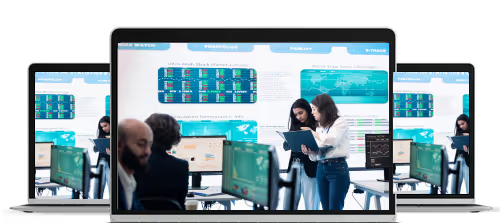
Our client was a mid-market investment management firm specializing in algorithmic trading, derivatives, and fixed-income instruments. With a rapidly expanding trading desk and increasing market participation, latency in their legacy infrastructure had begun to affect execution quality and profitability.
The firm operated across multiple exchanges and relied on co-located servers and a hybrid data center setup. However, as trade volumes grew, their infrastructure couldn’t sustain real-time demands. Order execution delays—sometimes in milliseconds—were causing significant slippage and missed opportunities.
The client engaged Zymr to design and deploy a next-generation, low-latency trading infrastructure capable of real-time data processing, high availability, and zero tolerance for outages.
The engagement was mission-critical—improving even a few milliseconds in execution time could directly impact millions in trading performance. Zymr’s goal was to transform the client’s trading backbone into a high-speed, resilient, and scalable platform.

During the initial assessment, Zymr identified a set of interrelated performance and architectural bottlenecks that collectively hampered system responsiveness and reliability.
High Network Latency and Jitter
The existing infrastructure relied on multiple geographically dispersed data centers with inconsistent routing paths. The average round-trip latency between trading nodes exceeded 20 milliseconds, affecting arbitrage and algorithmic trades.
Legacy Middleware and Processing Delays
The trading platform used a traditional message queueing system that was not optimized for high-frequency event processing. Data serialization overheads introduced processing lags in market data feeds.
Hardware and Storage Limitations
Outdated network switches, non-SSD storage, and shared compute resources limited throughput. System IO became a major bottleneck during peak trading hours.
Lack of Failover and Redundancy
Critical systems were hosted on single points of failure, with limited disaster recovery and replication mechanisms. This raised operational risk and regulatory compliance concerns.
Monitoring and Visibility Gaps
The firm lacked real-time performance monitoring and root cause analysis capabilities. System anomalies went unnoticed until they cascaded into trading disruptions.
The client’s infrastructure required not just optimization but architectural re-engineering—from storage to compute to networking—to meet the demands of real-time financial markets and regulatory uptime requirements.
By partnering with Zymr, the investment firm converted technical latency challenges into strategic advantage. The upgraded platform now supports microsecond-level execution, real-time analytics, and 24/7 operational resilience, positioning the client as a technology-driven player in an increasingly algorithmic market.
In essence, Zymr didn’t just optimize performance—it redefined what “real-time” means in trading infrastructure, helping the client compete head-to-head with larger, global institutions.
Within six months of project initiation, the trading infrastructure was completely transformed and validated through real-world benchmarks.
The firm’s upgraded infrastructure not only eliminated latency issues but also unlocked new business opportunities, enabling entry into high-frequency trading segments and complex derivatives markets.
Zymr designed a multi-layered infrastructure optimization strategy combining low-latency networking, in-memory processing, and resilient architecture principles.
Zymr’s engineers began with detailed latency mapping across the firm’s trading stack.
The analysis revealed that 45% of total latency originated from message serialization and queuing layers. Another 30% came from network inefficiencies due to non-optimized TCP configurations and hardware limitations.
By quantifying where time was lost—across the data path, code path, and network fabric—Zymr established a baseline that guided all subsequent optimization efforts.
Zymr re-architected the trading platform around in-memory event processing and high-speed networking.
Additionally, data centers were restructured for geographical redundancy:
This overhaul replaced decades-old components with modern, performance-driven technologies. Every microsecond counted, and the new design ensured deterministic performance and redundancy.
To handle the growing volume of market data, Zymr modernized the firm’s data ingestion and storage layer.
Zymr also built a real-time analytics dashboard using Grafana and Prometheus, providing:
With a redesigned data architecture, the client gained complete visibility into trading operations, enabling proactive performance management rather than reactive troubleshooting.
Zymr integrated a CI/CD framework tailored for trading environments to support safe, frequent updates without downtime.
This phase ensured that optimization wasn’t a one-time exercise but an ongoing operational discipline—aligning technology agility with business performance goals.






.svg)
.svg)
.svg)
.svg)
.svg)
.svg)