
Healthcare Interoperability Solutions: Types, Approaches, and How to Choose (2026)
This blog describes the 5 categories of healthcare interoperability solutions, vendor-native networks, standards-based exchange, HIEs, integration middleware, and point solutions, and gives a structured framework for the build-vs-buy-vs-partner decision. It's built for healthcare IT leaders choosing a stack in 2026, not picking one platform to standardize on.
Play Voice
Nirmal Suthar
Associate Director of Software Engineering
September 16, 2026
Key takeaways
- Healthcare interoperability requires secure, standardized data exchange across EHRs, payers, laboratories, devices, and patient applications.
- Organizations typically need a combination of vendor networks, FHIR-based solutions, HIEs, middleware, and specialized point solutions rather than one platform.
- Build, buy, or partner decisions should weigh technical expertise, implementation timelines, cost, compliance, and long-term scalability.
- The right platform must support standards, security, data quality, workflow integration, monitoring, and flexible deployment models.
- A structured evaluation framework helps prevent vendor dependency, fragmented integrations, governance gaps, and costly modernization failures.
What Are Healthcare Interoperability Solutions and Why They Matter in 2026
Healthcare interoperability solutions enable secure data exchange between EHRs, payers, laboratories, devices, and patient applications. Zymr's healthcare engineering teams work across all of these categories, which is where the framework below comes from.
These solutions use standards such as HL7 FHIR to structure data and support API-based integration. They also require identity management, consent controls, terminology mapping, and workflow integration the plumbing that determines whether a standards-compliant interface actually delivers usable data at the point of care.
In 2026, interoperability is essential for regulatory compliance and digital care delivery, coordinated in part through ONC. CMS rules now expand this further: the Interoperability and Prior Authorization Final Rule (CMS-0057-F) and the earlier Interoperability and Patient Access Final Rule both expand API-based access and prior authorization requirements.
Effective interoperability reduces manual work, fragmented records, and delayed decisions. It improves care coordination, payer operations, patient access, and enterprise data visibility which is why choosing the right mix of healthcare interoperability solutions is a strategic decision, not a procurement checkbox. There is rarely one correct interoperability solution for healthcare organizations to standardize on; the right answer is almost always a combination.
The 5 Categories of Healthcare Interoperability Solutions
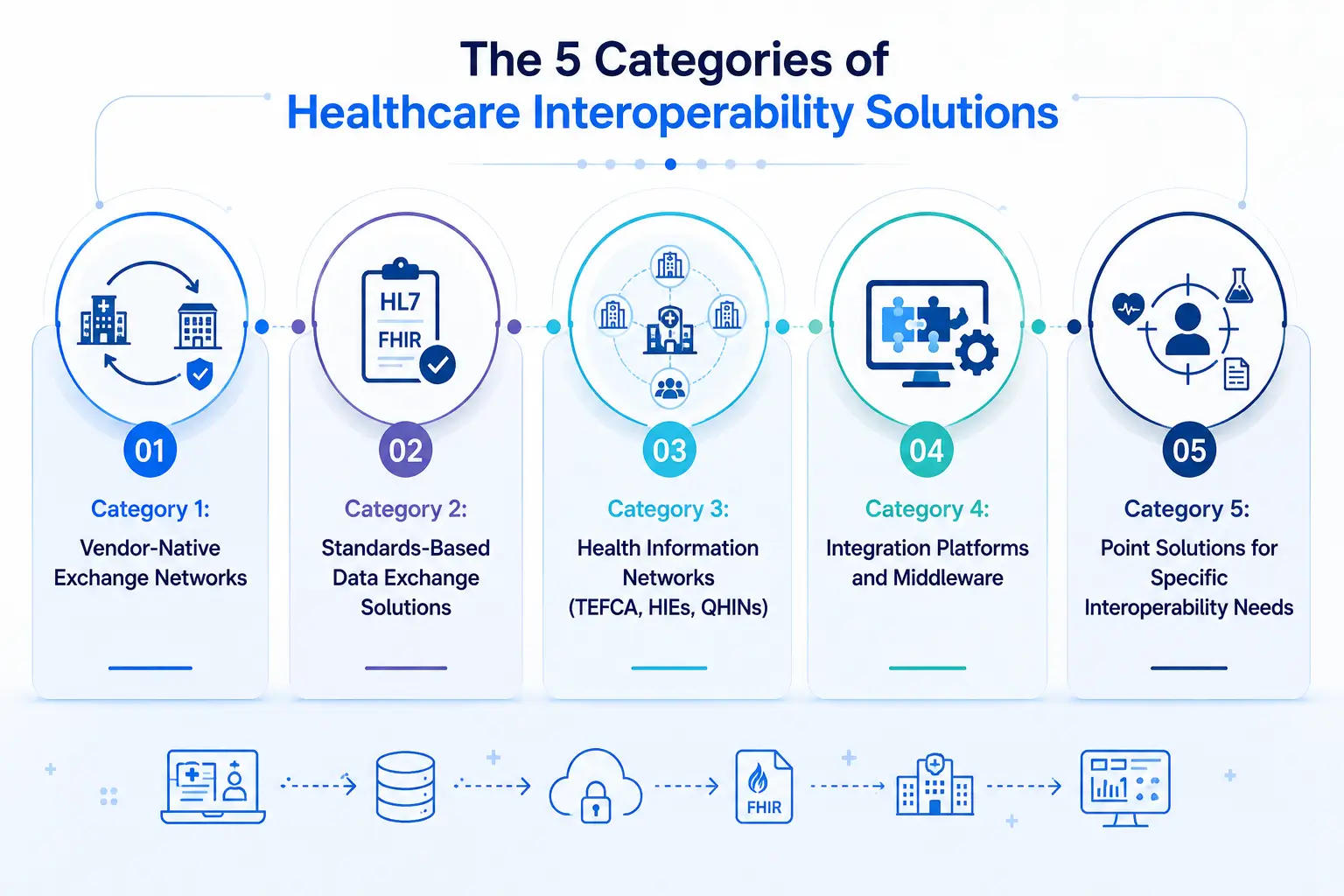
Healthcare interoperability solutions fall into five main categories based on architecture, exchange scope, and operational purpose. Most healthcare organizations require several categories rather than one standalone platform the solutions healthcare interoperability programs actually run on rarely come from a single vendor.
Category 1: Vendor-Native Exchange Networks
Vendor-native exchange networks connect healthcare organizations using the same EHR or technology ecosystem. They support structured data exchange through built-in interfaces, shared directories, and established trust frameworks Epic's FHIR APIs are a common example within a single-vendor environment.
These networks often simplify implementation because participating systems use compatible data models. They can support referrals, care summaries, results exchange, and patient record access without heavy custom engineering.
However, vendor-native networks may offer limited flexibility across competing platforms. Organizations should evaluate external connectivity, data portability, API access, governance controls, and future migration requirements before committing. This category works best when most exchange partners already operate within the same vendor environment.
Category 2: Standards-Based Data Exchange Solutions
Standards-based solutions connect different healthcare systems through common technical specifications. They commonly use HL7, FHIR, APIs, and standardized clinical terminologies to support structured exchange across EHRs, payer platforms, laboratories, and digital health applications.
These solutions improve data portability and reduce dependence on a single technology vendor. Implementation still requires terminology mapping, patient matching, consent controls, and workflow validation teams testing new endpoints often prototype against an open-source server such as HAPI FHIR before touching production data. Getting the underlying APIs right is usually where dedicated API development expertise pays off, and many of the EHR interoperability solutions organizations shortlist here are really just different implementations of this same standards-based approach.
Poorly governed standards can create incomplete or inconsistent data exchange. This category suits organizations needing scalable interoperability across multiple vendors and external partners.
Category 3: Health Information Networks (TEFCA, HIEs, QHINs)
Health information networks enable secure data exchange across multiple healthcare organizations and regions. They include HIEs, QHINs, and networks connected through TEFCA, with participation coordinated through the Sequoia Project as the TEFCA Recognized Coordinating Entity.
These networks support broader clinical data access beyond a single vendor environment, helping providers retrieve patient records, coordinate care, and reduce duplicate testing. Successful participation requires identity matching, consent management, governance alignment, and secure exchange controls.
Organizations must also assess network coverage, response speed, data quality, and onboarding requirements. This category suits healthcare systems needing regional or nationwide information exchange.
Category 4: Integration Platforms and Middleware
A healthcare integration platform connects EHRs, payer systems, laboratories, devices, and healthcare applications using interface engines, APIs, connectors, and data transformation services. It manages protocol conversion, message routing, validation, monitoring, and error handling.
These platforms also support legacy HL7 interfaces alongside modern FHIR interoperability solutions, and they're often the layer that governs third-party app access through frameworks like SMART on FHIR. Because this category spans protocol conversion, monitoring, and governance at once, it's frequently where organizations bring in product engineering support rather than trying to staff every specialty in-house.
Organizations should evaluate scalability, security, observability, vendor support, and cloud compatibility. Weak governance can create duplicated interfaces and difficult maintenance. This category suits enterprises managing complex, multi-vendor healthcare environments.
Category 5: Point Solutions for Specific Interoperability Needs
Point solutions address focused interoperability challenges within healthcare workflows: patient matching, consent management, terminology mapping, prior authorization, or document exchange. These tools can solve urgent gaps without replacing the entire integration architecture.
They also reduce implementation scope for organizations with clearly defined requirements though before any point solution touches production data, dedicated healthcare software testing against real clinical workflows is what actually catches the edge cases.
However, multiple point solutions can increase vendor complexity and maintenance effort. Organizations should assess API compatibility, data ownership, scalability, security, and integration dependencies. This category suits targeted use cases where a broader platform is unnecessary.
Should You Build, Buy, or Partner for Healthcare Interoperability?
Healthcare organizations can build custom solutions, buy commercial platforms, or partner with engineering specialists. The right sourcing model depends on technical maturity, timelines, compliance needs, budget, and long-term scalability.
Organizations leaning toward build typically bring in custom software development support to move faster without losing architectural control. Organizations leaning toward partner often fold interoperability into a broader digital transformation program rather than treating it as a standalone project.
Best-of-Breed vs. Unified Interoperability Platforms
The right model depends on system complexity, internal expertise, vendor strategy, and long-term integration costs.
Cloud, On-Premises, or Hybrid: 2026 Deployment Models
The right model depends on security requirements, existing architecture, compliance obligations, integration volume, and operational maturity.
Most 2026 deployments start with a cloud strategy engagement to map which workloads can move first, then lean on cloud infrastructure work to actually stand up the scalable, compliant environment underneath.
How AI Supports Healthcare Interoperability Solutions
AI improves healthcare interoperability by processing inconsistent, incomplete, and unstructured clinical data across connected systems.
AI requires standardized, reliable health data to produce dependable results. FHIR and USCDI provide stronger foundations for reusable data exchange and advanced computing. Building this reliably usually means pairing AI development work on the mapping and matching side with generative AI for document extraction, and data engineering to keep the pipelines feeding both clean. Organizations must also apply transparency, validation, privacy, and governance controls to AI-enabled workflows.
How to Choose the Right Healthcare Interoperability Solution
Choosing the right solution requires alignment between technical architecture, clinical workflows, compliance needs, and business goals.
- Define exchange requirements: identify systems, partners, data types, and workflows requiring connectivity.
- Assess standards support: confirm compatibility with FHIR, HL7, USCDI, and required implementation guides.
- Evaluate scalability: ensure the platform can support growing data volumes, users, and integrations.
- Review security controls: examine encryption, access management, audit logging, and consent capabilities.
- Check integration flexibility: assess APIs, connectors, middleware compatibility, and legacy system support.
- Measure operational readiness: review monitoring, support, governance, and internal technical capabilities.
Every interoperability solution for healthcare organizations of a given size looks different in practice the selected solution should reduce integration complexity without limiting future interoperability requirements.
The 10-Point Solution Evaluation Framework
Evaluate each healthcare interoperability solution against these ten criteria:
This framework helps organizations compare solutions using consistent technical and business criteria rather than vendor marketing claims.
Healthcare Interoperability Solutions by Organization Type
Different healthcare organizations require different interoperability architectures, workflows, and governance controls the data analytics and reporting demands alone vary widely by segment, which is why generic evaluations tend to miss the mark.
Zymr's data analytics work often surfaces which of these needs is actually the constraint the right healthcare interoperability solution depends on data volume, system diversity, regulatory obligations, and partner networks, not just organization type.
Common Mistakes When Selecting Interoperability Solutions
- Choosing tools before defining workflows: technology decisions should follow clear clinical, operational, and data exchange requirements.
- Ignoring legacy system constraints: older EHRs and interfaces may require additional middleware, mapping, or modernization support.
- Focusing only on initial cost: licensing prices often exclude integration, maintenance, training, monitoring, and upgrade expenses.
- Overlooking data quality: poor patient matching, inconsistent terminology, and incomplete records reduce interoperability value.
- Underestimating governance needs: effective exchange requires ownership, access policies, consent controls, and accountability including staying ahead of Information Blocking obligations.
- Relying on one vendor: excessive platform dependence can limit flexibility, portability, and future migration options.
- Skipping scalability testing: solutions must support increasing data volumes, partners, APIs, and transaction loads.
Avoiding these mistakes helps organizations select solutions that remain secure, scalable, and operationally effective the solutions healthcare interoperability teams regret are almost always the ones chosen before these gaps were mapped.
Conclusion
Healthcare interoperability requires coordinated technology, governance, security, and workflow design. No single platform can address every exchange requirement across complex healthcare environments.
Organizations should evaluate vendor-native networks, standards-based solutions, health information networks, middleware, and point tools together. The right combination must support FHIR, legacy systems, regulatory obligations, and future growth resources such as HIMSS's interoperability library are a useful ongoing reference alongside vendor-specific documentation.
A structured evaluation process reduces vendor risk and prevents fragmented integration investments. It also improves data quality, clinical coordination, payer workflows, and patient access and for organizations still modernizing legacy EHRs, that process often surfaces EHR interoperability solutions as the first priority rather than the last.
Zymr helps healthcare organizations design and engineer healthcare interoperability solutions as integrated programs. This approach connects architecture planning, platform selection, API engineering, cloud infrastructure, security, and implementation support.
Conclusion
FAQs
1. What are healthcare interoperability solutions?
>
Healthcare interoperability solutions connect clinical, administrative, payer, and patient systems. They support secure, standardized, and usable health data exchange.
2. What standards support healthcare interoperability?
>
Common standards include HL7, FHIR, USCDI, DICOM, X12, and clinical terminology systems. Each standard supports different data types and workflows.
3. What is the difference between HL7 and FHIR?
>
HL7 commonly supports message-based exchange between established healthcare systems. FHIR uses modern APIs and reusable resources for faster integration.
4. How does TEFCA support interoperability?
>
TEFCA establishes a common framework for nationwide health information exchange. It connects participating organizations through Qualified Health Information Networks.
5. Should healthcare organizations build or buy interoperability platforms?
>
The decision depends on technical expertise, timelines, budgets, integration complexity, and control requirements. Many organizations use a combined approach.
Have a specific concern bothering you?
Try our complimentary 2-week POV engagement


Our Latest Blogs





.svg)
.svg)
.svg)
.svg)
.svg)
.svg)
